Destination Wedding Abroad: Recognised in Singapore?
Singapore automatically recognises an overseas marriage that was legally contracted under that country's law, with no registration needed. But a symbolic resort ceremony is not a legal marriage, and Singapore still voids any marriage that breaks its age, monogamy or related rules.
On this page10 sections · tap to jump
- 01Is an overseas wedding recognised in Singapore?
- 02Symbolic ceremony or legal marriage?
- 03When Singapore will NOT recognise it
- 04In the destination country
- 05Legalising your Singapore documents (going out)
- 06Proving your marriage back home
- 07A common, safer plan: legal ROM first
- 08Muslim overseas marriages
- 09Frequently asked questions
- 10Where to go next
A beach in Bali, a chapel in the Maldives, a vineyard in Tuscany — a destination wedding is a lovely idea, and the usual worry is whether Singapore will accept it afterwards. The reassuring part first: Singapore automatically recognises a marriage that was legally contracted abroad, with no registration required. The part couples miss is subtler and more expensive to get wrong — whether the ceremony you booked is a legal marriage at all, and whether your union clears the capacity rules that Singapore applies no matter where the vows happened.
This guide is for couples planning to marry overseas. If you have already married abroad and just want a Singapore certificate on your records, go straight to registering an overseas marriage with ROM for the mechanics.
Is an overseas wedding recognised in Singapore?
Yes — if it was a valid, legal marriage where it took place. The Registry of Marriages is explicit that “the registration of an overseas marriage is voluntary and not a legal requirement under the Women’s Charter 1961.” In other words, a foreign marriage that was properly contracted under the destination country’s law is already a marriage in Singapore; you do not have to “convert” or re-register it here for it to count.
That recognition is not unconditional, though. It rests on two things: the marriage being legally registered under the law of the place it happened, and the couple having the capacity to marry under Singapore law. Miss either and recognition can fall away — which is why the next two sections matter more than the paperwork.
Symbolic ceremony or legal marriage?
Here is the single most important question to ask your overseas planner: is this a legal marriage, or a symbolic ceremony? Many “destination weddings” — especially resort and beach packages — are symbolic: a celebrant, vows, photos and a decorative certificate, but no registration with the country’s marriage authority. A symbolic ceremony is beautiful and completely valid as a celebration, but it does not create a legal marriage anywhere, so there is nothing for Singapore to recognise.
Because recognition depends on the marriage being legally contracted under local law, the practical rule is simple: if you want to come home legally married, the ceremony must be one the local authority actually registers as a marriage and for which it issues an official government marriage certificate — not a keepsake from the venue. ROM’s own guidance is to “check directly with the relevant authority in the country that you intend to register your marriage in, on the procedure and requirements.”
When Singapore will NOT recognise it
Even a marriage that was fully legal abroad can be void in Singapore if the couple lacked capacity. Crucially, several provisions of the Women’s Charter apply to a marriage “solemnised in Singapore or elsewhere” — the word elsewhere is what reaches your destination wedding. A marriage is void if, at the date of marriage, either of you:
- was under 18. Section 9: a marriage “solemnised in Singapore or elsewhere between persons either of whom is below 18 years of age is void” unless authorised by a special marriage licence.
- was already married to someone else. Section 11 voids a marriage where either party “is married under any law, religion, custom or usage to any other person” — Singapore’s monogamy rule, which a foreign ceremony cannot override.
- is within the prohibited degrees of kinship. Section 10 voids a marriage between a man or woman and the close relatives listed in the Charter’s First Schedule.
- are not respectively male and female. Section 12 voids such a marriage wherever it was solemnised.
There is also section 11A: a marriage “solemnised on or after 1 October 2016, whether in Singapore or elsewhere,” is void if a party entered it to obtain an immigration advantage — a marriage of convenience is void even if performed abroad.
In the destination country
Every country sets its own process, and it is the destination’s authority — not Singapore — you must satisfy to be legally married there. Expect some combination of:
- a residency or notice period before the ceremony (some countries want you in-country for several days first);
- proof of identity and single status (often a “certificate of no marriage” or “no impediment” document);
- translation and legalisation of your documents into the local language and format;
- an appointment with the civil registry, not just the resort.
ROM cannot tell you these rules. As its guidance says, check “directly with the relevant authority in the country.” Your Singapore embassy or the country’s embassy in Singapore can usually point you to the civil-registry requirements.
Legalising your Singapore documents (going out)
To marry abroad, the destination country will often demand that your Singapore documents — a proof-of-single-status record, a birth certificate — be legalised so its officials can trust them. In Singapore this is handled by the Singapore Academy of Law (SAL), not the embassy: SAL is “Singapore’s designated Competent Authority for the legalisation (Apostille) of documents issued in Singapore for overseas use,” and “legalisation of Singapore documents can only be carried out at SAL.” The Ministry of Foreign Affairs now simply directs the public to SAL for this.
Legalisation means SAL “certifies a document by affixing an Apostille Certificate, making it officially recognised in another country.” How far that goes depends on the destination:
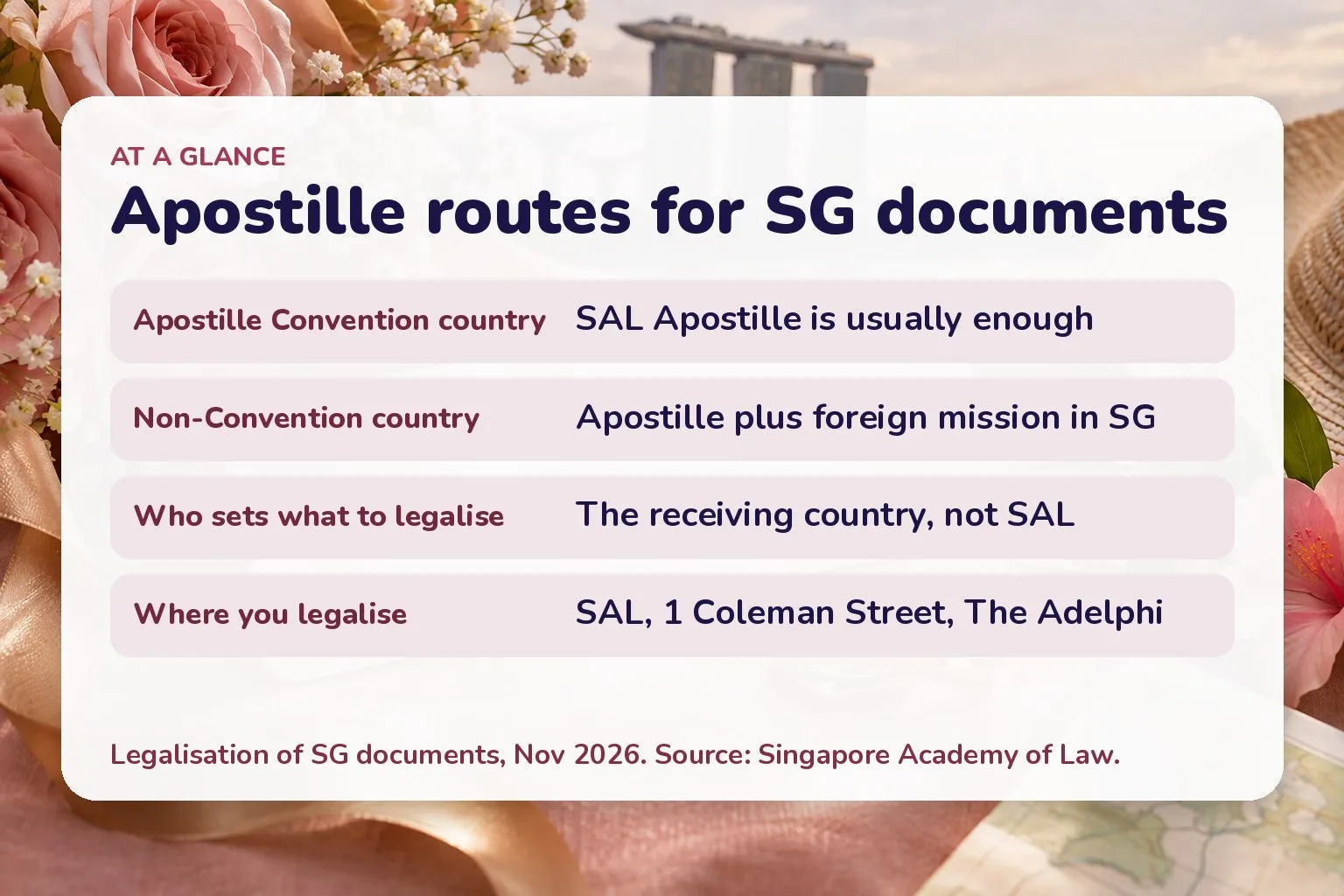
How far you must legalise Singapore documents for an overseas wedding. Source: Singapore Academy of Law, as of November 2026.
- If the country is a party to the Apostille Convention (in force since 16 September 2021), a document “will no longer need to be legalised at the respective foreign consulate” — the SAL Apostille alone is usually enough.
- If it is not a party, the document “will still require further legalisation through the relevant foreign missions in Singapore.”
Two practical notes from SAL: the receiving country, not SAL, decides what must be legalised (“legalisation requirements are established by the receiving party/country … not by SAL”), so confirm the list with that country first; and documents must be submitted in original form, in English or bilingual. SAL’s counter is at 1 Coleman Street, #08-06 The Adelphi, open Monday to Friday.
Proving your marriage back home
Once you are legally married abroad, you are married in Singapore automatically. What you choose to do next depends on what you actually need:
- Nothing at all is required for the marriage to be valid.
- Update your marital status in Singpass if you want government digital services to show you as married. ROM confirms this is “not a legal requirement” but helps “for ease of transacting with participating digital services using Singpass (i.e., HDB/CPFB).” It issues no certificate.
- Register the overseas marriage with ROM only if you need a Singapore marriage certificate — ROM’s page says register “if you need a Singapore marriage certificate for overseas use.” This is the voluntary S$75 route, and the full document list (including an endorsed copy of your foreign certificate) is in our overseas-marriage registration guide.
That endorsement works in the opposite direction to SAL’s Apostille: your foreign certificate is authenticated abroad (by that country’s MFA or Apostille, then the Singapore Embassy there) or by that country’s embassy in Singapore, with a certified English translation if it is not in English.
A common, safer plan: legal ROM first
Many Singapore couples sidestep the whole symbolic-ceremony risk with a two-step plan: do the legal marriage in Singapore first (a short solemnisation at ROM), then hold the symbolic destination celebration purely as a party. You come home already, unambiguously married; the overseas event carries no legal weight and needs no foreign paperwork. If you would rather marry legally in Singapore, start with our ROM complete guide; couples where one partner is a foreigner should also read getting married in Singapore as a foreigner, as a 31-day presence rule and other steps apply.
Muslim overseas marriages
If both of you are Muslim, a civil overseas marriage is not your route — a Muslim marriage is governed separately and its records sit with the Registry of Muslim Marriages (ROMM), not ROM. The recognition and registration steps differ, including extra documents such as a Letter of Recommendation from ROMM. Start with our ROMM Muslim marriage guide and confirm the exact requirements with ROMM before planning an overseas ceremony.
Frequently asked questions
Do I have to register my overseas marriage for it to be valid in Singapore? No. Registration is voluntary; a marriage legally contracted abroad is already recognised here.
We only had a symbolic beach ceremony — are we married? Not legally. If the local authority did not register the marriage and issue an official certificate, it is a celebration, not a marriage. Do a legal ceremony separately.
Our destination country allows marriage under 18 (or a second marriage). Will Singapore accept it? No. The Women’s Charter voids a marriage solemnised “in Singapore or elsewhere” that breaches its minimum-age or monogamy rules, regardless of local law.
Is a common-law or de facto overseas relationship recognised? Singapore recognises marriages validly contracted abroad; an informal cohabiting arrangement that is not a registered marriage is not a marriage here. Check your situation with ROM.
Will my Singapore ROM marriage certificate be accepted overseas? A Singapore certificate can be used abroad, but the receiving country may require it to be apostilled by SAL first — confirm with that country’s authority.
Where to go next
Sources
- Can I register my overseas marriage with the Registry of Marriages (ROM)? — Our Marriage Journey (Registry of Marriages) (as of November 2026)
- What are the procedure and requirements to marry overseas? — Our Marriage Journey (Registry of Marriages) (as of November 2026)
- I registered my marriage/divorce overseas. Do I need to update my marital status in Singpass? — Our Marriage Journey (Registry of Marriages) (as of November 2026)
- Women's Charter 1961 — Part 3, Validity of marriages (sections 9-12) — Singapore Statutes Online (Attorney-General's Chambers) (as of November 2026)
- Legalisation Services (Apostille) — FAQ — Singapore Academy of Law (as of November 2026)
- Legalisation of documents — Ministry of Foreign Affairs, Singapore (as of November 2026)
- Update marital status — Our Marriage Journey (Registry of Marriages / MSF) (as of November 2026)