How to Change Your Name After Marriage in Singapore

Marrying in Singapore does not change your name. You can add a married name as an alias using only your marriage certificate, but fully taking your spouse's surname needs a deed poll and then an NRIC update at ICA within 28 days.
On this page11 sections · tap to jump
- 01Nothing changes automatically
- 02Two different things: an added married name vs a legal name change
- 03Route 1: Add a married name (marriage certificate only)
- 04Route 2: Change your legal name (deed poll)
- 05Updating your NRIC at ICA
- 06Your passport: a new one, not an amendment
- 07The order to do it in
- 08After your NRIC: what updates itself and what doesn’t
- 09If you are a PR or a foreigner
- 10FAQ
- 11Where to go next
One of the most common questions couples ask after the ceremony is how to “change” their name. In Singapore the honest answer surprises many people: getting married does not change your name at all. There is no automatic update, and no legal requirement to take your spouse’s surname. Keeping your name is a complete, ordinary choice — and it is the simplest, because it means doing nothing.
If you do want your married name to appear on your documents, there are two very different routes, with different paperwork and different costs. This guide walks through both, in the order you actually do them. For the registration itself, see our complete ROM guide.
Nothing changes automatically
When you register a marriage, the Registry records it, but your legal name in the National Registration records stays exactly as it was. Your NRIC, your passport and your Singpass name do not update on their own. What you do next is entirely up to you, and it falls into one of two categories that people often confuse.
Two different things: an added married name vs a legal name change
- Adding a married name keeps your existing name and simply records your married name alongside it. This is handled on the strength of your marriage certificate and needs no deed poll.
- Changing your legal name — for example, dropping your maiden surname and taking your spouse’s in its place — replaces your principal name. That is a legal name change, and it needs a deed poll first.
Getting this distinction right saves you time and money, because the two routes use different documents and only one of them involves a lawyer.
Route 1: Add a married name (marriage certificate only)
This is the lighter-touch option and by far the more common one. ICA lets you include a married name on your identity card on the strength of your marriage certificate, with no deed poll required. When you apply to replace your IC, one of the accepted supporting documents is simply the “Marriage certificate (if you want to include your married name)”.
The key thing to understand is how the married name is recorded. It is added as an alias, not a replacement:
So after Route 1 your documents show both names — your original (principal) name, with the married name beneath it in parentheses. You can travel and transact under either, which is why many people choose this route: you gain the married name socially without losing your original identity on official records.
Route 2: Change your legal name (deed poll)
If you want to omit or replace your principal name — fully adopting your spouse’s surname, creating a double-barrelled surname, or dropping part of your current name — the marriage certificate is not enough. ICA’s position, as set out by the Singapore High Commission, is blunt: applicants who wish to omit or replace their principal name with their married name “must execute a Change of Name Deed Poll”.
A deed poll is a formal legal declaration that you are abandoning your former name and adopting a new one. In Singapore it must be signed in the physical presence of a practising lawyer, who witnesses it. Law firms typically charge somewhere in the region of S$50 to S$100 for a straightforward deed poll (these are market prices, not a government fee, and vary by firm). The deed poll on its own does not change your name — it is only the first step.
Updating your NRIC at ICA
Once you have a deed poll, you must act quickly. Under the National Registration Regulations, a person who changes their name “shall within 28 days report the fact to the nearest registration office and apply for a replacement identity card”. Miss that window and the deed poll lapses — it cannot be extended or renewed, and you would have to sign (and pay for) a fresh one.
The replacement IC itself:
- Fee: S$60, payable by card, internet direct debit or PayNow.
- Processing: within seven working days (longer at peak periods).
- You then have three months from approval to make an appointment and collect the new IC.
You apply through ICA’s e-Service with Singpass, uploading the deed poll and a recent passport-sized colour photo taken within the last three months. For Route 1 (married name only), you upload the marriage certificate instead of a deed poll.
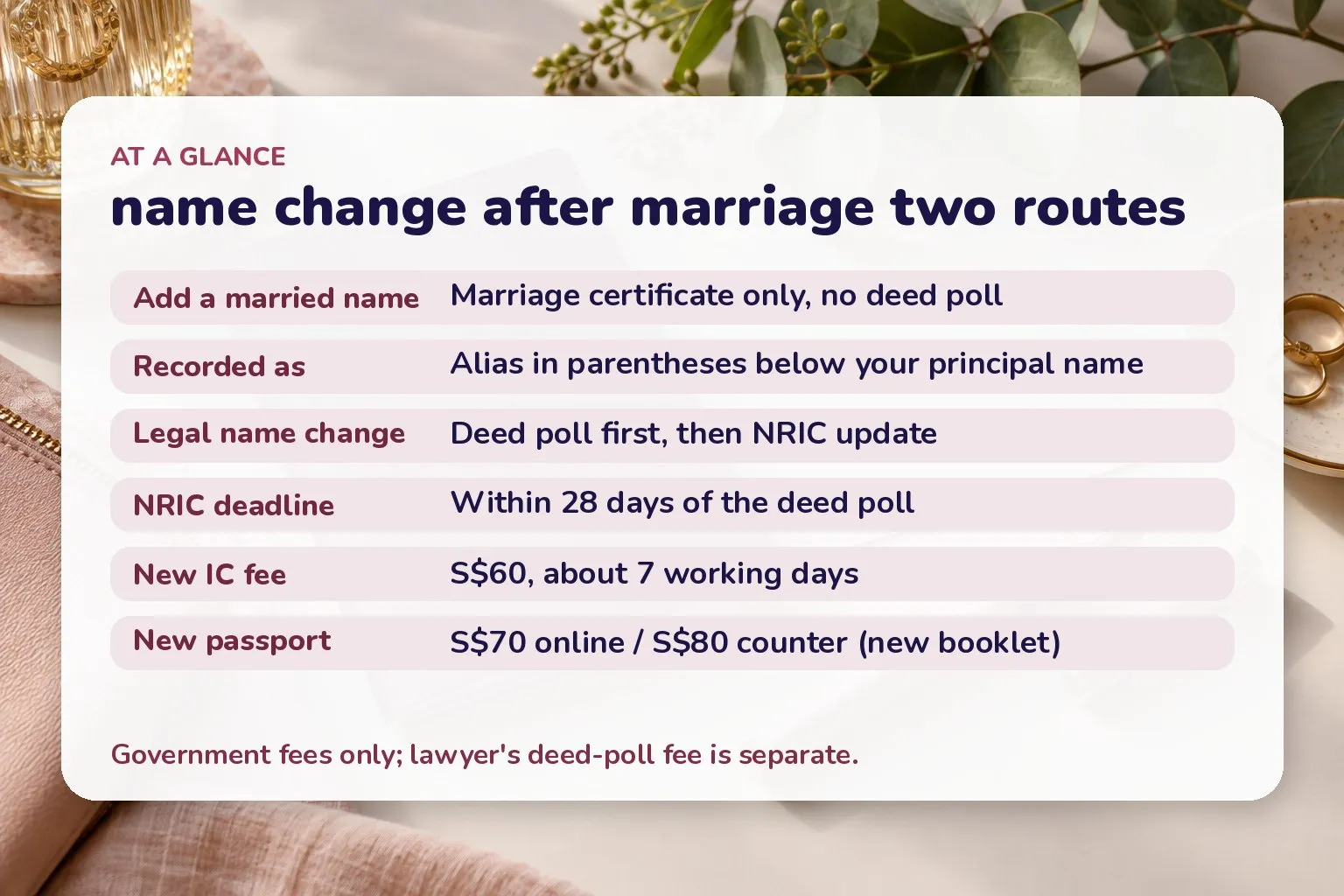
The two routes side by side. Source: ICA and MFA Singapore, as of October 2026.
Your passport: a new one, not an amendment
A biometric passport cannot be edited. To reflect a new or married name, ICA issues a completely new passport — you cannot have the old one amended. The fee is S$70 if you apply online, or S$80 over the counter at an ICA Services Centre or overseas mission.
For a married name specifically, married applicants enclose a short letter saying how they would like the married name to appear and provide a certified copy of the marriage certificate; ICA prints the name as recorded in the National Registration records. Remember that a new passport resets to a fresh 10-year validity for adults.
The order to do it in
For a full legal name change, the sequence matters:
- Execute the deed poll before a Singapore lawyer.
- Replace your NRIC at ICA within 28 days (S$60), uploading the deed poll.
- Apply for a new passport (S$70 online) once your NRIC reflects the new name.
- Update everyone else — banks, CPF, employer, insurers, schools — each on their own process.
For a married-name alias, you skip step 1 and use the marriage certificate at steps 2 and 3.
After your NRIC: what updates itself and what doesn’t
Government systems tied to the national identity records — such as your Singpass profile and CPF — generally follow your updated NRIC without a separate request. Private institutions do not. Banks, insurers, your employer’s payroll, utility accounts, loyalty programmes and your children’s schools each have their own update process, and you will need to notify them with a copy of your deed poll (or marriage certificate). Build in time for this admin tail; it usually outlasts the ICA steps.
If you are a PR or a foreigner
- Permanent residents changing their legal name must first update the name on their current (home-country) passport, then provide that passport as the supporting document to change the name on the Singapore IC. The order is reversed compared with citizens.
- Foreigners marrying here follow their own country’s rules for their passport and identity documents; Singapore’s deed poll and NRIC process applies to citizens and PRs. If you are navigating the marriage itself as a foreign couple, see getting married in Singapore as a foreigner.
FAQ
Do I have to change my name when I marry? No. There is no legal requirement. Many people keep their name entirely; others add a married name as an alias.
Is the married name my new legal name? No. Added via the marriage certificate, it is an alias printed below your principal name. Only a deed poll changes your principal (legal) name.
Can I revert to my maiden name after a divorce? A legal name change (in either direction) is done by deed poll, followed by the same NRIC and passport updates. A married-name alias can also be removed.
How much does the whole thing cost? For a legal change: roughly a lawyer’s deed poll fee (about S$50–S$100), S$60 for the NRIC and S$70 online for the passport. For a married-name alias: just the ICA charges, no deed poll fee.
How long does it take? The NRIC is processed within about seven working days; the admin tail with banks and other bodies usually takes longer than the official steps.
Where to go next
Sources
- Replace Identity Card (Change of Particulars/Damaged) — Immigration & Checkpoints Authority (as of October 2026)
- Apply for Passport — Immigration & Checkpoints Authority (as of October 2026)
- National Registration Regulations, regulation 10 — Singapore Statutes Online, Attorney-General's Chambers (as of October 2026)
- Change of name / Inclusion of married name in passport — Ministry of Foreign Affairs, Singapore (as of October 2026)
- Re-Register Identity Card for 30/55-year-olds — Immigration & Checkpoints Authority (as of October 2026)