LTVP vs Dependant Pass: Which Applies to Your Spouse

Which pass your foreign spouse needs is decided by whom they married: the spouse of a Singapore citizen or PR applies to ICA for a Long-Term Visit Pass (LTVP), while the spouse of an Employment Pass or S Pass holder gets a Dependant's Pass through MOM and the employer.
On this page13 sections · tap to jump
- 01The one question that decides it
- 02LTVP and Dependant’s Pass side by side
- 03Who issues it and who applies
- 04The S$6,000 salary gate (DP only)
- 05What each pass costs
- 06How long each takes
- 07Can your spouse work?
- 08If you don’t qualify for a Dependant’s Pass
- 09Which is the stronger status?
- 10Marriage is not an automatic pass
- 11Work Permit holders: get MOM approval first
- 12Frequently asked questions
- 13Where to go next
Couples planning a cross-border marriage in Singapore often hit the same confusion: the foreign spouse needs a pass to live here, and two very similar-sounding passes keep coming up — the Long-Term Visit Pass (LTVP) and the Dependant’s Pass (DP). They are not two flavours of the same thing, and you usually do not get to pick between them. Which one applies is decided by one fact: who your spouse is. This page sets the two side by side so you can see, in a minute, which door is yours — then points you to the full step-by-step guide for your route.
The one question that decides it
Before fees, forms or timelines, answer this: is the local spouse a Singapore Citizen or PR, or a foreigner working here on a work pass?
- Married a Singapore Citizen or Permanent Resident → your route is the LTVP, issued by the Immigration & Checkpoints Authority (ICA). After the marriage, the Singaporean or PR spouse sponsors the application through ICA’s e-Service with Singpass.
- Married a foreigner holding an Employment Pass (EP) or S Pass → your route is the Dependant’s Pass, issued by the Ministry of Manpower (MOM) and applied for by that spouse’s employer.
LTVP and Dependant’s Pass side by side
Here is the whole comparison in one view. The detail for each row follows below.
| Feature | Long-Term Visit Pass (LTVP) | Dependant’s Pass (DP) |
|---|---|---|
| Issued by | ICA | MOM |
| For the spouse of | A Singapore Citizen or PR | An EP or S Pass holder |
| Who applies | The citizen/PR spouse (sponsor), via ICA e-Service | The working spouse’s employer or agent |
| Income condition | No fixed salary gate; assessed on ties/circumstances | Working spouse must earn S$6,000 fixed monthly |
| Fee at submission | S$45 | S$105 |
| Fee at issuance | S$60 (+ S$30 Multiple Journey Visa if applicable) | S$225 (+ S$30 Multiple Journey Visa if applicable) |
| Processing | Up to 6 months (6 weeks with PMLA) | About 3 weeks for most cases |
| Tied to | Your own case, renewed by ICA | The main work pass — ends if that pass ends |
| Working | Letter of Consent / Pre-approved LOC from MOM | A separate EP, S Pass or DP-Work Permit |
LTVP compared with the Dependant’s Pass for a foreign spouse. Source: ICA and MOM, as of November 2026.
Who issues it and who applies
This is the cleanest way to tell them apart. The LTVP is an ICA residence pass for the family of Singaporeans and PRs; after marriage, your Singaporean or PR spouse must sponsor your application via ICA e-Service using Singpass. You cannot lodge it as a lone applicant — the local spouse drives it.
The Dependant’s Pass is a MOM work-pass-family benefit. MOM is firm that “an employer or appointed employment agent must apply on behalf of the candidate” — so the DP is submitted by the working spouse’s employer, not by either half of the couple directly. That single difference — employer-submitted versus spouse-sponsored — tells you which system you are in.
The S$6,000 salary gate (DP only)
The Dependant’s Pass carries a bar the LTVP does not. To sponsor a DP, the working spouse must hold an EP or S Pass, earn a minimum fixed monthly salary of S$6,000, and be sponsored by an established, Singapore-registered company. MOM stresses that this “is based on your salary, and not based on your combined household income” — so you cannot pool two incomes to clear it, and bonuses or variable allowances do not count.
The LTVP has no published salary figure. ICA assesses a spouse’s application on family and personal circumstances rather than a single income line, which is why the routes feel so different in practice: the DP is a clear numeric test on one person’s pay, while the LTVP is a broader, discretionary assessment.
What each pass costs
Neither pass is expensive, but the amounts differ and both are charged in two stages:
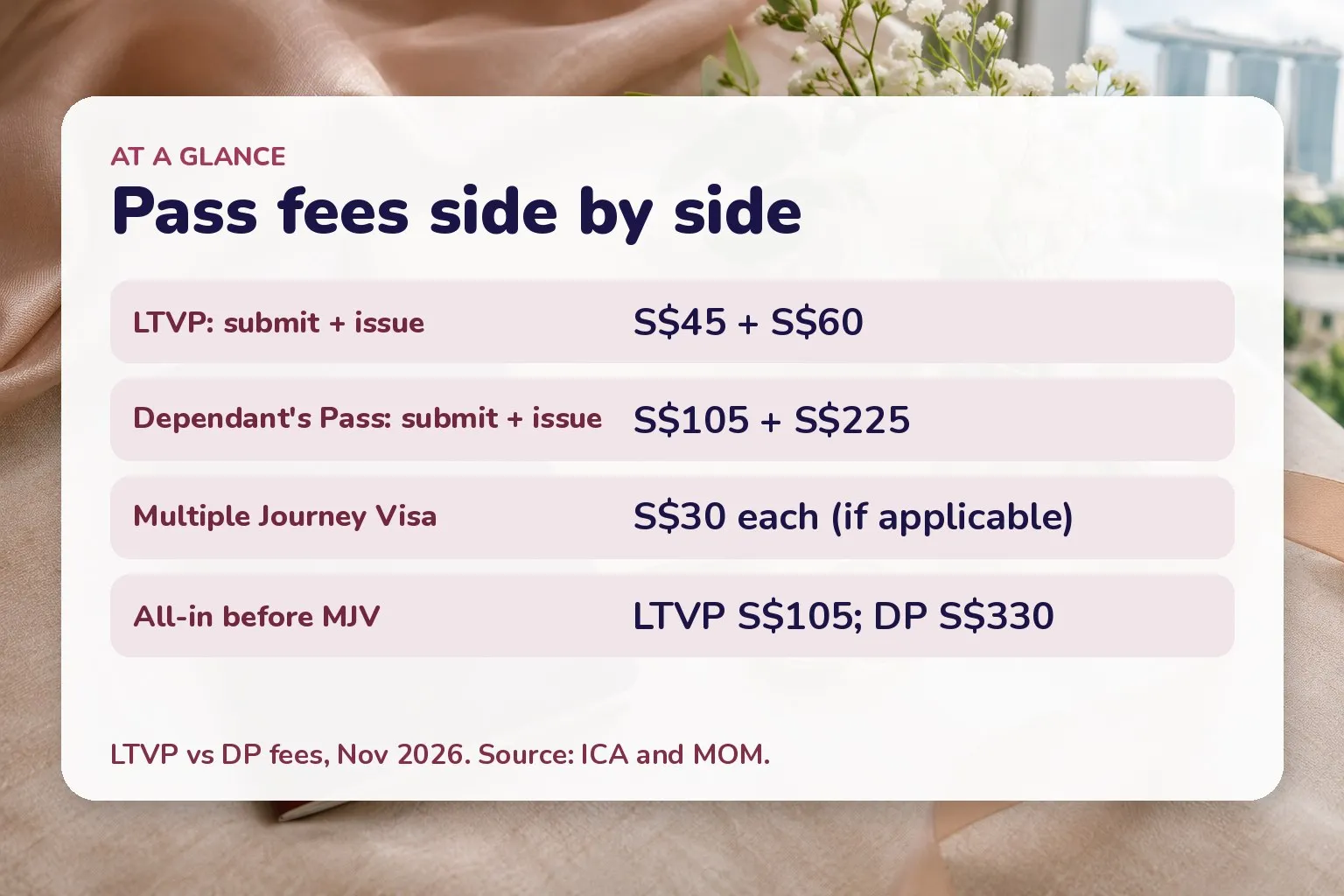
LTVP and Dependant’s Pass fees compared. Source: Immigration & Checkpoints Authority and Ministry of Manpower, as of November 2026.
- LTVP: S$45 per application at submission, then S$60 for issuance on approval, plus S$30 for a Multiple Journey Visa if applicable. ICA notes all fees are non-refundable.
- Dependant’s Pass: S$105 per pass at submission, then S$225 per pass at issuance, plus S$30 for a Multiple Journey Visa if applicable.
So the headline gap is modest — roughly S$105 all-in for an LTVP against S$330 for a DP before any Multiple Journey Visa — but remember a rejected application does not return the submission fee on either route.
How long each takes
Timelines are where the two diverge most. A Dependant’s Pass for the dependant of an EP or S Pass holder is processed “within 3 weeks for most cases,” though some take longer.
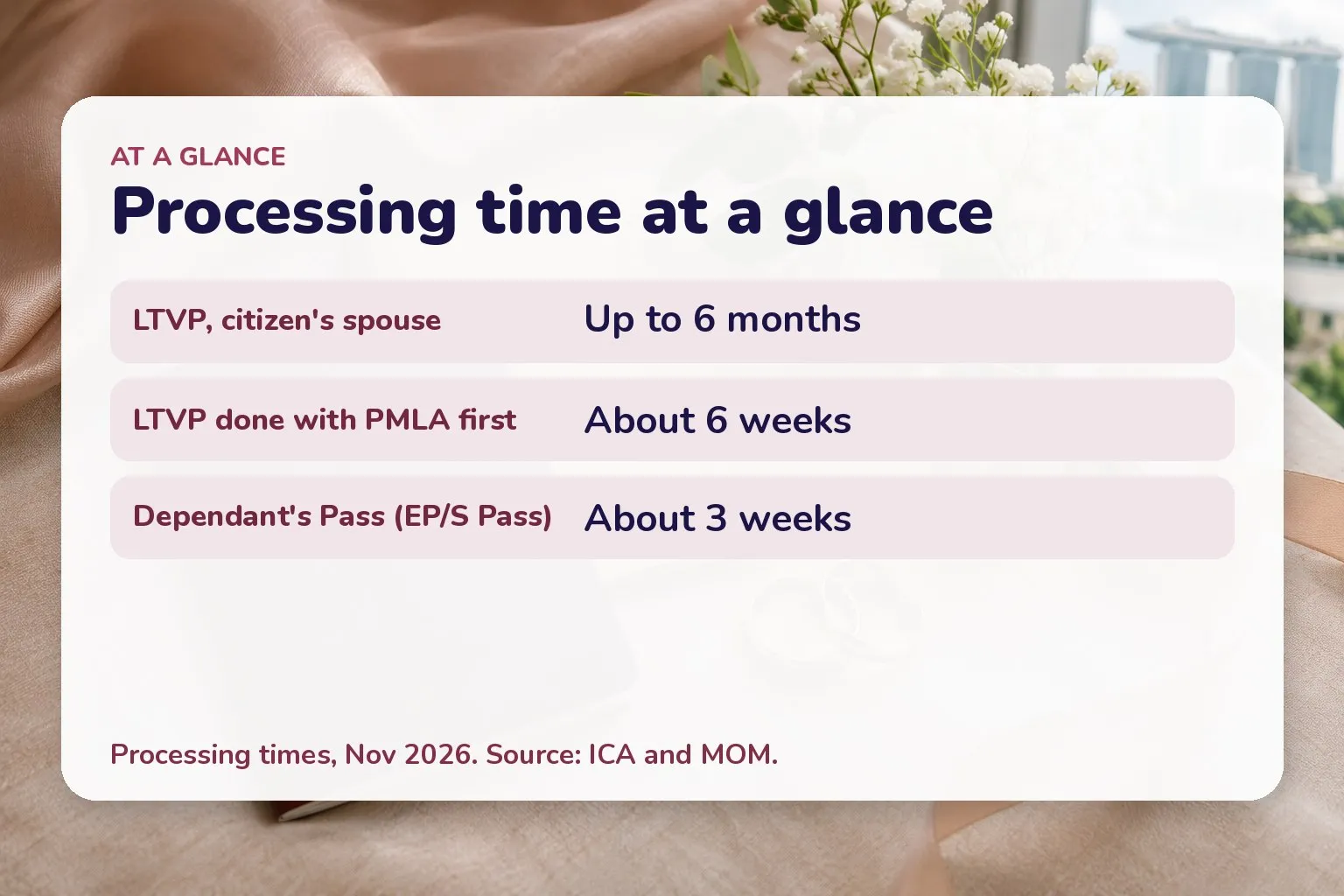
How long each pass takes to process. Source: Immigration & Checkpoints Authority and Ministry of Manpower, as of November 2026.
An LTVP for a citizen’s spouse is processed within 6 months — unless the couple completed ICA’s free Pre-Marriage LTVP Assessment (PMLA) before applying, which shortens it to about 6 weeks. That is a large practical difference, and it is the main reason the PMLA is worth doing.
Can your spouse work?
Neither pass is a work pass on its own. On an LTVP, a spouse works only with a Letter of Consent (LOC) or a Pre-approved LOC arranged through MOM. On a Dependant’s Pass, the holder needs a separate work pass — an EP, S Pass or DP-Work Permit obtained by an employer; MOM notes DP holders “may be able to work in Singapore” and that “no foreign worker levy or quota” applies to that route. In both cases, do not assume the spouse can start a job the day the pass is granted. The mechanics for each are set out on the two detailed guides linked at the end.
If you don’t qualify for a Dependant’s Pass
If the working spouse earns under S$6,000, the Dependant’s Pass is simply closed — and MOM itself redirects you: “if your family members are not eligible for a Dependant’s Pass, they may qualify for a Long-Term Visit Pass.” The catch is that the MOM-sponsored LTVP route (for families of work-pass holders who miss the DP bar) is a different animal from the ICA spouse LTVP for citizens’ and PRs’ families. The principle to take away: the two passes act as each other’s fallback, so a “no” on one is a prompt to check the other, not a dead end.
Which is the stronger status?
For a foreign spouse thinking long term, the citizen’s-spouse LTVP route is the one with a clear upward path: it can lead to the stronger LTVP+ status and, in time, to applying for PR or citizenship as a family of a Singaporean. The Dependant’s Pass, by contrast, is only ever as secure as the working spouse’s EP or S Pass — “the duration is tied to the validity of the main work pass” — so if that pass is cancelled, the DP falls with it. Neither is “better” in the abstract; but if you are a citizen’s spouse, your route also happens to be the one with the most durable future.
Marriage is not an automatic pass
Worth saying plainly for both routes: marrying a Singaporean, a PR or a work-pass holder does not guarantee the spouse a pass. ICA states that “marriage does not guarantee LTVP approval,” and both agencies assess each case. Treat the pass as a considered application, not an automatic consequence of the wedding — which is exactly why the free PMLA exists for citizen couples.
Work Permit holders: get MOM approval first
One trap sits before either pass. An existing or former Work Permit holder (including a Training Work Permit) who wants to marry a Singapore Citizen or PR — whether the marriage is civil, religious or customary — must first seek approval from the Controller of Work Passes at MOM. Failing to do so can cause their privileges to work in Singapore to be withdrawn, and they may be barred from entering Singapore for a period. If this is your situation, sort out MOM’s approval before the wedding; our guide on marrying a Work Permit holder covers it, and it also feeds into the PMLA.
Frequently asked questions
We are both foreigners — which pass? If your spouse works here on an EP or S Pass earning at least S$6,000, you are on the Dependant’s Pass through their employer. If neither of you is a citizen, PR or qualifying work-pass holder, neither spouse pass applies — check your options with ICA.
My spouse is a PR, not a citizen. LTVP or DP? The LTVP: a PR’s foreign spouse applies for an LTVP through ICA. The Dependant’s Pass is only for spouses of EP/S Pass holders, not of PRs.
Can we switch from a Dependant’s Pass to an LTVP later? They are separate applications to separate agencies, so a “switch” means applying afresh — for example, if the couple’s circumstances change, or the working spouse becomes a PR. There is no automatic conversion.
Does either pass let my spouse work immediately? No. An LTVP needs a Letter of Consent; a Dependant’s Pass needs a separate work pass. Line up the employer side before counting on income.
Is the Dependant’s Pass cheaper because it’s faster? No — it is both faster (about 3 weeks) and more expensive (S$330 before a Multiple Journey Visa) than the LTVP. Speed and cost track the agency and route, not a discount.
Where to go next
- Long-Term Visit Pass for a foreign spouse — the full ICA route, PMLA, LTVP+ and renewals
- Dependant’s Pass for a foreign spouse — the full MOM route, documents and working rights
- Getting married in Singapore as a foreigner
- Applying for PR after marrying a Singaporean
Sources
- Key facts on Dependant's Pass — Ministry of Manpower, Singapore (as of November 2026)
- Eligibility for Dependant's Pass (S$6,000 salary rule) — Ministry of Manpower, Singapore (as of November 2026)
- Apply for a Dependant's Pass (fees, 3-week processing) — Ministry of Manpower, Singapore (as of November 2026)
- LTVP for Spouse of a Singapore Citizen (fees, processing, sponsor) — Immigration & Checkpoints Authority, Singapore (as of November 2026)
- Pre-Marriage Long-Term Visit Pass Assessment (PMLA) — Immigration & Checkpoints Authority, Singapore (as of November 2026)
- Long-Term Visit Pass — apply for a pass (fees, processing) — Ministry of Manpower, Singapore (as of November 2026)