ROM vs ROMM: Which Registry Applies to You

If both of you are Muslim, you must register with ROMM under Muslim law; if either of you is non-Muslim, you register a civil marriage with ROM. You do not get to choose the registry — your religion decides it.
On this page12 sections · tap to jump
- 01The one rule that decides it: are both of you Muslim?
- 02ROM vs ROMM at a glance
- 03The fees compared
- 04Notice and validity differ
- 05Witnesses: who qualifies
- 06What ROMM adds that ROM has none of
- 07If only one of you is Muslim
- 08If both of you are Muslim
- 09Same legal marriage, same certificate
- 10Where each one is now
- 11FAQ
- 12Where to go next
Couples planning to marry in Singapore often ask which registry they should use — as if ROM and ROMM were two service options to compare on price and speed. They are not. The two registries sit under different laws, and one of them already applies to you the moment you know whether both of you are Muslim. This page is the side-by-side: what decides it, and exactly how the two differ once it is decided. For the full step-by-step of each, see our complete ROM guide and ROMM guide.
The one rule that decides it: are both of you Muslim?
Everything turns on a single question. The Registry of Marriages (ROM), part of the Ministry of Social and Family Development, administers civil marriages under the Women’s Charter 1961. A civil marriage is any marriage where at least one party is a non-Muslim. The Registry of Muslim Marriages (ROMM), part of the Ministry of Culture, Community and Youth, administers Muslim marriages under the Administration of Muslim Law Act (AMLA) 1966 — marriages where both parties are Muslims.
So the test is simple:
- Both of you Muslim → ROMM, under AMLA.
- One or both of you non-Muslim → ROM, under the Women’s Charter.
ROM vs ROMM at a glance
Once you know which applies, these are the headline differences. The numbers below are the current official figures.
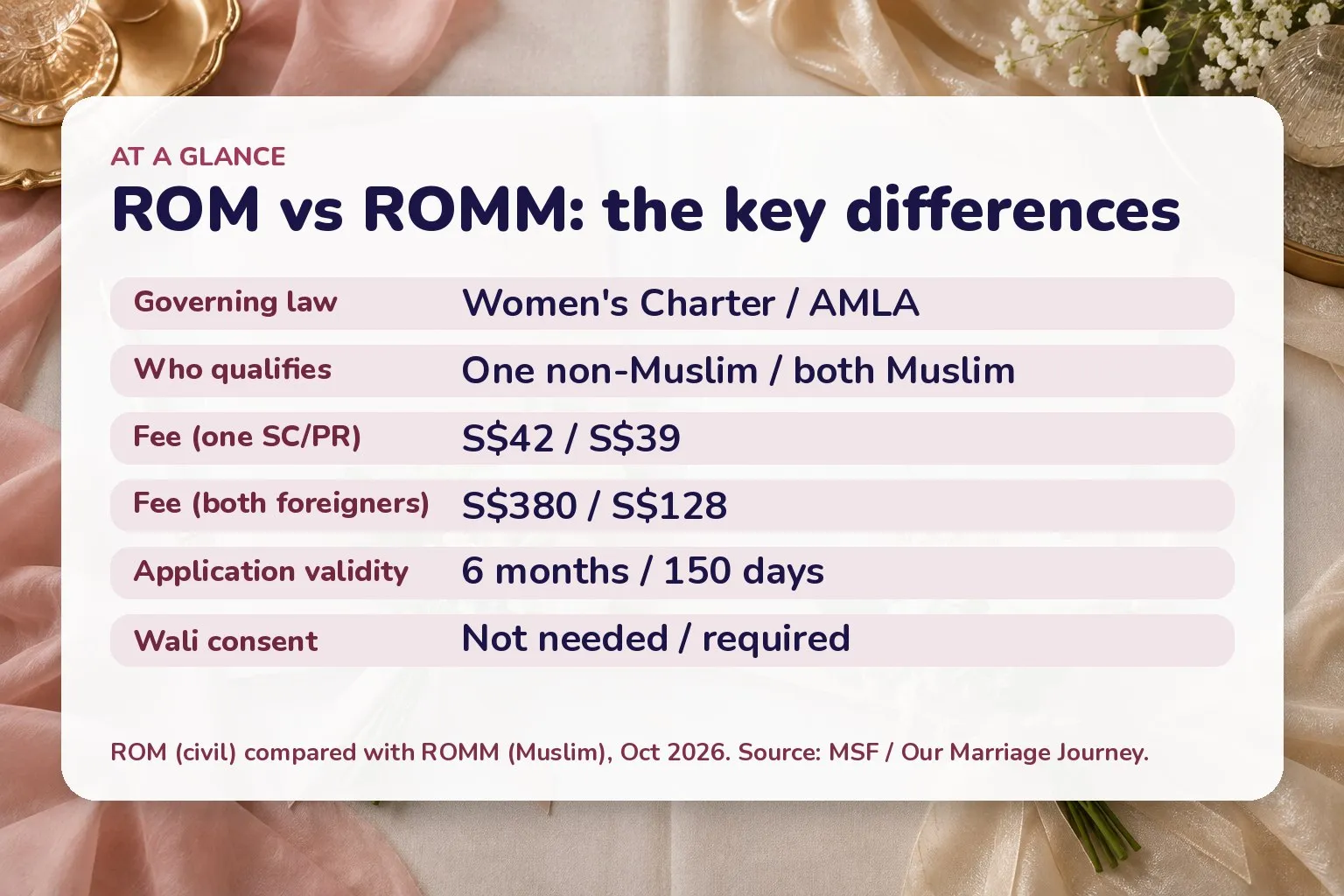
The headline differences between the two registries. Source: MSF / Our Marriage Journey (ROM and ROMM), as of October 2026.
| Feature | ROM (civil) | ROMM (Muslim) |
|---|---|---|
| Governing law | Women’s Charter 1961 | Administration of Muslim Law Act 1966 |
| Who qualifies | At least one party non-Muslim | Both parties Muslim |
| Solemnised by | A licensed solemniser | A Kadi or Naib Kadi |
| Application fee (≥1 SC/PR) | S$42 | S$39 |
| Application fee (both foreigners) | S$380 | S$128 |
| Minimum notice | 21 days | 21 days |
| Application validity | 6 months | 150 days |
| Guardian’s (wali) consent | Not required | Required (bride’s wali) |
| Mas kahwin | Not applicable | Minimum S$100 from groom |
The fees compared
The civil marriage licence costs S$42 where at least one of you is a Singapore Citizen or Permanent Resident, and S$380 where both of you are foreigners. The ROMM marriage application costs S$39 where at least one is a citizen or PR, and S$128 where both are foreigners. Two things follow from this. First, the gap is small for local couples — a few dollars — so cost is never a sensible reason to prefer one. Second, you could not act on the gap even if it mattered, because the registry is already fixed by religion. Both figures are from the Our Marriage Journey fee schedules and were current as of October 2026; reconfirm on the portal before you pay.
Notice and validity differ
Both registries ask for at least 21 days’ notice before the solemnisation. What differs is how long a filed application stays alive. A civil (ROM) application must be lodged no earlier than 6 months before the date and stays valid for 6 months, lapsing automatically if you do not marry. A ROMM application expires 150 days (about five months) from the date of submission, after which you file afresh. In practice both windows are generous, but note the ROMM window is the shorter of the two.
Witnesses: who qualifies
Both ceremonies need two witnesses aged 21 or older who attend, show original identity documents and sign the certificate. The difference is who may serve. A civil marriage accepts any two adults of any nationality or religion. A Muslim marriage requires the two witnesses to be male Muslims. If you are planning a ROMM ceremony, line up eligible witnesses early — it is a requirement the civil side does not have. The full detail for each is in the ROM guide and ROMM guide.
What ROMM adds that ROM has none of
A Muslim marriage carries requirements with no civil equivalent:
- The wali’s consent. The bride’s wali (lawful guardian) must consent to the marriage. The wali is identified in a set order — birth father, paternal grandfather, brother, paternal uncle, then another eligible paternal-side male relative — and ROMM verifies eligibility rather than letting the family choose freely.
- The mas kahwin. The groom gives the bride a mas kahwin (mahar), with a current minimum of S$100, at the solemnisation (the akad nikah).
- A Kadi or Naib Kadi, not a licensed civil solemniser, conducts and registers the marriage, at ROMM or a ROMM-approved venue.
A civil marriage has none of these; a licensed solemniser conducts it and there is no guardian-consent step for couples aged 21 and over.
If only one of you is Muslim
An inter-faith couple — one Muslim, one non-Muslim — cannot use ROMM, because ROMM requires both parties to be Muslim. Our Marriage Journey states that such a couple may register a marriage under Civil Law at ROM instead. One caution the Registry itself flags: if either of you resides in another country, check whether a Singapore civil marriage between a Muslim and a non-Muslim will be recognised there, and take legal or religious advice on the point before you file.
If both of you are Muslim
If both of you are Muslim, the position is firm: you must register with ROMM, and a civil ROM marriage is not available to you. This holds regardless of how observant either of you is — the law keys off being Muslim, not off practice. Any religious questions around the marriage go to MUIS or a qualified Asatizah; ROMM handles the official registration only. The cultural ceremonies that surround a Malay-Muslim wedding are described neutrally in our Malay-Muslim traditions guide.
Same legal marriage, same certificate
Whichever registry applies, the outcome is a legally recognised marriage in Singapore, and both registries issue a digital certificate of marriage on registration. Neither is “more married” than the other; they are simply administered under different laws. You cannot, however, hold the same marriage at both — a marriage registered at ROMM is a ROMM marriage and is not duplicated at ROM.
Where each one is now
Both ROM and ROMM currently operate from an interim site at Esplanade Mall while their Canning Rise home is redeveloped, and both are due to return to a rebuilt Canning Rise in 2029. Check the current location when you plan; our solemnisation venues guide tracks where ceremonies are held.
FAQ
Can we choose ROM because it is a few dollars cheaper or the application lasts longer? No. The registry is decided by whether both of you are Muslim, not by fee or validity.
We are both Muslim but not practising — can we marry civilly at ROM? No. If both parties are Muslim the marriage must be registered at ROMM.
One of us is Muslim and one is not. Which registry? ROM, as a civil marriage under the Women’s Charter; ROMM is not available to inter-faith couples.
Is a ROMM marriage recognised the same as a civil one? Yes — both are legally recognised marriages in Singapore and both produce a digital marriage certificate.
One of us is a foreigner — does that change the registry? No. Nationality affects the fee and extra document steps, not which registry applies; see getting married as a foreigner.
Where to go next
- ROM Singapore: the complete registration guide
- ROMM: the Muslim marriage registration guide
- Getting married in Singapore as a foreigner
- Malay-Muslim wedding traditions, explained
For any religious question about your marriage, consult MUIS or a qualified Asatizah. This guide explains the official choice of registry only.
Sources
- Registering & Solemnising Your Marriage (civil and Muslim) — Ministry of Social and Family Development (as of October 2026)
- What are the fees for the various Registry of Marriages (ROM) services? — Our Marriage Journey (Registry of Marriages) (as of October 2026)
- Who can apply for a marriage with the Registry of Muslim Marriages? — Our Marriage Journey (Registry of Muslim Marriages) (as of October 2026)
- Submit marriage application (Muslim marriage) — ROMM fees, notice and validity — Registry of Muslim Marriages, Singapore (as of October 2026)
- If both parties to the marriage are Muslims, can they marry at ROM under Civil Law? — Our Marriage Journey (Registry of Marriages) (as of October 2026)
- Can one Muslim and one non-Muslim marry at ROM under Civil Law? — Our Marriage Journey (Registry of Marriages) (as of October 2026)
- What is the '21-day notice' and '6-month validity period'? — Our Marriage Journey (Registry of Marriages) (as of October 2026)
- ROM and ROMM to return to Canning Rise in 2029 — Ministry of Social and Family Development (as of 8 February 2026)