Malay-Muslim Wedding Traditions in Singapore
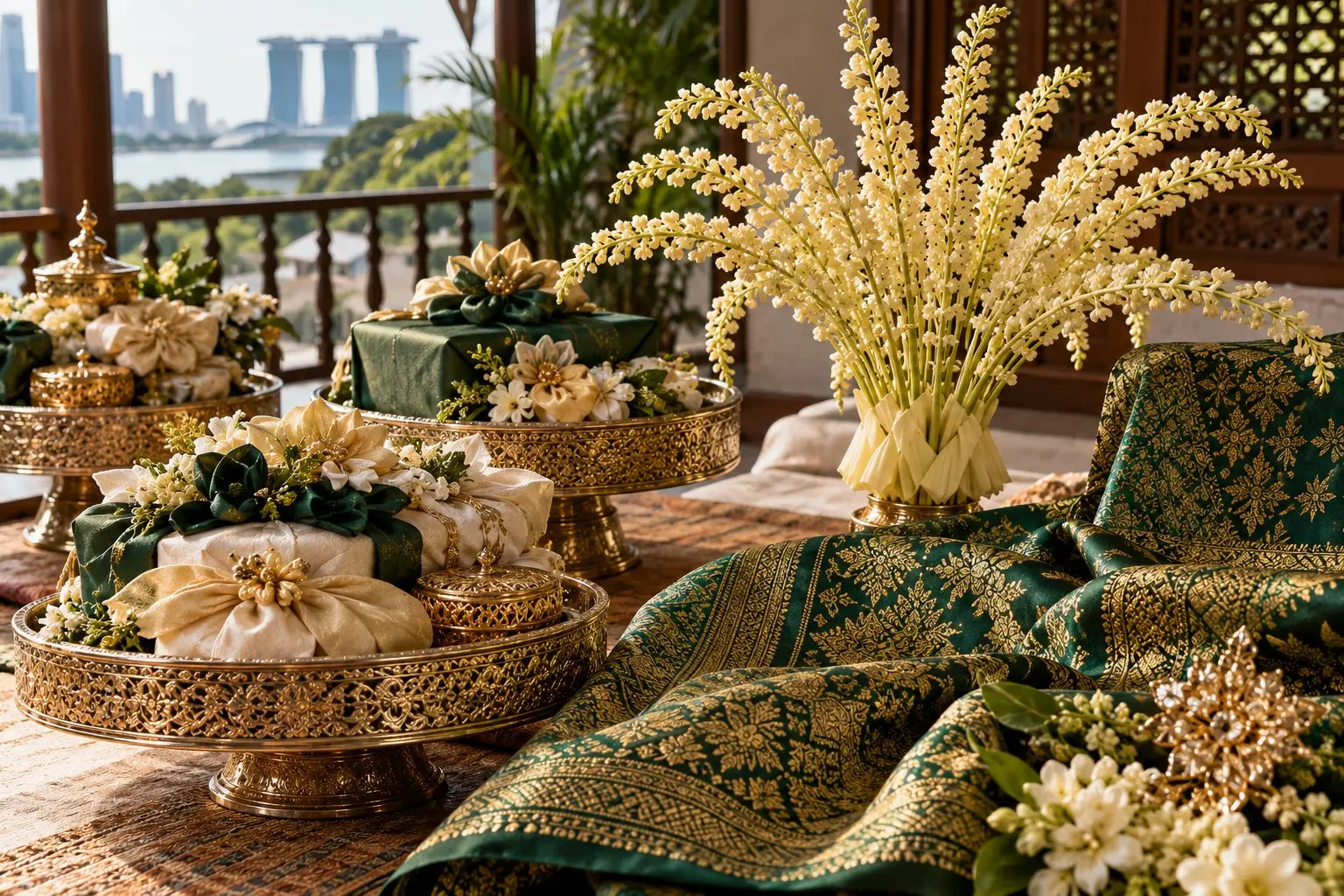
A Malay-Muslim wedding combines Islamic obligation with Malay custom. The required step is the akad nikah (solemnisation) by a Kadi, which legalises the marriage through ROMM; the groom gives the bride the obligatory mas kahwin. Surrounding customs include the hantaran exchange, the walimah feast and the bersanding sitting-in-state.
A Malay-Muslim wedding in Singapore weaves together Islamic obligation and Malay custom. The one religiously required step is the akad nikah — the solemnisation that legalises the marriage through the Registry of Muslim Marriages (ROMM). Everything around it is custom, observed in different ways by different families. This is a respectful overview, not a religious ruling; for anything concerning Islamic law, speak to MUIS or a qualified Asatizah.
Before the wedding: merisik and the engagement
Traditionally a Malay wedding begins with merisik (“investigating”), where a family discreetly enquires about a prospective match, followed by the meminang (proposal) and the pertunangan (engagement). At the engagement the families meet formally, often exchanging decorated trays (dulang) and agreeing the duit hantaran and the wedding date. These early steps have become more of a formality today, but many families still observe them.
Hantaran and mas kahwin: two different things
It’s worth being clear about two terms that are often confused:
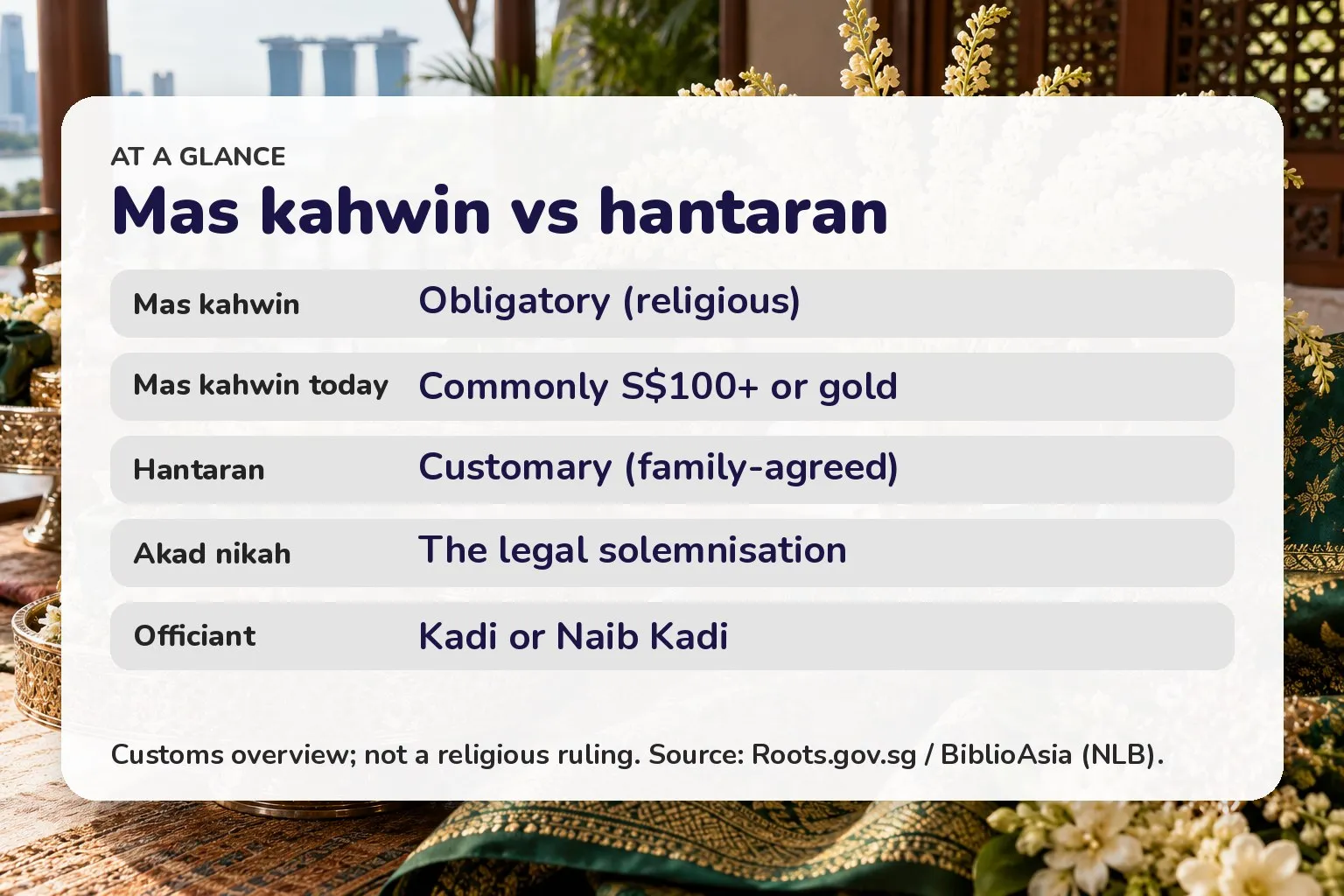
Mas kahwin (obligatory) and hantaran (customary) are different things. Source: Roots.gov.sg / BiblioAsia (NLB).
- Mas kahwin (also mahar) is an obligatory gift from the groom to the bride under Islam, marking the start of his responsibilities. In Singapore it is commonly at least S$100 today, and may be given as gold or jewellery rather than cash.
- Hantaran (duit hantaran) is a customary cash-and-gift exchange to help cover wedding expenses, usually negotiated between the families beforehand. It is separate from the religious mas kahwin.
The gift trays themselves are often beautifully arranged — fabric folded into flowers or swans, chocolates, cakes and personal items — and exchanged between the two sides.
The akad nikah: the solemnisation
The akad nikah is the heart of the wedding. A Kadi (or Naib Kadi) officiates, delivers a short sermon, checks the couple’s and witnesses’ credentials, confirms the bride’s consent, and the groom accepts the marriage with the stated mas kahwin before two male Muslim witnesses. The bride is given away by her wali (guardian). This is both a religious obligation and, through ROMM, the legal act — the full process and documents are in our ROMM guide.
The celebration: walimah and bersanding
After the nikah comes the walimah, the communal wedding feast, often serving nasi minyak or nasi biryani to a large gathering of family and friends. Its high point is the bersanding, where the bride and groom sit “in state” on a decorated dais (pelamin) to receive guests. The groom’s arrival is announced by the kompang (drum ensemble) and the bunga manggar (palm-blossom standards), and there are playful obstacles — the groom offers token payments before being seated beside his bride. A mak andam (a bridal specialist) prepares the bride and oversees parts of the ceremony. Historically a bertandang followed at the groom’s home; today it is often on the same day.
How this fits the legal marriage
The akad nikah is the legal solemnisation for a Muslim marriage, registered through ROMM — unlike a Chinese wedding, where the rites and the legal ROM step are separate. For cost planning, the hantaran is a significant, family-negotiated line; the feast and venue follow the same venue economics covered in how much a wedding costs.
Where to go next
- The ROMM registration process
- Chinese wedding traditions, for comparison
- How much a wedding costs in Singapore
This guide describes customs respectfully and neutrally. It is not a religious ruling; for questions on Islamic law, consult MUIS or a qualified Asatizah.
Sources
- Malay Weddings — National Heritage Board (Roots.gov.sg) (as of October 2026)
- Malay-Muslim Weddings: Keeping Up with the Times — BiblioAsia, National Library Board (as of October 2026)