Who Can Be a Witness at Your ROM

You need two witnesses aged 21 or older at a ROM solemnisation. They can be any family member or friend of any nationality, must attend in person with their original NRIC or passport, and watch you exchange vows.
On this page11 sections · tap to jump
- 01How many witnesses, and why two
- 02Who can be a witness
- 03What a witness does
- 04What witnesses bring on the day
- 05Do witnesses attend the verification appointment?
- 06Must witnesses be physically present?
- 07Age is checked on the wedding day
- 08If a witness cannot make it
- 09Muslim marriages (ROMM) are different
- 10FAQ
- 11Where to go next
Among all the planning around a Singapore wedding, the witnesses are easy to leave to the last minute — and that is exactly how couples end up scrambling on the morning of their solemnisation. The rule itself is short: you need two witnesses, each aged 21 or older, physically present at the ceremony with their original identity document. Everything else is detail, but the details are where people trip up. Here is who qualifies, what they bring, and what they actually do.
This page sits alongside our complete ROM guide; if you want the whole registration process, start there.
How many witnesses, and why two
Two witnesses are required, and the requirement comes from the law, not from office practice. The Women’s Charter states that “every marriage shall be solemnised in the presence of at least 2 credible witnesses.” It is taken seriously: solemnising a marriage “otherwise than in the presence of at least 2 credible witnesses other than the person solemnising the marriage” is an offence, carrying up to three years’ imprisonment and a fine of up to S$5,000 for the person conducting it.
That is why a solemniser will not begin without both witnesses in the room. After the ceremony, the certificate of marriage must be attested by the two credible witnesses who were present, so their role is legal, not merely ceremonial.
Who can be a witness
The pool of eligible people is wide. According to the Registry of Marriages, “any individual above the age of 21 is eligible to be a witness at your solemnisation. This includes family members and your close friends of any nationality.” Breaking that down:
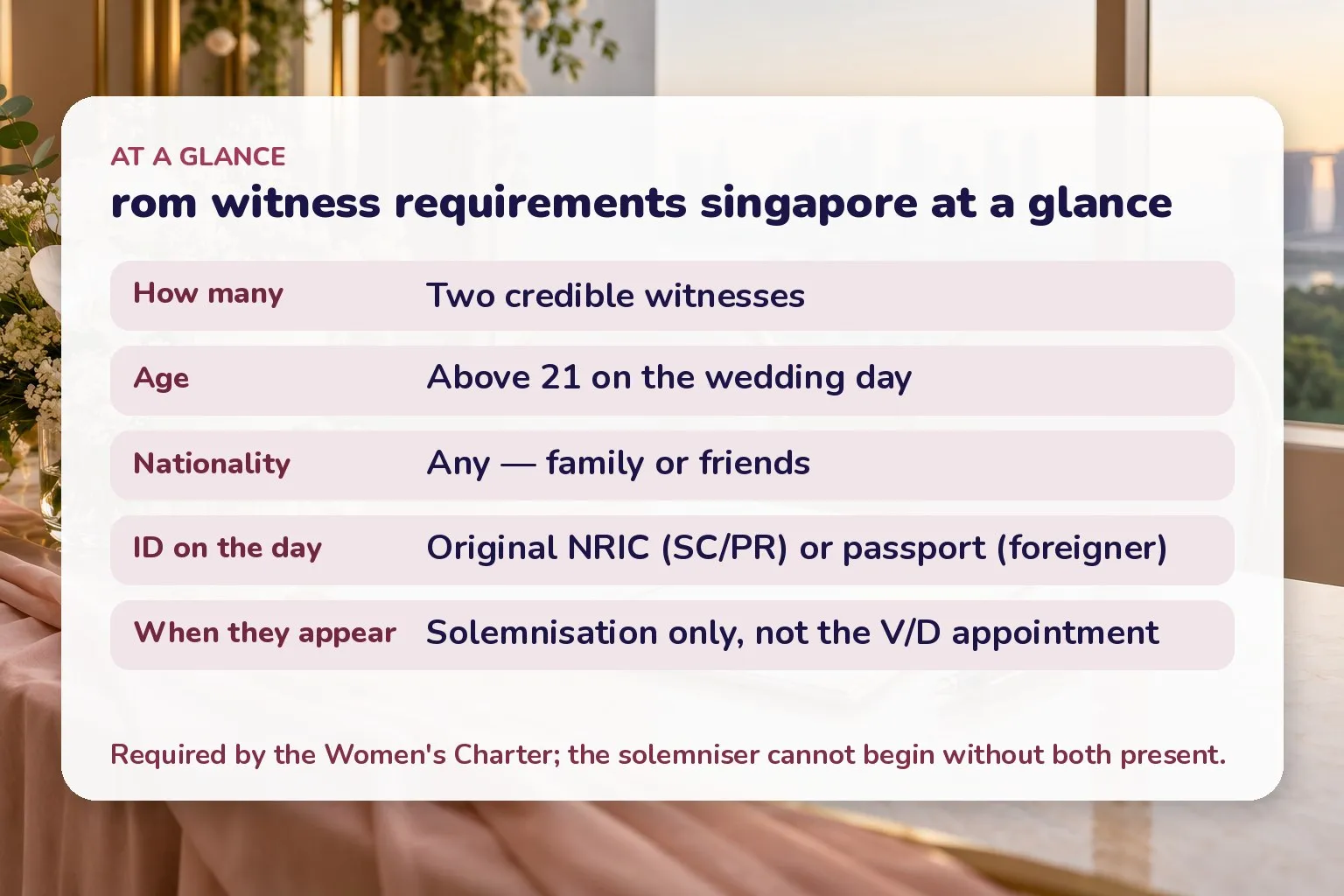
The civil (ROM) witness rules in one view.
- Age: each witness must be above 21. This is the one hard filter.
- Nationality: there is no nationality requirement. A witness does not need to be a Singapore Citizen, PR or even a resident — an overseas relative flying in for the wedding qualifies, provided they bring a valid passport.
- Relationship to you: they do not have to be related. ROM confirms that “parents or other persons who are known to the couple can be official witnesses,” so a sibling, a colleague, a long-time friend or a parent are all fine.
What a witness does
A witness is not a silent decoration. Their job, in ROM’s words, is to “observe the solemnisation ceremony, including exchange of marriage vows between the groom and bride,” and then to sign the marriage certificate to attest that they saw it happen. In practice that means being attentive during the short ceremony and being ready to sign afterwards — no speeches, no special preparation.
What witnesses bring on the day
This is the single most common slip-up. On the day of the marriage, each of the two witnesses must be physically present with their original identity document:
- Singapore Citizens and PRs bring their original NRIC.
- Foreigners bring their original passport.
A photo on a phone, a photocopy or a laminated copy is not accepted at the ceremony. The document must be the physical original, and for a foreign witness it must still be valid (not expired) on the wedding date.
Do witnesses attend the verification appointment?
No — and this surprises people. ROM is clear that “the witnesses need not accompany the couple for the Verification of documents and Declaration (V/D) appointment.” For that appointment, the couple simply brings photocopies or screenshots of each witness’s NRIC (for citizens/PRs) or passport (for foreigners) so the details can be recorded. The witnesses themselves only need to turn up, in person, on the day of the solemnisation.
(For completeness: both members of the couple do have to attend the V/D appointment together — that part cannot be delegated.)
Must witnesses be physically present?
Yes. For a standard in-person solemnisation, both witnesses must be physically present at the ceremony to observe it and sign the certificate. They cannot “attend” by video call for an ordinary ceremony. Video-link solemnisation exists only in exceptional circumstances and needs the Registrar’s prior approval; it is not a workaround for a witness who cannot travel, and the case is covered in our ROM guide. The safe assumption for planning: your two witnesses are in the room with you.
Age is checked on the wedding day
The “above 21” bar is assessed on the solemnisation date, in line with how ROM assesses age for the marrying couple too. A friend who is 20 when you file the Notice of Marriage but who turns 21 only after the wedding date does not qualify. If a potential witness is close to the line, either confirm their birthday clears your wedding date or pick someone whose age is beyond question.
If a witness cannot make it
Because witnesses are a legal requirement, a no-show is not something the solemniser can waive. If one of your witnesses falls through:
- Have a backup adult in mind — any eligible person over 21 can step in, including a guest already attending.
- If you are marrying at an external venue, make sure both witnesses know the exact address and arrival time; a late witness can hold up the whole ceremony.
- Keep each witness’s ID requirement front of mind right up to the day — the ceremony legally cannot proceed with fewer than two credible witnesses present.
Muslim marriages (ROMM) are different
Everything above applies to civil marriages registered with the Registry of Marriages. If both of you are Muslim and marrying under the Registry of Muslim Marriages (ROMM), the witness rules differ: a witness for the solemnisation must be a male Muslim aged 21 or older, and the ceremony also involves the bride’s wali (guardian). Do not assume the civil rules carry across. See our ROMM marriage guide and Malay/Muslim wedding traditions for that pathway.
FAQ
How many witnesses do I need? Two. The Women’s Charter requires every marriage to be solemnised before at least two credible witnesses.
Can a foreigner or an overseas relative be a witness? Yes. Witnesses can be of any nationality; a foreigner brings their original, valid passport.
Do the witnesses have to be family? No. Any adult over 21 known to you — friend, colleague or relative — can serve.
Do witnesses come to the verification appointment? No. You bring copies of their ID to that appointment; the witnesses only attend in person on the wedding day.
Can a witness join by video call? For an ordinary solemnisation, no — both witnesses must be physically present. Video-link ceremonies are a rare, pre-approved exception.
Where to go next
Sources
- Prepare your marriage application — Finalise key details — Registry of Marriages, Singapore (as of October 2026)
- Who can be witnesses to a marriage? — Our Marriage Journey (Registry of Marriages) (as of October 2026)
- Can I go to Registry of Marriages (ROM) without a witness? — Our Marriage Journey (Registry of Marriages) (as of October 2026)
- What is the responsibility of a witness in a marriage solemnisation? — Our Marriage Journey (Registry of Marriages) (as of October 2026)
- Is it compulsory for the couple's parents to attend the solemnisation ceremony? — Our Marriage Journey (Registry of Marriages) (as of October 2026)
- Women's Charter 1961, sections 22 and 40 (witnesses to solemnisation) — Singapore Statutes Online, Attorney-General's Chambers (as of October 2026)
- Overview of Marriage Process — Registry of Marriages, Singapore (as of October 2026)