How Your ROM Date Fits Your BTO Timeline

Engaged couples can apply for a BTO flat before marrying under the Fiancé/Fiancée Scheme, but must register their marriage within 3 months of collecting their keys. With a BTO wait of several years, most couples hold their ROM well before key collection.
On this page13 sections · tap to jump
- 01Applying before the wedding: the Fiancé/Fiancée Scheme
- 02The one hard deadline: marriage within 3 months of key collection
- 03Family Scheme vs Fiancé/Fiancée Scheme
- 04The BTO timeline, stage by stage
- 05Start with the HFE letter
- 06When to actually book your ROM date
- 07Standard, Plus and Prime: the MOP clock starts at keys
- 08If you are still studying or serving NS
- 09If the plan changes
- 10A worked example
- 11Common mistakes
- 12Frequently asked questions
- 13Where to go next
Two of the biggest decisions a couple in Singapore make — when to register their marriage and when to get a flat — run on completely different clocks. A BTO flat can take years to build; a marriage application takes three weeks. Fit them together badly and you can end up with a rushed solemnisation nobody wanted, or a deadline you did not see coming. This guide maps how the HDB Fiancé/Fiancée Scheme, the BTO build timeline and your ROM date actually interlock, with the rules and fees as of November 2026. Confirm the details at hdb.gov.sg and marriage.gov.sg before you lock in dates.
Applying before the wedding: the Fiancé/Fiancée Scheme
You do not need to be married to apply for a flat. Under HDB’s Fiancé/Fiancée Scheme, an engaged couple can apply for a BTO (or resale) flat together, provided both are at least 21 and at least one is a Singapore Citizen. The combined income ceiling is S$14,000 for a family flat. The scheme exists precisely because the housing clock and the marriage clock do not naturally align — it lets you enter the BTO queue years before the wedding.
The one hard deadline: marriage within 3 months of key collection
Here is the rule that governs everything else. A fiancé/fiancée couple must solemnise their marriage within 3 months of collecting the keys to their new flat. If the marriage is registered overseas, you must submit a copy of the marriage certificate within 3 months of key collection.
Miss it and you are in breach of the scheme’s conditions, which can trigger the financial forfeitures that apply when a flat application is cancelled. It is a date to respect, not to improvise around.
Family Scheme vs Fiancé/Fiancée Scheme
If you are already married, you apply under the Family Scheme instead, and there is no marriage deadline — you simply keep your marriage certificate ready for HDB. Both schemes share the same S$14,000 income ceiling and the same flat-type range; the only real difference is the marriage-certificate condition.
| Fiancé/Fiancée Scheme | Family Scheme | |
|---|---|---|
| Marital status at application | Engaged, not yet married | Already married |
| Marriage deadline | Marriage certificate within 3 months of key collection | None |
| Minimum age | Both at least 21 | Both at least 21 |
| Citizenship | At least one Singapore Citizen | At least one Singapore Citizen |
| Income ceiling (family flat) | S$14,000 | S$14,000 |
The two main schemes couples use to buy an HDB flat. Source: HDB and Made For Families, as of November 2026.
Choosing the wrong scheme for your situation gets the application rejected, so pick based on whether your ROM is done or still ahead of you. If you want the registration process itself explained end to end, see our complete ROM guide.
The BTO timeline, stage by stage
BTO flats are launched in three sales exercises a year — February, June and October. In 2026 HDB is launching about 19,600 flats, including more than 4,000 with shorter waiting times of under three years. A typical application runs roughly like this:
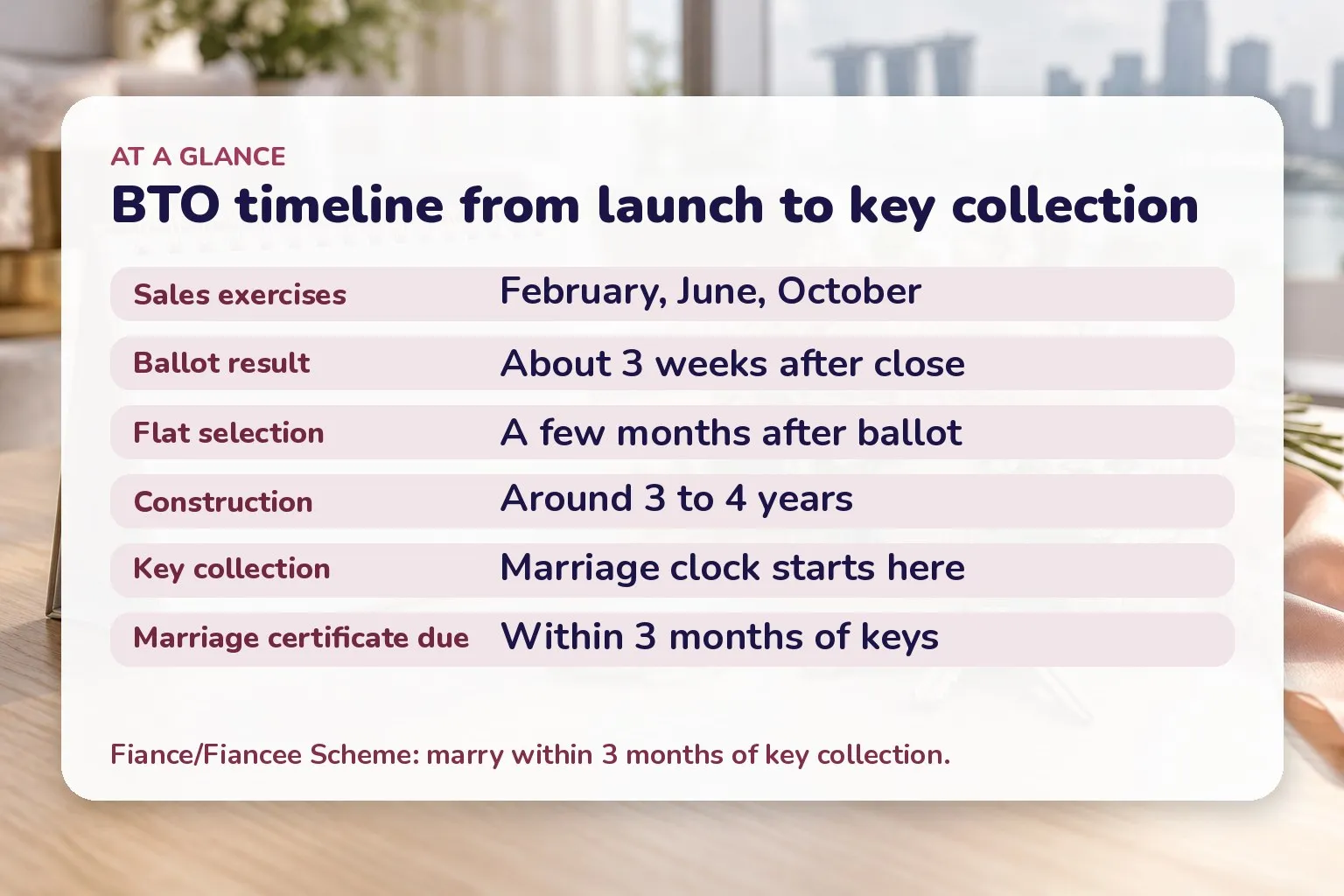
The BTO journey from launch to key collection. Source: HDB sales-exercise and key-collection guidance, as of November 2026.
- Launch and application — a short application window during the exercise.
- Ballot result — about three weeks after applications close.
- Flat selection — a few months after the ballot, in queue order.
- Construction — commonly around three to four years for a standard project; shorter-waiting-time flats are quicker.
- Key collection — and only now does the three-month marriage clock start.
The upshot: from application to keys is usually several years. That long gap is exactly why the ROM date is a planning question, not a deadline panic.
Start with the HFE letter
Before you can apply for any flat, you need a valid HDB Flat Eligibility (HFE) letter. It is valid for 9 months from issue and cannot be extended, and it must be valid on the day you submit your BTO application. Processing takes about a month, longer around a sales exercise, so apply well ahead of the February, June or October window you are targeting. The HFE letter also tells you your grant and loan amounts upfront — see our guide to CPF housing grants for married couples for what those come to.
When to actually book your ROM date
The ROM side has its own timing rules, and they are tight:
- You give notice by submitting a marriage application at least 21 days before your solemnisation — that 21-day notice is a legal requirement.
- The earliest you can submit is 6 months ahead of the ceremony; the application expires 6 months after submission.
- The fee is S$42 if at least one of you is an SC or PR, or S$380 if both are foreigners.
For couples solemnising under Muslim law (ROMM), the application instead expires 150 days from submission, with a fee of S$39 (SC/PR) or S$128 (both foreigners). The differences between the two registries are covered in our guide to ROM vs ROMM.
Standard, Plus and Prime: the MOP clock starts at keys
Since the October 2024 sales exercise, every new flat is classified Standard, Plus or Prime, and the class sets your Minimum Occupation Period (MOP). A Standard flat has a 5-year MOP; Plus and Prime flats carry a 10-year MOP plus tighter resale and rental rules. Crucially, the MOP starts from the day you collect your keys — not from your marriage — so the flat’s class decides how long you are tied to it before you can sell or buy private property.
If you are still studying or serving NS
Couples who are full-time students or in National Service (or have just finished) can apply for a flat first and defer their income assessment for grants and the loan until nearer key collection. From the July 2025 exercise onwards, only one of you needs to be a student or NSF for the couple to qualify. This lets younger couples enter the BTO queue early without their current low income working against them. First-timer families also get at least two ballot chances, and First-Timer (Parents & Married Couples) applicants get an extra ballot — worth knowing when you plan which exercise to try.
If the plan changes
If a relationship ends before key collection, the consequences depend heavily on how far the application has progressed — early on, before a unit is selected, the cost is usually a small non-refundable application fee, but after booking, financial forfeitures apply. Because the stakes rise at each stage, couples under the Fiancé/Fiancée Scheme should treat booking as a genuine commitment, not a placeholder. For the money that a wedding itself adds on top of the flat, see how much a wedding costs in Singapore.
A worked example
Illustrative only. Priya and Daniel apply in the June exercise as an engaged couple under the Fiancé/Fiancée Scheme. Their ballot result comes about three weeks later; they select a Standard flat a few months after that. Construction runs around three and a half years, so key collection lands roughly four years out. They solemnise their marriage about a year into the wait — comfortably inside the three-month-after-keys rule — and file their ROM application only once their solemnisation date is set, staying within its six-month validity. The housing and marriage calendars meet by design, not by accident.
Common mistakes
- Thinking you must marry before applying — the Fiancé/Fiancée Scheme is built for engaged couples.
- Reading the 3-month rule as 3 months from application — it runs from key collection.
- Filing the ROM application too early — it expires after 6 months.
- Letting the HFE letter lapse — it is valid 9 months and must be valid on application day.
- Assuming the MOP starts at the wedding — it starts at key collection, and is 10 years for Plus/Prime flats.
Frequently asked questions
Can we apply for a BTO before we are married? Yes, under the Fiancé/Fiancée Scheme, as long as both of you are at least 21 and at least one is a Singapore Citizen.
By when must we register our marriage? Within 3 months of collecting the keys to your new flat; an overseas marriage certificate must be submitted within the same 3 months.
How long does a BTO take? Usually several years from application to keys — a short application window, a ballot about three weeks later, flat selection a few months after, then roughly three to four years of construction.
When should we book our ROM date? Once HDB confirms a key-collection window. Submit the marriage application at least 21 days before the ceremony and no earlier than 6 months ahead, since it expires after 6 months.
Does the Minimum Occupation Period start when we marry? No. It starts on the day you collect your keys — 5 years for a Standard flat, 10 years for a Plus or Prime flat.
Where to go next
Sources
- Key Collection — solemnisation within 3 months, overseas marriage certificate — Housing & Development Board (HDB) (as of November 2026)
- Submit marriage application — 21-day notice, 6-month validity, fees — Registry of Marriages (Our Marriage Journey), Singapore (as of November 2026)
- Housing Schemes and Grants — deferred income assessment, ballot chances — Made For Families, Government of Singapore (as of November 2026)
- HDB to Launch 19,600 BTO Flats in 2026 across three sales exercises — Channel NewsAsia / HDB media release (as of November 2026)
- How to Apply for an HDB Flat Eligibility (HFE) Letter (9-month validity) — MyNiceHome, Housing & Development Board (HDB) (as of November 2026)