Married Child Priority Scheme: Now the Family Care Scheme

The Married Child Priority Scheme was replaced by the Family Care Scheme (Proximity) from the July 2025 sales exercises. It still gives couples priority in the BTO ballot to buy a flat with or within 4 km of their parents, with up to 30% of flats set aside.
On this page13 sections · tap to jump
- 01What happened to the Married Child Priority Scheme
- 02How the priority works
- 03Who qualifies
- 04Living with vs living near your parents
- 05The 4 km rule and how to check it
- 06How many flats are set aside
- 07The catch: the proximity condition runs through the MOP
- 08Applying for two flats together: FCS (Joint Balloting)
- 09Priority access is not the Proximity Housing Grant
- 10A worked example
- 11Common mistakes
- 12Frequently asked questions
- 13Where to go next
If you have been researching how to improve your BTO odds by applying near your parents, you will have met the Married Child Priority Scheme (MCPS) — and you may now be confused, because HDB has retired that name. From the July 2025 sales exercises the MCPS was folded into the new Family Care Scheme (FCS) (Proximity). For an engaged or married couple the benefit is essentially the same: priority in the ballot to buy a new flat with or within 4 km of your parents. This guide explains what changed, who now qualifies, the set-aside quotas, and the condition that bites after you collect your keys — all from HDB and Made For Families, as of November 2026.
What happened to the Married Child Priority Scheme
The Married Child Priority Scheme no longer exists under that name. HDB’s July 2025 announcement is explicit: “From the July 2025 sales exercises, married and single children will enjoy priority access when they apply for a new flat to live with or near their parents, under the new Family Care Scheme (FCS) (Proximity).” The same release confirms that “FCS (Proximity) will replace both of these schemes” — the old MCPS and the Senior Priority Scheme — “with no change to the priority access for married couples and seniors”.
So if a guide, forum post or agent still says “MCPS”, read it as the FCS (Proximity). The scheme was first announced at the National Day Rally 2024 and rolled out in two parts: FCS (Proximity) from July 2025, and FCS (Joint Balloting) from the October 2025 exercise. Made For Families puts the change plainly: “From mid-2025, the new Family Care Scheme (FCS) will replace the MCPS and offer priority access to all parents and their children, married or single”.
How the priority works
Priority schemes do not hand you a flat. HDB runs a computer ballot, and these schemes “help support households with specific needs by improving their chances in the ballot”. The mechanism is a set-aside quota: a slice of each project’s flats is reserved for applicants who qualify under the scheme, so you are effectively balloting against a smaller pool for those units. Clear the ballot and your actual queue number is still random — priority raises your odds of being invited to book, not the number you draw.
First-timer families already start with two ballot chances, and those in the First-Timer (Parents & Married Couples) category get an extra one; unsuccessful Standard-flat applicants can build up to five chances in total. The FCS (Proximity) quota stacks on top of those first-timer advantages.
Who qualifies
The eligibility for FCS (Proximity), from HDB’s current guidance, is:
- Citizenship: at least one parent or child is a Singapore Citizen or Permanent Resident.
- Marital status: at least one parent or child is married — including fiancé/fiancée applicants — or single. A single child must be aged 35 and above.
- Living with your parents/child: you include them in your HFE letter and flat application.
- Living near your parents/child: the flat you apply for must be within 4 km of the home your parent or child owns and lives in.
Because fiancé and fiancée applicants count, an engaged couple can use the scheme before registering their marriage — the same window in which you would be planning your ROM date around a BTO timeline.
Living with vs living near your parents
There are two ways to qualify, and they carry different obligations:
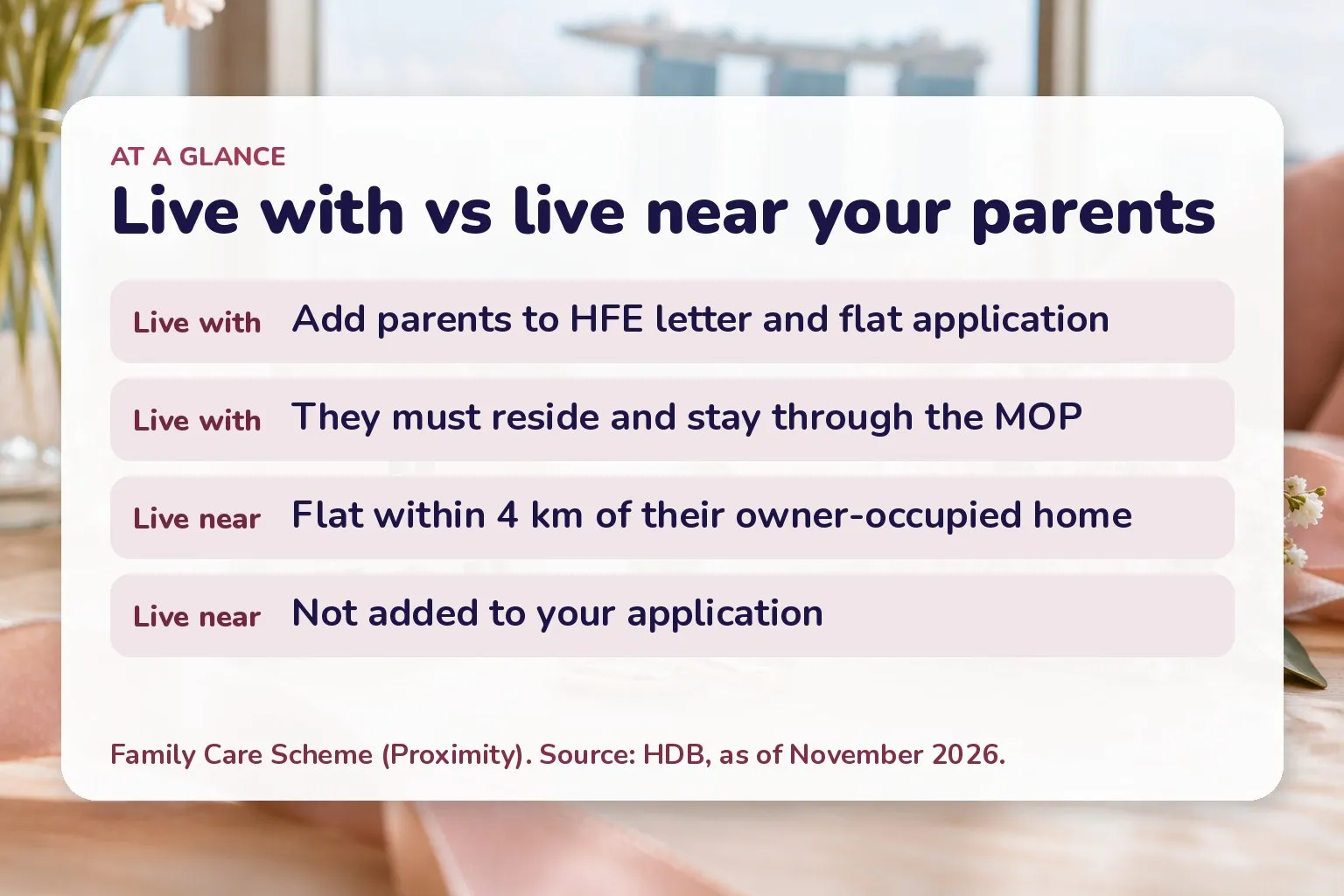
The two ways to qualify under the Family Care Scheme (Proximity). Source: HDB and MyNiceHome, as of November 2026.
- Live with: you list your parents (or child) in the flat application; they must physically reside in the flat, and their names cannot be removed during the Minimum Occupation Period. If anyone in the application already holds an HDB flat, that interest must be disposed of “within 6 months of completing your flat purchase”.
- Live near: you do not add them to the application; instead the flat must sit within 4 km of the home they own and occupy. That reference home can be an HDB flat, an HDB rental flat, or a private residential property.
The 4 km rule and how to check it
The 4 km is measured from the nearest block in the project to your parents’ or child’s home, so a large project can qualify even if some blocks are further out. If your parents own more than one property, the one they actually live in is the reference.
How many flats are set aside
The quota is generous but capped. Under FCS (Proximity):
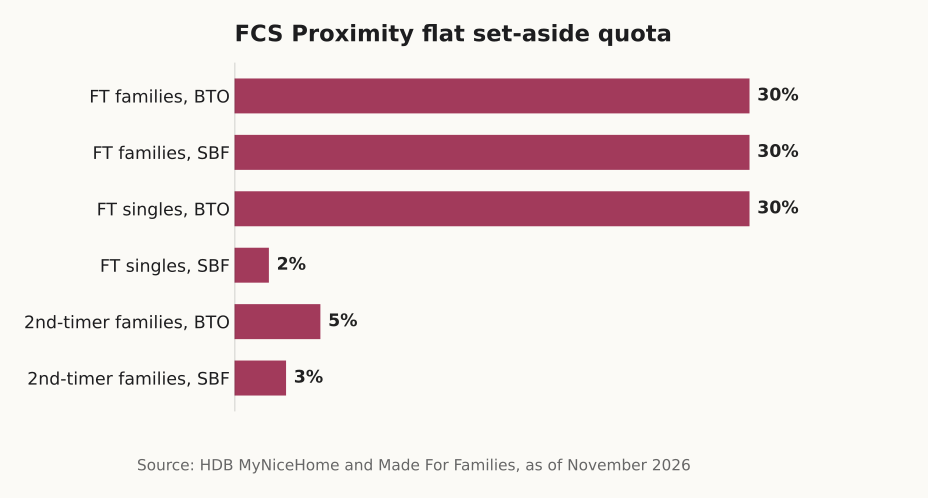
Share of flats set aside under the Family Care Scheme (Proximity). Source: HDB MyNiceHome and Made For Families, as of November 2026.
- First-timer families: up to 30% of the public supply for both BTO and SBF flats.
- First-timer singles (aged 35+, 2-room Flexi): up to 30% of BTO and up to 2% of SBF, within the non-senior 2-room Flexi supply.
- Second-timer families: up to 5% of BTO flats and up to 3% of SBF units.
These are ceilings, not guarantees: if more qualifying applicants apply than there are reserved flats, you are back in a ballot for the set-aside pool.
The catch: the proximity condition runs through the MOP
The priority comes with a lasting string attached. HDB’s rule: “After collecting the keys to your new flat, the parents or child who has helped you to qualify for the FCS (Proximity) must continue to live with you or within 4 km of your new flat throughout the minimum occupation period of the new flat.”
Applying for two flats together: FCS (Joint Balloting)
If you and your parents each want your own flat in the same project, that is the other half of the scheme — FCS (Joint Balloting), which replaced the old Multi-Generation Priority Scheme. It is “for parents and their child(ren), married or single, who wish to make a joint application for 2 units in a BTO project that offers 2-room Flexi or 3-room flats”. Up to 15% of the 2-room Flexi and 3-room flats are set aside for the parents and another 15% for the child. The parents may only take a 2-room Flexi or 3-room flat, while a married child can apply for up to a 5-room flat.
Priority access is not the Proximity Housing Grant
A common mix-up: the FCS (Proximity) is about ballot priority for a new (BTO/SBF) flat. The Proximity Housing Grant (PHG) is a separate cash grant for buying a resale flat near family — “$20,000 if you buy a resale flat to live near (i.e. within 4km) your parents or child, or $30,000 if you buy a resale flat to live with your parents or child”. You can benefit from proximity either way, but through different routes — the PHG and the other grants a couple can claim are covered in our guide to CPF housing grants for married couples.
A worked example
Illustrative only. Nadia and Arjun are engaged and want to stay near Nadia’s parents, who own and live in a flat in Tampines. They apply as fiancé/fiancée first-timers for a Tampines BTO project whose nearest block, confirmed on the FCS Distance Enquiry tool, is 3.2 km from the parents’ flat. They apply under the FCS (Proximity) “live near” route, so the parents are not in their application. Their application goes into the set-aside pool of up to 30% of the project’s flats for first-timer families, on top of their first-timer ballot chances. If they succeed and collect keys, Nadia’s parents must keep living within 4 km of the new flat through the MOP.
Common mistakes
- Searching for “MCPS” and assuming it’s gone — the benefit continues as the FCS (Proximity).
- Treating priority as a guarantee — it is a quota and better odds, not a reserved unit.
- Measuring 4 km from the wrong block — HDB uses the nearest block in the project; check it on the Distance Enquiry tool.
- Forgetting the MOP proximity string — your parents must stay within 4 km for the whole occupation period.
- Confusing it with the Proximity Housing Grant — that is a resale-flat cash grant, not BTO ballot priority.
Frequently asked questions
Does the Married Child Priority Scheme still exist? Not under that name. It was replaced by the Family Care Scheme (Proximity) from the July 2025 sales exercises, with the priority for married couples unchanged.
Can engaged couples use it? Yes. Fiancé and fiancée applicants qualify, so you can apply before registering your marriage.
How close to my parents must the flat be? Within 4 km, measured from the nearest block in the project to the home your parents own and live in.
How much priority does it actually give? Up to 30% of a project’s public flat supply is set aside for first-timer families under the scheme; you still ballot within that pool and your queue number stays random.
Is this the same as the Proximity Housing Grant? No. This is ballot priority for a new BTO or SBF flat; the Proximity Housing Grant is a cash grant for buying a resale flat near family.
Where to go next
Sources
- New Family Care Scheme (Proximity) Better Supports Parents and Children to Live Closer Together — Housing & Development Board (HDB) (as of November 2026)
- Priority Schemes for HDB BTO Flat Buyers (FCS Proximity and Joint Balloting) — MyNiceHome, Housing & Development Board (HDB) (as of November 2026)
- Priority Schemes (FCS Proximity eligibility, quota, MOP) — Housing & Development Board (HDB) (as of November 2026)
- Housing Schemes and Grants (MCPS to FCS, quotas, Proximity Housing Grant) — Made For Families, Government of Singapore (as of November 2026)
- FCS Distance Enquiry e-service (4 km check) — Housing & Development Board (HDB) (as of November 2026)