Tax Reliefs for Married Couples in Singapore

Marriage itself gives no automatic tax break in Singapore. A resident who supports a low-income spouse (earning no more than S$8,000) can claim S$2,000 Spouse Relief; most couple tax savings come later from child reliefs and the Parenthood Tax Rebate.
On this page12 sections · tap to jump
- 01Does marriage alone reduce your tax?
- 02The short list for a married couple
- 03Spouse Relief: S$2,000 (or S$5,500)
- 04NSman Wife Relief
- 05Reliefs that start when you have children
- 06The Parenthood Tax Rebate
- 07The S$80,000 relief cap
- 08A note on the Foreign Domestic Worker Levy Relief
- 09How to claim and share reliefs
- 10Common mistakes
- 11Frequently asked questions
- 12Where to go next
Newlyweds often ask whether tying the knot changes their tax bill. In Singapore the honest answer is: not by much on its own. There is no joint filing and no married-person allowance — each spouse files individually. What marriage does is open the door to specific reliefs and a rebate from the Inland Revenue Authority of Singapore (IRAS), most of which only pay off when one spouse has little income, or once you have children. This guide sets out what a married couple can actually claim, the exact amounts and conditions for the Year of Assessment (YA) 2026, and the traps to avoid. Figures are IRAS’s as of November 2026; always confirm your own position in myTax Portal.
Does marriage alone reduce your tax?
Short answer: rarely, by itself. Singapore taxes each spouse separately and offers no automatic “married” deduction. The one relief that flows directly from being married — Spouse Relief — is only available when your spouse’s income is low. Once you have children, a cluster of child-related reliefs and the Parenthood Tax Rebate come into play, and these are where most couples see real savings. So the useful question is not “do we save tax by marrying?” but “which of these reliefs do we each qualify for this year?”
The short list for a married couple
Here is the full set a married couple might touch, before children and after:
- Spouse Relief / Spouse Relief (Disability) — for supporting a low-income or disabled spouse.
- NSman Wife Relief — for the wife of an operationally-ready National Serviceman.
- Qualifying Child Relief (QCR) / Child Relief (Disability) — once you have a child.
- Working Mother’s Child Relief (WMCR) — working mothers only.
- Grandparent Caregiver Relief (GCR) — working mothers whose parent or in-law minds the child.
- Parenthood Tax Rebate (PTR) — a one-off rebate, not a relief, for a Singaporean child.
Each has its own conditions, and the total of all your reliefs is capped (see below).
Spouse Relief: S$2,000 (or S$5,500)
Spouse Relief recognises a taxpayer — male or female — who supported their spouse. To claim it for YA 2026, both conditions must have been met in 2025: your spouse lived with or was supported by you, and your spouse’s annual income was not more than S$8,000. The relief is S$2,000. Where the spouse is physically disabled or mentally impaired, you claim Spouse Relief (Disability) of S$5,500, and the income test does not apply.
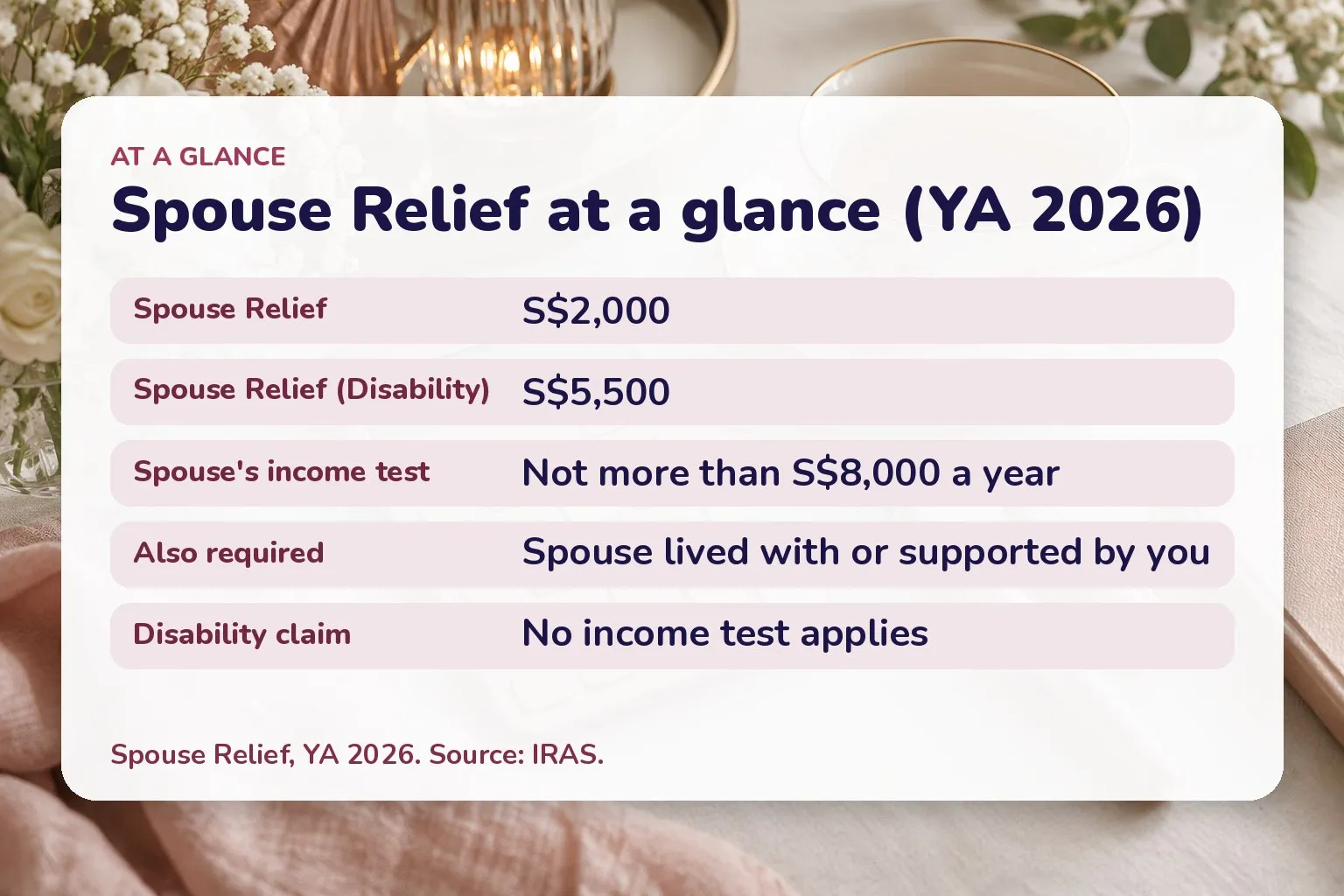
Spouse Relief amounts and conditions for YA 2026. Source: IRAS, as of November 2026.
The S$8,000 income test is broader than salary. IRAS counts your spouse’s taxable income (employment, trade, rental, SRS withdrawals), their tax-exempt income such as bank interest, dividends and pensions, and their foreign-sourced income — whether or not it is brought into Singapore. Only CPF payouts are left out. A spouse with a modest overseas income or investment income can therefore fail the test even if they earn nothing locally.
Two edge cases: legally separated spouses can claim only if they make maintenance payments under a Court Order or Deed of Separation (and from YA 2026 this is extended to separated wives paying husbands, not just husbands paying wives), while divorced taxpayers paying alimony cannot claim Spouse Relief at all. Also note that if you claim Spouse Relief on your partner, no one else may claim Parent Relief (except Grandparent Caregiver Relief) or Sibling Relief (Disability) on that same person.
NSman Wife Relief
If your husband is an operationally-ready National Serviceman, you may receive NSman Wife Relief of S$750. The conditions: you were a Singapore Citizen in the year before the YA, and your husband is eligible for NSman Self Relief. You do not apply — IRAS grants it automatically based on your eligibility. (Widows of deceased NSmen keep it unless they remarry.) It is small, but it stacks on top of the other reliefs.
Reliefs that start when you have children
Most of a couple’s tax savings arrive with children. The main building blocks:
- Qualifying Child Relief (QCR) is up to S$4,000 per child (S$7,500 for Child Relief (Disability)). Parents can share it by an agreed split, as long as the total per child does not exceed the cap. The child must be unmarried and either under 16 or studying full-time with annual income not over S$8,000.
- Working Mother’s Child Relief (WMCR) is for working mothers only — single and male taxpayers cannot claim it. For a Singaporean child born or adopted on or after 1 January 2024, it is a fixed S$8,000 for the first child, S$10,000 for the second, and S$12,000 for the third and beyond. For a child born or adopted before that date, the old percentage basis (15%, 20%, 25% of the mother’s earned income) still applies.
- Grandparent Caregiver Relief (GCR) gives a working mother S$3,000 where her parent, grandparent or in-law lives in Singapore, cares for her child, earned no more than S$8,000 the previous year, and no one else claims GCR on that caregiver.
Because these child reliefs have their own detailed rules, we keep them brief here; the amounts above are the ones a newly-married couple planning a family will care about first.
The Parenthood Tax Rebate
The Parenthood Tax Rebate (PTR) is different from the reliefs above: it is a rebate that offsets the tax you owe, not a deduction from income. It is a one-off entitlement per qualifying child and is given to married (or divorced/widowed) parents of a Singapore Citizen child:
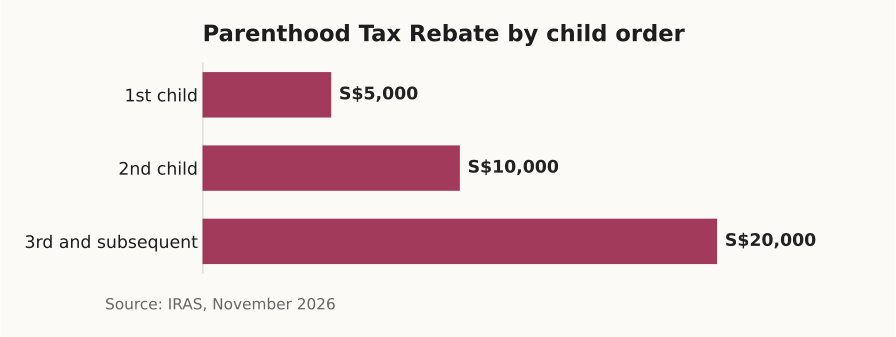
Parenthood Tax Rebate by child order (child born from 2008 onwards). Source: IRAS, as of November 2026.
- S$5,000 for the first child, S$10,000 for the second, and S$20,000 for the third and each subsequent child (for a child born from 2008).
You and your spouse share the PTR by an agreed percentage, and any unutilised balance is carried forward automatically to offset future tax — though it is never refunded as cash. In IRAS’s own worked example, a couple each earning S$100,000 with their first Singaporean child, sharing QCR and PTR and with the wife claiming WMCR, GCR and NSman Wife Relief, end up with the wife owing S$0 and the husband S$430 after the rebate.
The S$80,000 relief cap
There is a ceiling on the whole exercise. A personal income tax relief cap of S$80,000 per YA applies to the total of all your reliefs (it has applied since YA 2018). If your reliefs add up to more than S$80,000, the excess is disregarded — and cannot be transferred to your spouse. IRAS’s advice if you are near the cap: consider letting the spouse who is under it claim shareable reliefs such as QCR or Parent Relief. The PTR, being a rebate against tax rather than a relief against income, sits outside this S$80,000 cap.
A note on the Foreign Domestic Worker Levy Relief
If you have read older guides, you may expect a relief for the maid levy. The Foreign Domestic Worker Levy (FDWL) Relief has been discontinued from YA 2025 — the final year it could be claimed was YA 2024. Working mothers who relied on it should not expect it on current returns.
How to claim and share reliefs
Most of these are handled in myTax Portal when you file your Income Tax Return under “Deductions, Tax Reliefs and Rebates.” A few points for couples:
- Spouse Relief is added under the “Spouse” section the first time; thereafter IRAS pre-fills it if you still qualify — check it is correct.
- NSman Wife Relief is auto-granted; if it is missing, you can write to IRAS via myTax Mail with your marriage certificate.
- Shareable items (QCR, PTR) require you and your spouse to agree a split; if your percentages do not add up to 100%, IRAS apportions equally.
- To amend a claim, use Amend Tax Bill in myTax Portal within 30 days of your tax bill.
Getting married is also a good moment to tidy up the admin that feeds your tax profile — for example, if either of you is changing your name after marriage, update it with the relevant agencies. For the wider money picture of the wedding itself, see how much a wedding really costs here, and if one of you is a foreign spouse, our guide to applying for PR after marrying a Singaporean covers the residence side.
Common mistakes
- Claiming Spouse Relief when the spouse earns over S$8,000 — including from overseas or investments. The test is broad; check it before claiming.
- Expecting a “married couple” deduction — there isn’t one; the savings come from Spouse Relief and, later, child reliefs.
- Forgetting the caps — the S$50,000 per-child and S$80,000 overall limits can quietly shrink your total.
- Men claiming mother-only reliefs — WMCR and GCR are for working mothers; single and male taxpayers are not eligible.
Frequently asked questions
Do married couples file taxes jointly in Singapore? No. Each spouse files individually; there is no joint assessment and no married-person allowance.
My spouse doesn’t work — can I claim Spouse Relief? Yes, S$2,000, provided you supported them and their annual income (including foreign and tax-exempt income, but not CPF payouts) was not more than S$8,000 in the preceding year.
We’re both working — what can we claim? If you have no children, usually only reliefs each of you qualifies for individually (such as CPF or NSman reliefs); Spouse Relief needs one spouse to have low income. Child reliefs and the PTR come with children.
Is the Parenthood Tax Rebate the same as a relief? No. A relief reduces your chargeable income; the PTR is a rebate that offsets tax payable, is one-off per child, and its unused balance carries forward.
Can I still claim the maid levy relief? No. FDWL Relief ended from YA 2025; YA 2024 was the last year it could be claimed.
Where to go next
Sources
- Tax savings for married couples and families (overview, worked examples) — Inland Revenue Authority of Singapore (IRAS) (as of November 2026)
- Spouse Relief / Spouse Relief (Disability) — Inland Revenue Authority of Singapore (IRAS) (as of November 2026)
- Tax reliefs (full list and the $80,000 personal income tax relief cap) — Inland Revenue Authority of Singapore (IRAS) (as of November 2026)
- Working Mother's Child Relief (WMCR) — Inland Revenue Authority of Singapore (IRAS) (as of November 2026)
- Parenthood Tax Rebate (PTR) — Inland Revenue Authority of Singapore (IRAS) (as of November 2026)
- NSman Relief (Self, Wife and Parent) — Inland Revenue Authority of Singapore (IRAS) (as of November 2026)
- Foreign Domestic Worker Levy (FDWL) Relief (discontinued from YA 2025) — Inland Revenue Authority of Singapore (IRAS) (as of November 2026)