Chinese Wedding Traditions in Singapore
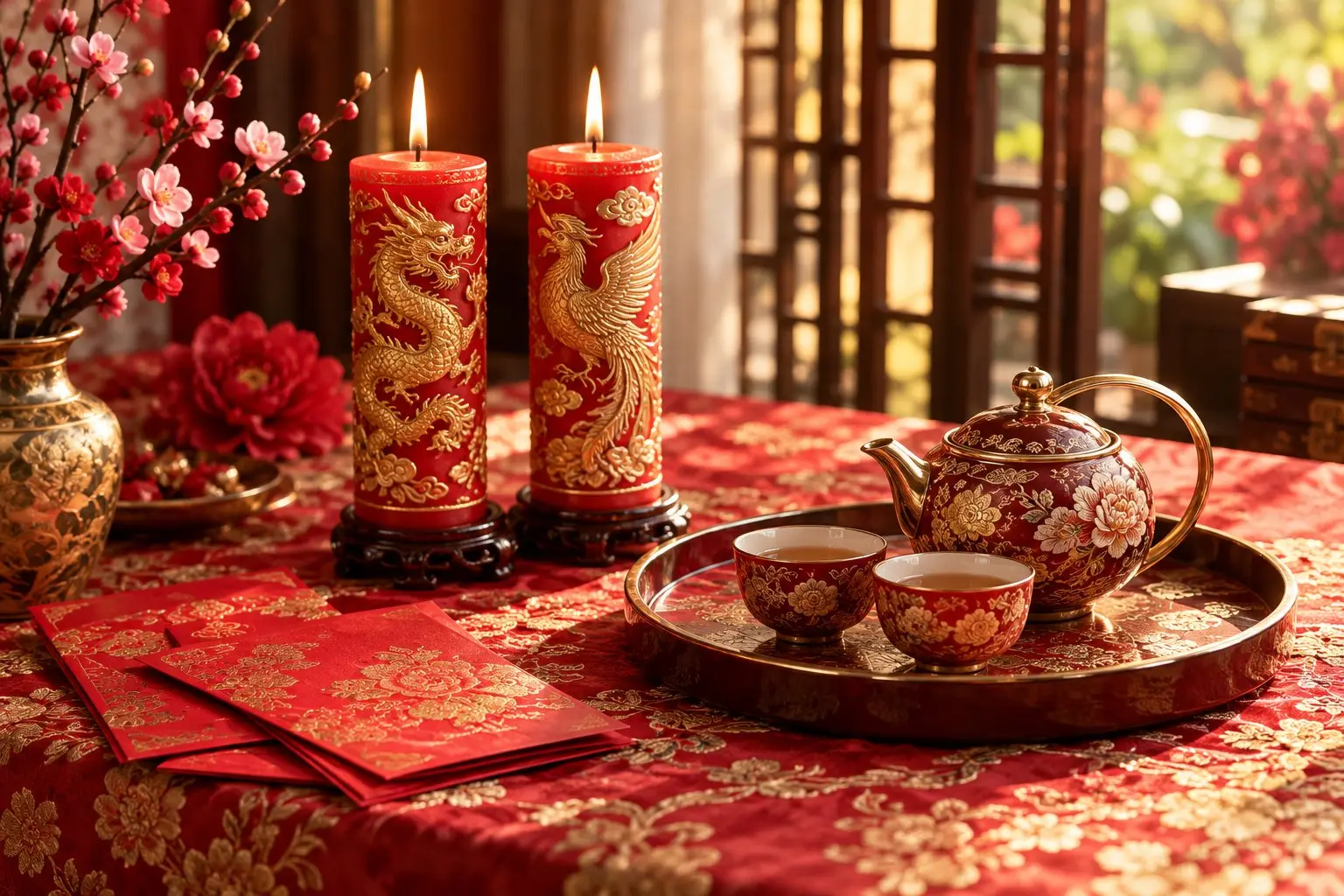
A Chinese wedding in Singapore layers customary rites around the legal ROM marriage: guo da li betrothal, the optional shang tou hair-combing on the eve, the morning gatecrash, and the tea ceremony where the couple serve tea to elders and receive red packets. Specific customs vary by dialect group.
A Chinese wedding in Singapore is really two things happening together: the legal marriage, registered through the Registry of Marriages, and a set of customary rites that bless the union and honour both families. The rites are cultural, not legal — you choose which to keep. This is a neutral overview of the most common ones; the specifics vary a lot by dialect group (Hokkien, Teochew, Cantonese, Hakka, Hainanese), so treat it as a map, not a rulebook.
Guo da li: the betrothal
Guo da li (过大礼) is the betrothal gift exchange, in which the groom’s family formally presents gifts to the bride’s family as a sign of sincerity. In Singapore it is usually held on an auspicious date one to four weeks before the wedding. The gifts symbolise good fortune and fertility and, across dialect groups, their number tends to add up to six, eight, ten or twelve, arranged in pairs.
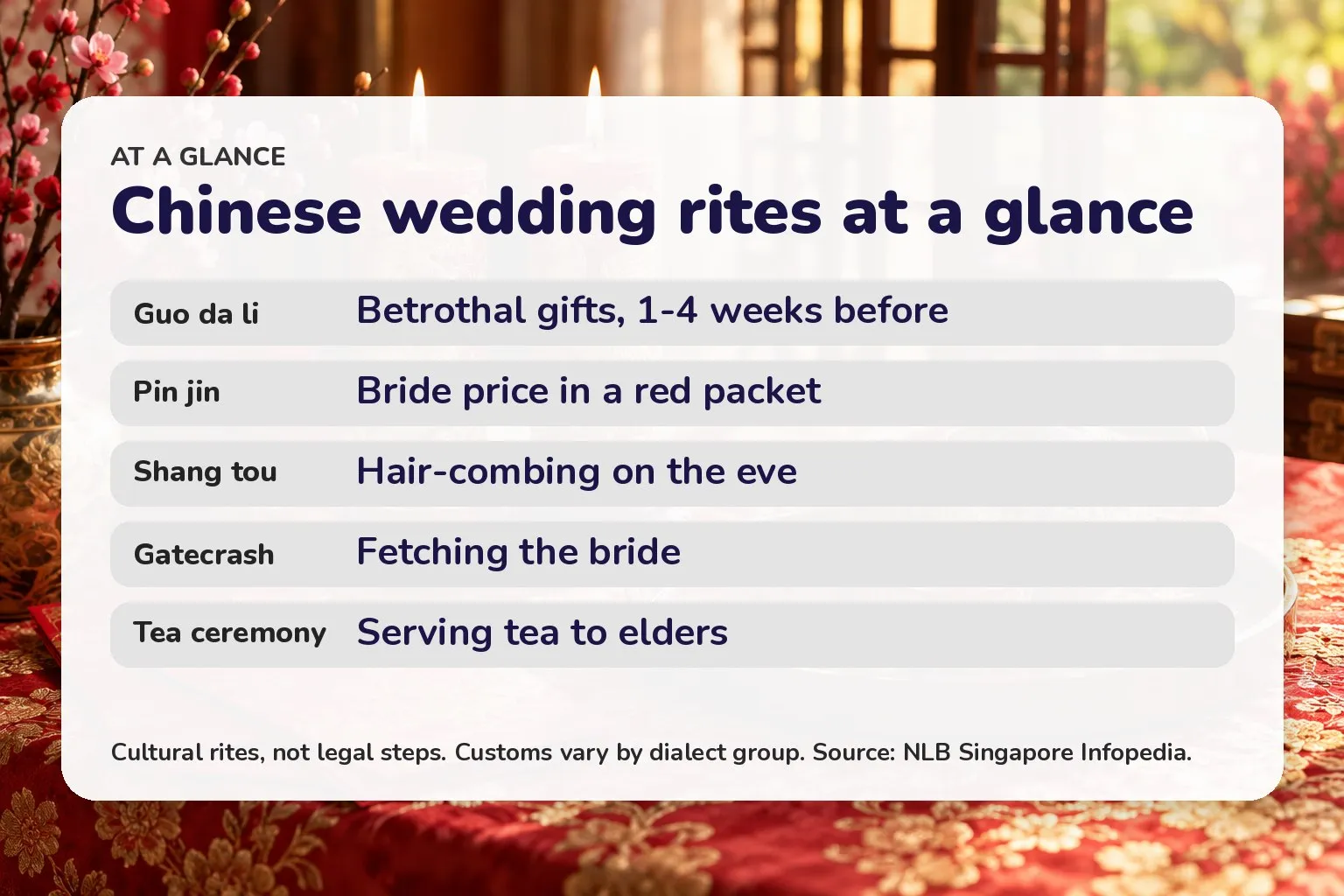
The common rites around a Chinese wedding. These are cultural, not legal. Source: NLB Singapore Infopedia.
The bride’s family also receives the pin jin (聘金), or bride price, in a red packet. By custom the bride’s family often accepts only a token sum and returns the rest, so as not to look as though they are “selling” their daughter. A typical guo da li set may include dragon-and-phoenix candles, wine or liquor, traditional wedding cakes and a red banner, with the bride’s side later returning some items (hui li).
The eve: hair-combing (shang tou)
Some families observe the shang tou (上头), or hair-combing ritual, on the eve of the wedding, performed separately at the bride’s and groom’s homes during an auspicious hour. Auspicious words are spoken with each brush of the hair to mark the couple’s coming of age, and the ritual is traditionally conducted by a happily married elder. It’s optional and more commonly kept by some dialect groups than others.
Wedding morning: the gatecrash
On the wedding day the groom and his groomsmen go to “fetch” the bride. At her door they’re met by the bride’s “sisters” (jie mei), who set playful tasks and negotiate for a red packet before letting him in. It’s lighthearted by design, and the fun of the haggling is part of the tradition.
The tea ceremony
The tea ceremony is the rite that formally recognises the couple before both families. Kneeling or bowing, the couple serve tea — often brewed with red dates and longans to symbolise a sweet, fertile marriage — to parents and senior relatives in order of seniority. In return, each elder gives the couple a hongbao (red packet) or a piece of jewellery. It is, at heart, a moment of gratitude and blessing between the generations.
How this fits the legal marriage
None of these rites register your marriage — that happens separately through ROM (or ROMM for a Muslim marriage). Many couples solemnise at a Registry site or their own venue and hold the tea ceremony and banquet around it. Budget-wise, the pin jin is a real line many couples forget to plan for; the banquet itself is covered in how much a wedding costs.
Where to go next
This guide describes customs neutrally and is not religious or cultural prescription. Families observe different rites in different ways.
Sources
- Chinese weddings — Singapore Infopedia — National Library Board (Singapore Infopedia) (as of October 2026)
- What are the fees for the various Registry of Marriages (ROM) services? — Our Marriage Journey (Registry of Marriages) (as of October 2026)