Bridal Studio Packages: What Is Included
A Singapore bridal package typically bundles gown rentals, a groom's suit, actual-day makeup and hairdo, accessories and basic alterations, sometimes with photography. Premium-gown surcharges, overtime makeup, extra looks, delivery fees, a damage deposit and 9% GST are commonly charged on top — confirm the nett total in writing.
On this page8 sections · tap to jump
- 01What a bridal package usually bundles
- 02The extras that are usually not included
- 03Nett, GST and the price you actually pay
- 04Deposits: the gown deposit and the booking deposit
- 05Your rights if the package falls short
- 06Before you sign: the written checklist
- 07Frequently asked questions
- 08Where to go next
A bridal studio package can look like a tidy all-in solution — one signature and your gown, your groom’s suit, your makeup and your photos are handled. The headline price is usually honest; the surprises come from what sits outside it. This guide explains what a Singapore bridal package normally bundles, the extras that routinely get added, and what the law does and doesn’t do for you if the studio falls short. We don’t rank studios or quote their rates, which vary and change — always get the specifics in writing from the studio.
What a bridal package usually bundles
Packages differ by studio, but the core of a typical Singapore bridal package is consistent:
- Gown rentals — usually two or three looks, often a white wedding gown plus an evening gown, and sometimes a ROM dress or a cheongsam/kua.
- A groom’s suit rental — one look for the groom.
- Actual-day makeup and hairdo — commonly one or two looks for the bride.
- Accessories — veil, petticoat (can-can), hairpieces and sometimes a tiara.
- Basic alterations — hemming and minor adjustments to fit the rented gowns.
- Post-wedding cleaning — dry cleaning of the rented pieces after the day.
A “bridal package” traditionally focuses on the bride’s attire and beauty. An “all-in-one” package usually widens that to include photography and videography (sometimes called PGVG — photographer and videographer). The names are used loosely, so read the contents, not the label.
For how attire and beauty fit the whole budget, see how much a wedding costs in Singapore.
The extras that are usually not included
This is where budgets slip. None of these are legal requirements — they are commercial conventions — but they are common enough that you should ask about each one before you sign:
- Premium-gown surcharges. Studios often tier their gowns (for example, classic, signature, boutique). The dress in the window may be a top tier that costs more than the base package.
- Extra makeup looks or overtime. More than the one or two included looks, early-morning call times, or a session that over-runs are usually billed on top.
- Additional photo prints or album pages beyond the set number included.
- Gown delivery and collection fees when multiple dresses are involved.
- A gown damage deposit (see below), which is separate from your booking deposit.
- 9% GST, if the studio quotes before tax (see the next section).
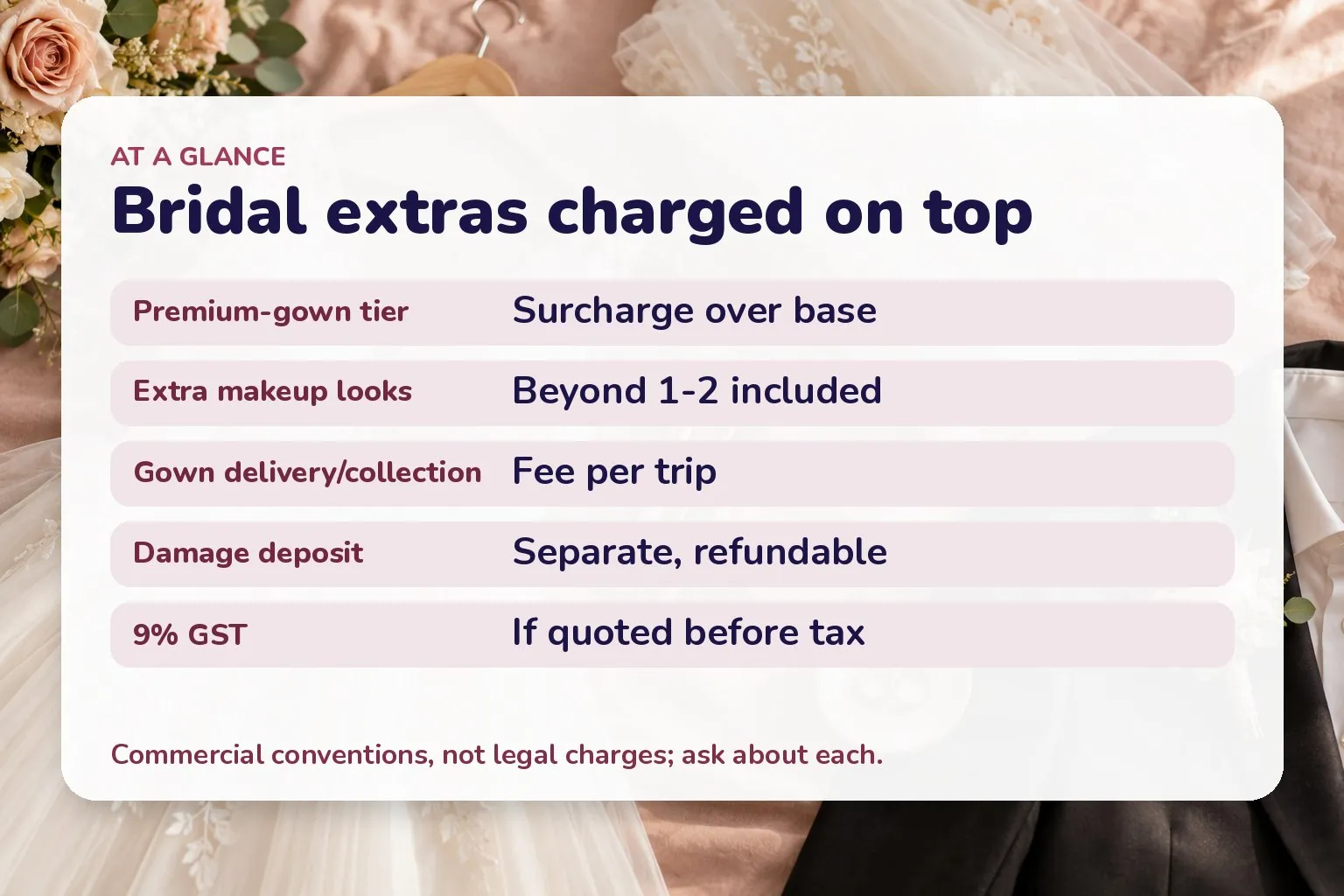
Common add-ons that sit outside a bridal package’s base price. These are commercial conventions, not legal charges — ask about each.
Nett, GST and the price you actually pay
The prevailing GST rate in Singapore is 9%. A GST-registered studio must display and quote prices inclusive of GST on its price lists, advertisements and website, so its advertised figure should already contain the tax. If a quote adds “+9% GST”, ask for the final nett number so you are comparing like with like.
Watch one specific claim: a GST-registered business must not advertise “no GST” even when it gives a discount equal to the tax. IRAS treats that as misleading, because the 9% is still in the price and must be paid. A “no GST” wedding promotion, in other words, does not make the tax vanish.
Deposits: the gown deposit and the booking deposit
Two different deposits often appear in a bridal contract, and couples confuse them:
- The booking deposit secures your date and package. It is usually non-refundable if you cancel, so check what it actually guarantees.
- The gown damage deposit is a separate, refundable sum held against damage or late return of the rented gowns, returned if the pieces come back in good condition. Confirm the amount, the exact condition for its return, and when you get it back.
A deposit is only as safe as the business holding it. Before paying a large sum, check whether the studio is CaseTrust-accredited: CaseTrust Prepayment Protection lets consumers claim back the unused portion of a prepayment if an accredited business closes, and prepayments expressly include deposits. Our deposits and cancellations guide explains how to verify accreditation and claim.
Your rights if the package falls short
Couples often assume the Lemon Law will rescue a bad bridal experience. It will not, for two reasons. First, the Lemon Law does not apply to services — and a bridal package (styling, makeup, coverage) is a service. Second, the gowns are rented, and the Lemon Law does not apply to rental or leased goods either. The Lemon Law is for defective goods you buy (it lets you ask for repair, replacement, a price reduction or to cancel for goods that don’t conform to the contract) — not for a hired gown or a service.
So what does protect you?
- The contract. A gown not delivered, a look missing, a studio that doesn’t perform — these are breaches of contract. Raise them in writing against what was promised.
- The CPFTA. If the studio misled you or engaged in an unfair practice, the Consumer Protection (Fair Trading) Act gives you civil redress; errant suppliers who persist are referred to the Competition and Consumer Commission of Singapore (CCCS).
- CASE, then the courts. CASE handles consumer-to-business disputes for personal purchases of goods or services; its process runs from consultation to an assisted or filed scheme to mediation. If that stalls, a bridal package can be taken to the Small Claims Tribunals as a contract for the provision of services (claim limit S$20,000, or S$30,000 by consent; file within 2 years; individual filing fee from S$10).
Before you sign: the written checklist
Get all of this on paper before any payment:
- The nett total, itemised, with the exact gown tier and number of looks.
- Every add-on you expect (extra prints, delivery, overtime rate).
- Both the booking deposit and the gown damage deposit, with refund conditions.
- The cancellation and postponement terms.
- Fitting and collection/return dates for the gowns.
- For any photography in the bundle, the deliverables and delivery date — see our photography and videography cost guide.
Frequently asked questions
What’s the difference between a bridal package and an all-in-one package? A bridal package traditionally covers the bride’s attire and beauty (gowns, makeup, accessories, suit). An all-in-one package usually adds photography and videography. The terms aren’t standardised, so compare the actual contents.
Is the gown damage deposit the same as my booking deposit? No. The booking deposit secures your date and is often non-refundable; the gown damage deposit is a separate, refundable sum held against damage or late return. Confirm both amounts and the refund condition in writing.
Does the Lemon Law cover a faulty rented gown? No. The Lemon Law excludes rental and leased goods, and it does not apply to services. Your recourse for a rental or package problem is the contract and the CPFTA/CASE route, not the Lemon Law.
The studio quoted a price “before GST” — is that allowed? A GST-registered business must display GST-inclusive prices to the public. If you were quoted a pre-GST figure, ask for the final nett price. A “no GST” promotion does not remove the 9% — the tax is still inside the price.
Where to go next
Sources
- Prevailing GST rate (9%) — Inland Revenue Authority of Singapore (IRAS) (as of November 2026)
- Displaying and quoting prices (GST-inclusive display rules) — Inland Revenue Authority of Singapore (IRAS) (as of November 2026)
- CPFTA & Lemon Law — coverage and the services exclusion — Consumers Association of Singapore (CASE) (as of November 2026)
- General Advisory on the Lemon Law (rental goods and services excluded) — Ministry of Trade and Industry (MTI) (as of November 2026)
- Submit a complaint — CASE dispute process — Consumers Association of Singapore (CASE) (as of November 2026)
- Cases eligible for a small claim (contract for the provision of services) — Small Claims Tribunals, State Courts (Singapore Courts) (as of November 2026)