Wedding Vendor Deposits and Cancellations

A wedding deposit is only as safe as the business holding it, and most are non-refundable. Before paying, check CaseTrust accreditation and get the cancellation terms in writing. If it goes wrong, escalate from the vendor to CASE to the Small Claims Tribunals (limit S$20,000, within 2 years).
A deposit feels like progress — the date is held, the vendor is “yours”. But a deposit is also the moment you hand over money for something you have not yet received, and that is exactly where wedding plans go wrong. Singapore has seen bridal and wedding firms collect deposits and then close, leaving couples out of pocket. This guide is about protecting that money: what each payment should secure, how prepayment protection works, what a cancellation clause must say, and the exact route to recover money if a vendor fails you.
Why a deposit is a risk
A deposit is only as safe as the business holding it, so treat it as a risk to manage, not a formality. Before you transfer anything, get two things in writing:
- A payment schedule. The deposit amount, each later instalment, the due dates, and — crucially — what each payment secures. A deposit that “holds the date” is different from one that part-pays the final bill.
- The cancellation terms (covered below), so you know what you lose if plans change.
Most booking deposits are non-refundable by the contract’s terms, so the deposit is money you may not get back. That makes the size of it — and the strength of the vendor behind it — matter more than the discount it unlocks.
CaseTrust Prepayment Protection
The single best protection against a vendor closing is to use a CaseTrust-accredited business. CaseTrust Prepayment Protection lets consumers claim back the unused portion of a prepayment if the accredited business closes, and “prepayment” expressly includes deposits (as well as prepaid packages, vouchers and membership fees).
Two conditions matter:
- It only applies to businesses accredited under the relevant CaseTrust schemes — a deposit to a non-accredited vendor is not covered this way.
- On paying, you should receive a proof of protection showing the protected sum, so keep it.
You can verify a business against the public CaseTrust accredited list before you pay. If prepayment protection matters to you, make accreditation a condition of booking — not an afterthought.
Cancellation terms to pin down
A good cancellation clause answers these before you need it:
- What you forfeit if you cancel, at each stage (after the deposit, after an instalment, close to the date).
- Postponement and date changes — whether they are allowed, the notice required, and the fee.
- Force majeure — what happens if illness, a venue closure or an official restriction forces a change, and who bears the cost.
- Who can cancel — the vendor’s own cancellation rights and what they refund if they pull out.
Factor in a cost couples forget: if a venue or vendor forces your date to move, changing your solemnisation details with ROM costs S$25. It is small against the whole budget, but it is a real, official fee that a date change triggers.
For the contract points that sit alongside cancellation, see questions to ask every wedding vendor.
Your legal rights: the CPFTA
If a vendor behaves unfairly — misrepresents a service, or persists in an unfair practice — the Consumer Protection (Fair Trading) Act (CPFTA) gives consumers the right to civil action against suppliers who persist in unfair practices. CASE and the Singapore Tourism Board are appointed specified bodies under the Act, and the CPFTA has been administered by the Competition and Consumer Commission of Singapore (CCCS) since 1 April 2018; errant suppliers who persist are referred to CCCS for investigation.
One thing the CPFTA’s Lemon Law provisions do not do: help with a cancelled or poorly delivered service. The Lemon Law does not apply to services — it is a remedy for defective goods. A wedding vendor contract is a service, so your levers are the contract itself and the CPFTA’s unfair-practice route, enforced through CASE and the courts, not a “return it” right.
The CASE complaint route
If raising it directly with the vendor doesn’t work, CASE handles consumer-to-business disputes. The process runs in three stages:
- Consultation. After you submit a complaint, a CASE officer assesses it and advises the next step.
- Assisted or filed scheme. In the assisted scheme, CASE helps you draft a letter you deliver to the business yourself. In the filed scheme, a CASE officer corresponds with the business on your behalf. Both may incur a small fee.
- Mediation. If talks reach deadlock, CASE proposes mediation. CASE reports its mediation service has a success rate of about 70%, and each signed settlement is legally binding in court — usually faster and cheaper than litigation.
CASE itself notes that for disputes about deposits, consumers may need to lodge the case with the Small Claims Tribunals.
The Small Claims Tribunals
If CASE cannot resolve it, the Small Claims Tribunals (SCT), part of the State Courts, is the low-cost next step. It is built for consumers: claims are filed online through the Community Justice and Tribunals System (CJTS), and it is designed for you to represent yourself without a lawyer.
What the SCT can hear and the limits that decide your case:
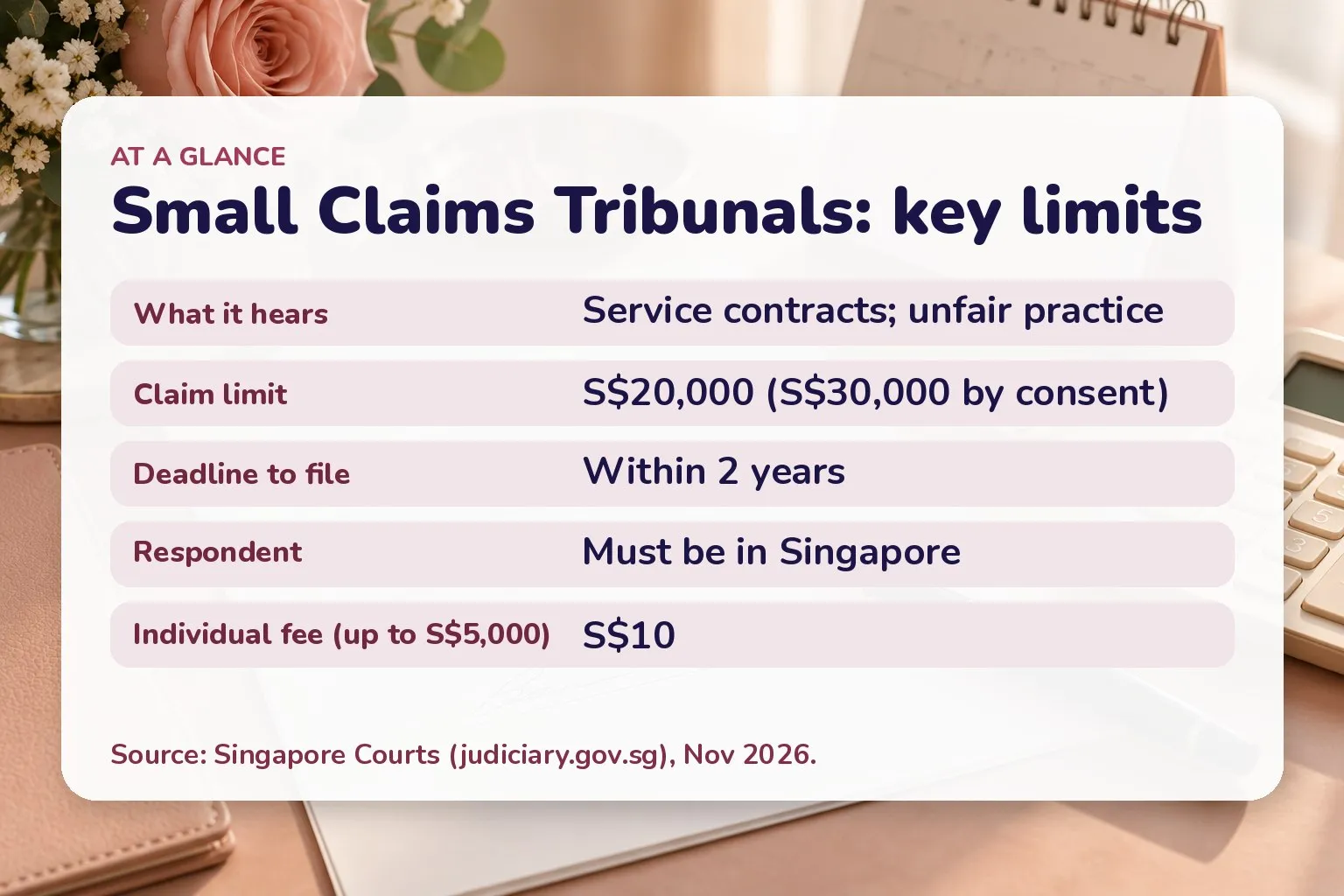
Small Claims Tribunals jurisdiction and limits. Source: Singapore Courts (judiciary.gov.sg), Nov 2026.
- Scope: the SCT hears a contract for the provision of services and a dispute against a supplier for an unfair practice under the CPFTA — which covers most wedding vendor disputes.
- Claim limit: up to S$20,000, raised to S$30,000 only if both parties sign a Memorandum of Consent. You cannot split one dispute into smaller claims to fit the cap.
- Deadline: file within 2 years of the event that gives rise to the claim. You cannot file against a respondent located outside Singapore.
- Filing fees (individual): S$10 up to S$5,000; S$20 above S$5,000 to S$10,000; 1% of the claim above S$10,000 to S$30,000. (Businesses pay S$50 / S$100 / 3%.)
- Timeline: after filing you must serve the claim on the respondent within 7 days, and most SCT cases conclude within about 4 months.
Frequently asked questions
Are wedding deposits refundable? Usually not — most booking deposits are non-refundable by the contract’s terms. That is why you should confirm what the deposit secures and the cancellation terms before paying, and keep the sum proportionate to the vendor’s reliability.
My vendor isn’t CaseTrust-accredited — is my deposit protected? Not by CaseTrust Prepayment Protection, which only covers accredited businesses. If a non-accredited vendor closes, your recourse is the contract and, if there was unfair practice, the CPFTA via CASE and the Small Claims Tribunals.
Should I go to CASE or straight to the Small Claims Tribunals? Usually CASE first: mediation is faster and cheaper, settles about 70% of cases, and a signed settlement is legally binding. If it deadlocks, the SCT is the next step — within the 2-year window.
How much does it cost to take a vendor to the SCT? For an individual, the filing fee is S$10 for claims up to S$5,000, S$20 up to S$10,000, and 1% of the claim above that up to S$30,000. You normally represent yourself, so there are no lawyer’s fees.
Where to go next
Sources
- CaseTrust Prepayment Protection — Consumers Association of Singapore (CASE) (as of October 2026)
- Submit a complaint — CASE dispute resolution process — Consumers Association of Singapore (CASE) (as of November 2026)
- CPFTA & Lemon Law — unfair practices, CCCS and the services exclusion — Consumers Association of Singapore (CASE) (as of November 2026)
- Cases eligible for a small claim (limits, deadline, scope) — Small Claims Tribunals, State Courts (Singapore Courts) (as of November 2026)
- How to file and serve a small claim (fees and timelines) — Small Claims Tribunals, State Courts (Singapore Courts) (as of November 2026)
- What are the fees for the various Registry of Marriages (ROM) services? — Our Marriage Journey (Registry of Marriages) (as of October 2026)