Wedding Budget Breakdown: Where the Money Goes

Start from a total you can afford, then split it: the banquet usually takes 40 to 55 percent, with photography, attire, decor, planning and a contingency sharing the rest. The one fixed official cost is the S$42 ROM fee (S$380 if both are foreigners); everything else is a planning estimate.
On this page9 sections · tap to jump
Most wedding advice tells you what each thing costs. This page is about something different: once you have a number you can afford, how do you split it, in what order do you commit it, and which lines do couples routinely forget? Think of it as the budgeting method rather than the price list. For per-item price ranges see how much a wedding costs, and for ways to spend less see how to save on your wedding; here we assume you have a total and want to divide it well. The only truly fixed, official cost in the whole plan is the marriage-application fee; every other figure below is an approximate third-party range, marked as such.
Start from a number, then split it
The single most useful habit is to work top-down. Decide what you and your partner can realistically fund — from savings and a monthly set-aside, not a loan — and treat that as the ceiling. Then allocate it across categories. Third-party tracking by Vows.sg in 2026 gives a reasonable starting split, with the banquet dominating and everything else sharing the remainder:
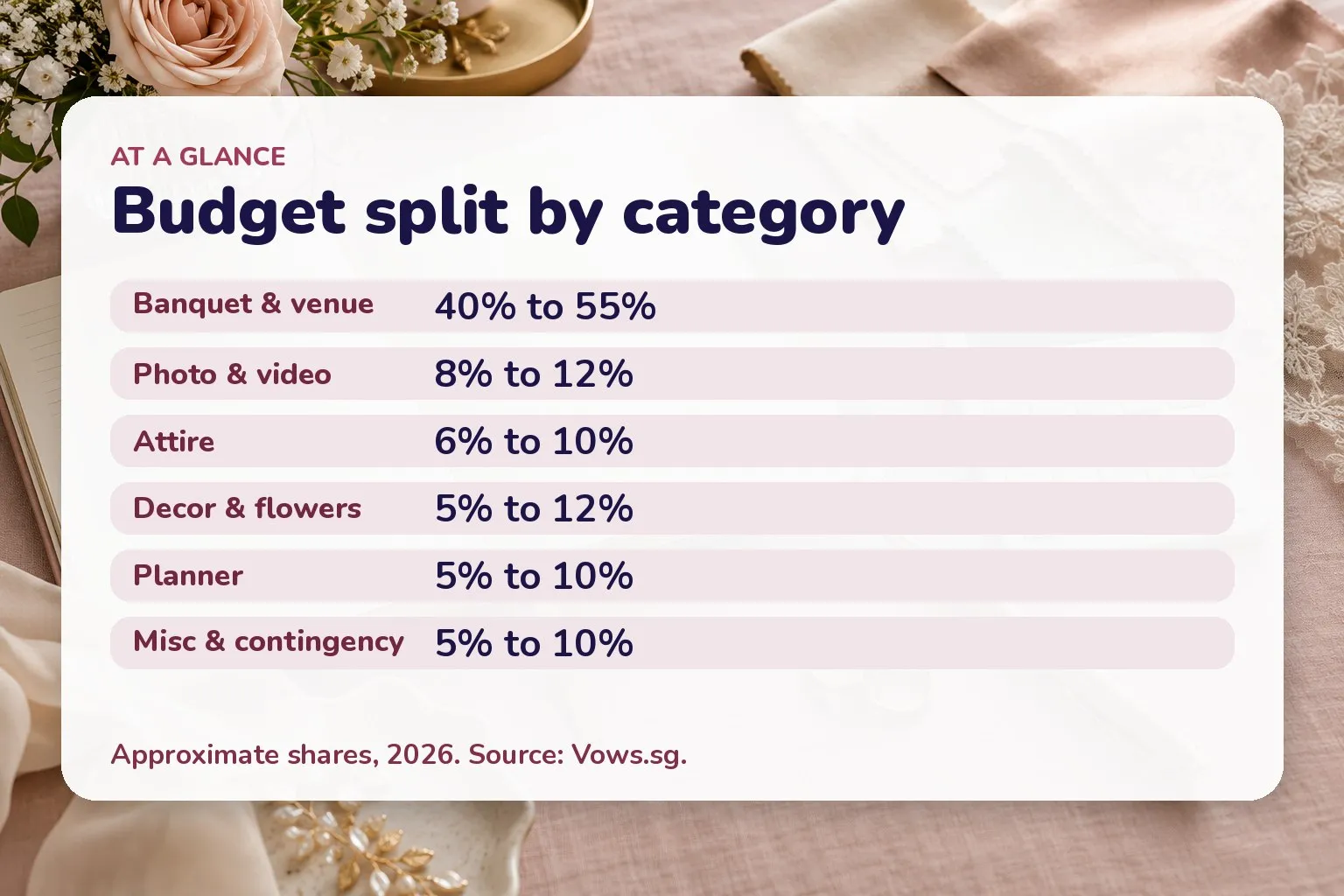
How a Singapore wedding budget typically splits by category (approximate shares, 2026). Source: Vows.sg.
- Banquet & venue — 40% to 55%. Vows.sg notes this alone “will eat up 40–55% of your total budget”, so it sets the shape of everything else.
- Photography & videography — 8% to 12%.
- Bridal attire & accessories — 6% to 10%.
- Decorations & flowers — 5% to 12%.
- Wedding planner or coordinator — 5% to 10%.
- Entertainment & music — 3% to 7%.
- Makeup & hairstyling — 2% to 5%.
- Transport — 1% to 3%; stationery — 1% to 2%.
- Miscellaneous & contingency — 5% to 10%.
Two big items usually sit outside this split because couples fund them separately: wedding rings (S$2,000–S$6,000) and the honeymoon (S$5,000–S$10,000+). Decide early whether they come from the same pot or a different one, so they don’t ambush the total.
The only fixed official line: the ROM fee
Everything in the split moves except one line. The civil marriage-application fee is S$42 if at least one of you is a Singapore Citizen or PR, or S$380 if both are foreigners; changing the solemnisation details afterwards costs S$25. You must submit the application at least 21 days before the solemnisation. Muslim couples register through ROMM instead. As Vows.sg puts it, “a ROM ceremony at the Registry of Marriages costs as little as $42 for the application fee” — the cheapest legal route to being married, before any celebration is added. The step-by-step is in the ROM guide.
Build the banquet share in nett dollars
Because the banquet anchors the whole budget, get its number right, and that means nett, not “++”. IRAS confirms the current GST rate is 9%, and in the hotel and F&B sector a service charge “typically at 10%” is itself subject to GST, calculated on the price inclusive of the service charge. IRAS’s own worked example: S$100 of food plus a S$10 service charge is S$110, and 9% GST on S$110 is S$9.90 — a total of S$119.90, about 20% above the headline. Vows.sg runs the same arithmetic on a table: “a $2,500++ table actually costs you about $2,998 nett. On a 20-table banquet, that’s an extra $9,960”. Budget the nett figure from the start so the 40–55% share is honest. The mechanics are covered further in how to save on your wedding.
The lines couples leave out
The forgotten costs are rarely huge on their own, but together they can swallow the contingency. These are approximate 2026 third-party ranges from Vows.sg:
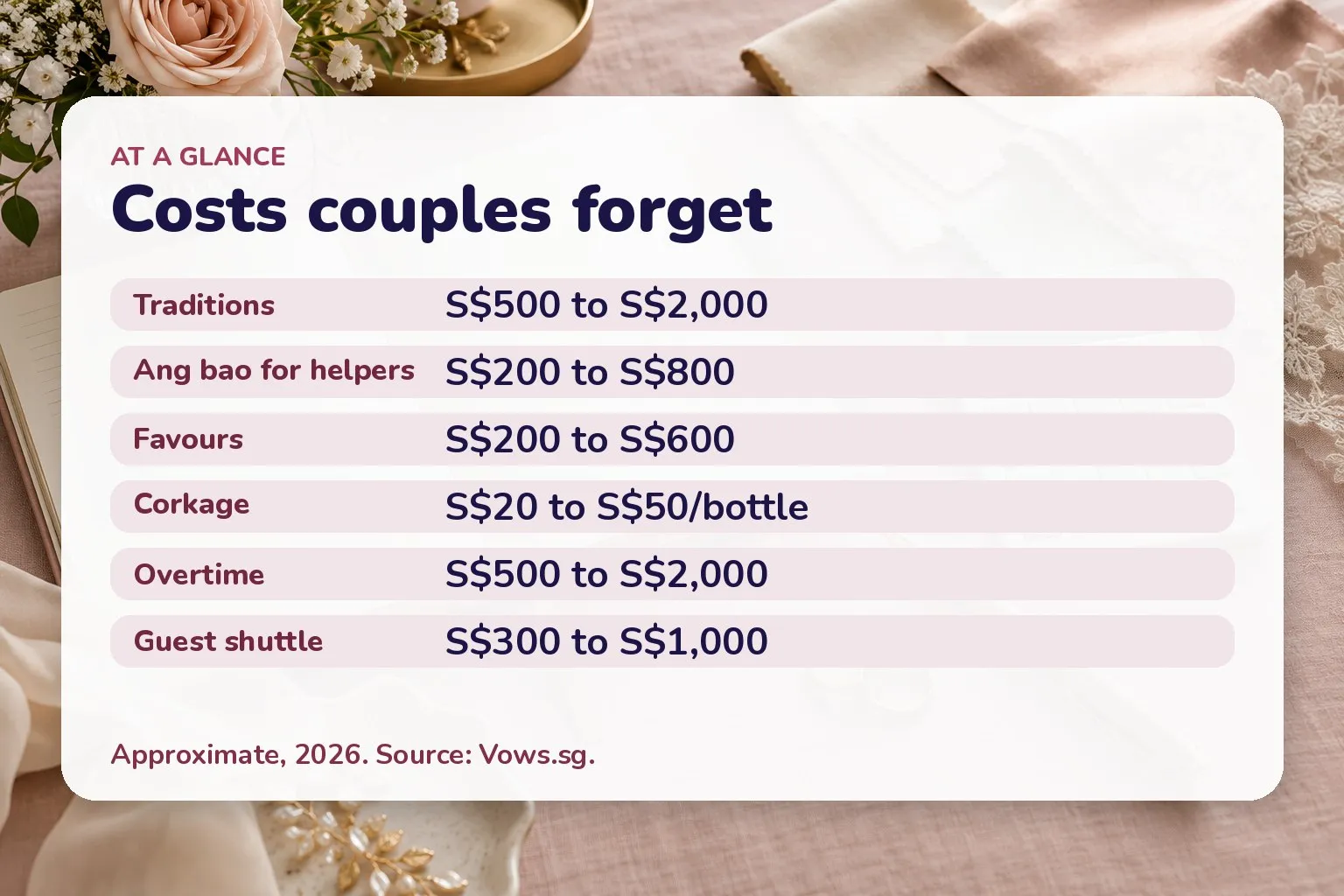
Lines that often sit outside the headline budget (approximate, 2026). Source: Vows.sg.
- Traditions: S$500–S$2,000 for betrothal gifts, a tea ceremony set and related items.
- Ang bao for helpers: S$200–S$800 total, for gatecrash, drivers, emcee and photographer.
- Wedding favours: S$200–S$600; a dai kum jie (wedding chaperone): S$200–S$500.
- Corkage: S$20–S$50 per bottle if you bring your own wine or liquor.
- Overtime: S$500–S$2,000 if the event runs past the contracted time.
- Menu upgrades: S$100–S$300 per table; guest shuttle bus: S$300–S$1,000.
Keep a contingency
A contingency is a category, not an afterthought. Vows.sg bundles miscellaneous and contingency at 5% to 10% of the budget, and the forgotten lines above are exactly what it exists to absorb — a menu upgrade you decide on late, an extra table, overtime on the night. On a mid-range budget a 10% contingency is several thousand dollars that keeps a surprise from becoming a scramble. Fund it first, and only draw on it when you must.
Count ang bao as an offset, not a plan
Many couples quietly assume guest ang bao will wipe out the bill. It usually offsets a good share but rarely clears it. Vows.sg estimates ang bao recovery for a mid-range hotel wedding at about S$30,000–S$37,500, based on S$200–S$250 per guest. Against a S$50,000 budget that still leaves a real out-of-pocket gap — and guest counts drop, some give less, and costs creep. Plan around the net you can genuinely afford to pay, then let ang bao reduce it. The same source is blunt about borrowing the difference: “we’d strongly advise against” a wedding loan.
The same categories at three budgets
The split holds its shape across very different totals; only the dollars change. Vows.sg’s three worked scenarios show it: an intimate ~S$24,000 wedding (80 guests at a restaurant), a mid-range ~S$50,000 wedding (150 guests at a four-star hotel), and a luxury ~S$95,000+ wedding (250 guests at a five-star hotel). In every one, the banquet is the largest block and the smaller categories scale around it. That is the point of budgeting by percentage: pick your total, apply the shares, and you have a realistic first draft to refine. Put the numbers into the wedding budget calculator and sequence the commitments with the planning timeline.
Frequently asked questions
What share should the banquet take? Around 40% to 55% of the total, per third-party tracking — it is almost always the biggest single line, so size it first and build the rest around it.
What is the one cost I can rely on? The ROM marriage-application fee: S$42 if at least one of you is a Singapore Citizen or PR, or S$380 if both are foreigners. Everything else is an estimate that moves with your choices.
How much contingency should I keep? A common planning figure is 5% to 10% of the budget. It absorbs the forgotten lines — overtime, extra tables, late upgrades — so keep it funded and separate.
Will ang bao cover the wedding? Usually not. It offsets a large share, often around S$200–S$250 per guest at a hotel, but plan for the net amount you must still pay yourself.
Should I take a wedding loan to close the gap? The weight of planning advice, including Vows.sg, is against it; scaling the guest list or extending the engagement to save more is the safer route.
Where to go next
Sources
- What are the fees for the various Registry of Marriages (ROM) services? — Our Marriage Journey (Registry of Marriages) (as of November 2026)
- Submit marriage application (fees and notice period) — Our Marriage Journey (Registry of Marriages) (as of November 2026)
- GST: what it is and how it works (current rate 9%) — Inland Revenue Authority of Singapore (IRAS) (as of November 2026)
- GST: Hotel and Food & Beverage (service charge and GST method) — Inland Revenue Authority of Singapore (IRAS) (as of November 2026)
- Wedding Cost Singapore 2026: breakdown by category — Vows.sg (third-party; approximate ranges) (as of November 2026)