Do Married Couples File Taxes Separately in Singapore?

Yes. Singapore has no joint tax return: each spouse is assessed as an individual, files their own return and gets their own tax bill. Marriage changes your tax only through the reliefs you each claim — and a few, like child reliefs and the rebate, you can split.
On this page11 sections · tap to jump
- 01Each spouse files on their own
- 02Does your spouse’s income touch your bill?
- 03Who must file, and the deadlines
- 04Two people, two Notices of Assessment
- 05What you CAN share across two returns
- 06Who should claim what
- 07The S$80,000 cap is per person
- 08If one spouse is a non-resident
- 09Fixing a wrong split
- 10Frequently asked questions
- 11Where to go next
A common newlywed question is whether getting married means filing one combined tax return. In Singapore the answer is the opposite of what couples coming from the US or the UK often expect: there is no joint return at all. Each spouse is taxed as an individual, files on their own, and receives their own bill. What marriage changes is not how you file but what you can claim — and, crucially, how you divide a handful of shared reliefs between two separate assessments. This guide explains the filing mechanics for a married couple and the one decision that actually moves your combined bill. For the amounts and conditions of each relief, see our companion guide to tax reliefs for married couples.
Each spouse files on their own
Singapore’s income tax is assessed per individual, not per couple. There is no joint tax return and no option to elect for one, and there is no married-person allowance that automatically lowers your bill. Each person files their own Income Tax Return through myTax Portal using their own Singpass, is taxed on their own income at their own rates, and claims the reliefs they personally qualify for.
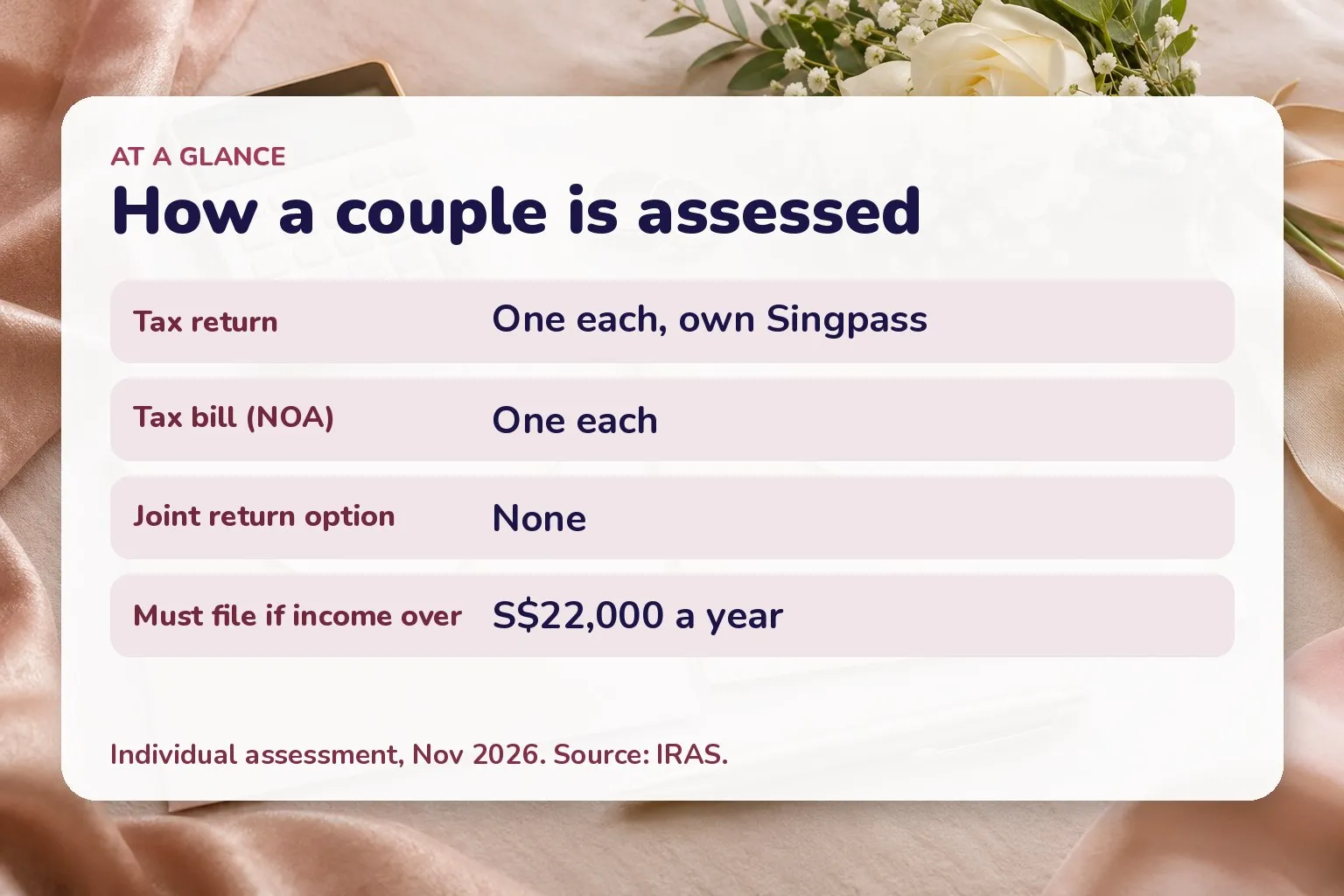
Married couples are assessed as two individuals. Source: IRAS, as of November 2026.
That means the mechanics are the same whether you are single or married. You must file a return if, in the preceding calendar year, your total income was more than S$22,000, or you had self-employment net profit over S$6,000, or you are a non-resident who earned Singapore income. Marriage does not merge these obligations — each of you is tested, and files, on your own figures.
Does your spouse’s income touch your bill?
Almost never. Your spouse’s income does not get added to yours, and it does not push you into a higher bracket. The one way it matters is Spouse Relief: you can claim S$2,000 for supporting a spouse only if that spouse’s annual income was not more than S$8,000 in the preceding year. Earn above that and the relief is simply unavailable — but your own tax is otherwise unaffected by what your spouse earns.
This is why a dual-income couple is not penalised for marrying. Each spouse keeps their own tax-free threshold and their own low starting rates; two moderate incomes assessed separately generally attract less tax than the same total earned by one person and taxed as a single rising stack.
Who must file, and the deadlines
Filing season opens on 1 March each year. For most couples it is light work: IRAS says tax filing “is a simplified event for 8 in 10 taxpayers” because employers submit income under the Auto-Inclusion Scheme, and many are placed on the No-Filing Service — “you do not even have to file a tax return,” you just check the pre-filled income and relief information is correct. Those who do need to file generally do so between 1 March and 18 April.
Each spouse handles their own filing or verification. One of you being on the No-Filing Service does not do anything for the other; log in to each account separately and check each set of pre-filled figures.
Two people, two Notices of Assessment
After assessment, each spouse receives their own Notice of Assessment (NOA) — the tax bill — computed on that person’s income and reliefs. There is no combined household bill to reconcile. If anything is wrong on your NOA, IRAS expects you to use the “Amend Tax Bill” digital service within 30 days of the bill’s date, and notes you have a legal duty to flag inaccurate income or relief claims. Because the two bills are independent, a correction on one spouse’s NOA does not automatically change the other’s — if a shared relief was split wrongly, both returns may need adjusting.
What you CAN share across two returns
Here is where “separate filing” stops being a mere formality and starts to matter. A few family tax benefits are claimable by both parents, and IRAS expects couples to decide the split: “some reliefs are claimable by both mum and dad so couples can have a frank discussion on how to split these reliefs.” The shareable items a married couple most often meets:
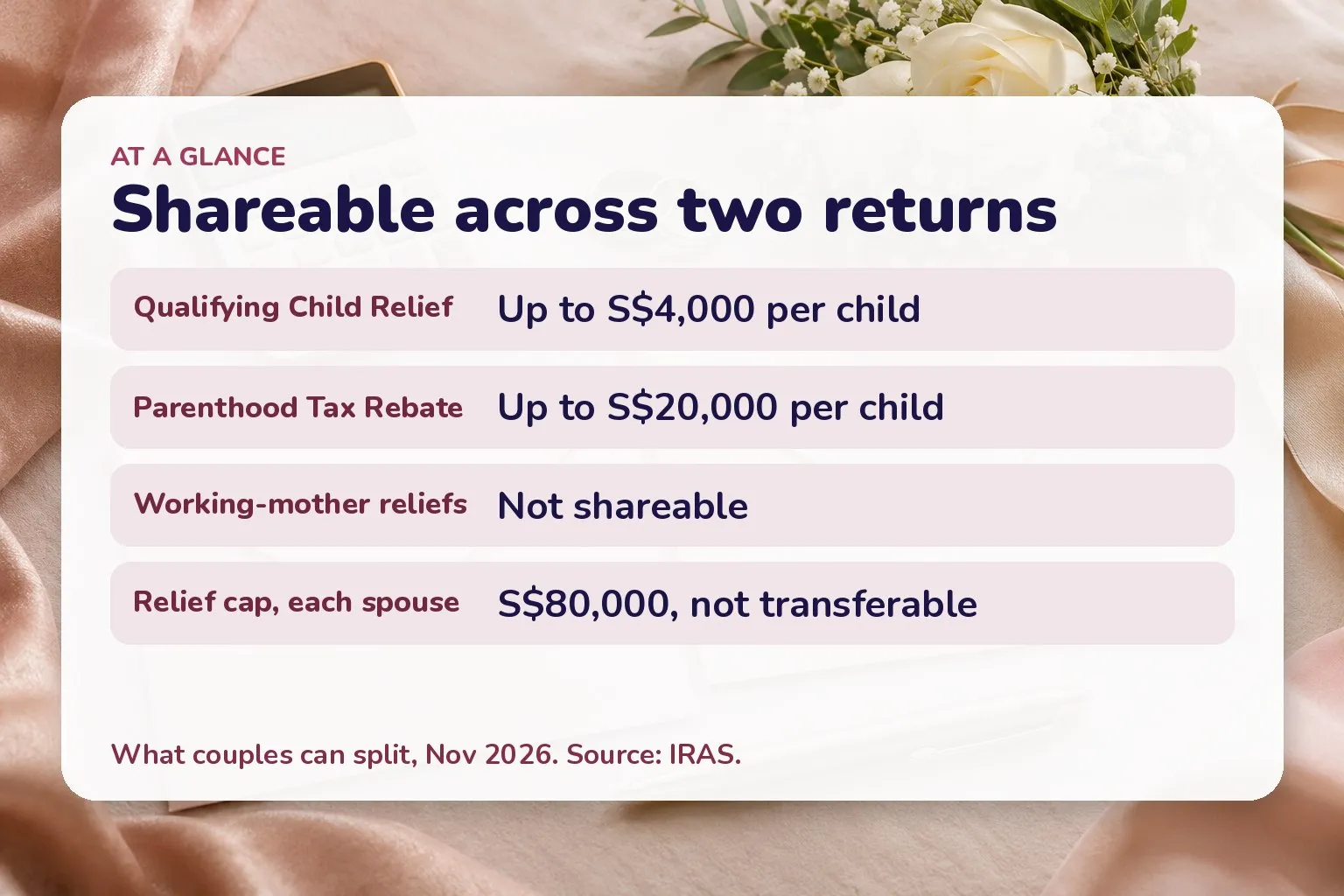
Which family tax benefits a couple can split between two returns. Source: IRAS, as of November 2026.
- Qualifying Child Relief (QCR) — up to S$4,000 per child, which you can apportion between the two of you by an agreed percentage, as long as the total per child does not exceed the cap.
- Parenthood Tax Rebate (PTR) — a one-off rebate of up to S$20,000 per child, and you “can share the PTR with your spouse based on an agreed percentage share,” with any unutilised balance carried forward automatically to offset future tax.
Note the distinction: QCR is a relief (it reduces the income you are taxed on), while the PTR is a rebate (it reduces the tax itself, after it has been worked out). The PTR’s leftover can roll forward for years; a wasted relief cannot.
Who should claim what
Since each spouse is taxed separately, where you place a shareable relief changes the household result. Two principles help:
- Put a relief where it does the most work. A relief is worth more to the spouse whose top slice of income is taxed at a higher rate, because it removes income that would otherwise be taxed hardest. If both of you sit in the same rate band, the split makes no difference to the total.
- Respect each person’s own cap. The S$80,000 relief cap (next section) is individual, so loading everything onto one spouse can waste relief above that spouse’s ceiling. IRAS’s own advice if you are near the cap is to “consider giving up certain reliefs … and let others (e.g. your spouse) claim the reliefs, provided that they satisfy the conditions.”
The S$80,000 cap is per person
There is a ceiling on the whole exercise, and it is individual. A personal income tax relief cap of S$80,000 per Year of Assessment applies to the total of all reliefs you claim. If your reliefs exceed it, the excess is “disregarded … and cannot be transferred” to your spouse. That is the sharpest reason the couple’s filing is truly separate: there is no pooling of unused allowance. The planning response is to steer shareable reliefs toward the spouse who still has room under their own cap.
If one spouse is a non-resident
Marriage does not change tax residency. A non-resident spouse who derived income from Singapore “is required to file an Income Tax Return, regardless of how much” they earned, and is taxed under the non-resident rules — separately from the resident spouse, as always. Reliefs, meanwhile, are only available to a tax resident, so a non-resident spouse generally cannot claim the personal reliefs even though they still file. If one of you is a foreign spouse, the residence side is covered in our guide to applying for PR after marrying a Singaporean.
Fixing a wrong split
Because the two returns are independent, correcting a mis-allocated shareable relief can touch both. Use Amend Tax Bill in myTax Portal within 30 days of each affected NOA. Getting married is also a good prompt to tidy the admin that feeds your tax profile — for instance, if either of you is changing your name after marriage, update it with the relevant agencies so your records match. For the wider cost picture of the wedding itself, see how much a wedding really costs here.
Frequently asked questions
Can married couples file taxes jointly in Singapore? No. Each spouse files their own return and is assessed on their own income; there is no joint return and no option to elect for one.
Will marrying push me into a higher tax bracket? No. Your spouse’s income is not added to yours. The only link is Spouse Relief, which you lose if your spouse earned more than S$8,000.
Do we each get a separate tax bill? Yes. Each spouse receives their own Notice of Assessment and can amend it within 30 days.
Is a single-income household taxed more than a dual-income one? For the same total income, generally yes — because each spouse separately enjoys the tax-free threshold and the lower starting rates.
We share child relief — does the split matter? It can. Placing QCR or the Parenthood Tax Rebate with the spouse who benefits more (higher rate, or room under the S$80,000 cap) lowers the household total; agree the percentages before you file.
Where to go next
- Tax reliefs for married couples — the amounts and conditions for each relief and rebate
- Changing your name after marriage
- Applying for PR after marrying a Singaporean
- How much a wedding really costs here
Sources
- Individuals required to file tax (who files, own return, own NOA) — Inland Revenue Authority of Singapore (IRAS) (as of November 2026)
- Tax savings for married couples and families (sharing, worked examples) — Inland Revenue Authority of Singapore (IRAS) (as of November 2026)
- Tax reliefs and the $80,000 personal income tax relief cap — Inland Revenue Authority of Singapore (IRAS) (as of November 2026)
- Parenthood Tax Rebate (PTR) — sharing and carry-forward — Inland Revenue Authority of Singapore (IRAS) (as of November 2026)
- 5 tips for tax filing for married couples and families — Inland Revenue Authority of Singapore (IRAS) (as of November 2026)
- Spouse Relief / Spouse Relief (Disability) — Inland Revenue Authority of Singapore (IRAS) (as of November 2026)