ROMM vs ROM: Muslim vs Civil Marriage Cost

Neither is a free choice — your religion sets the registry. The civil ROM licence is S$42 (both foreigners S$380); the Muslim ROMM application is S$39 (both foreigners S$128). ROMM adds a compulsory mas kahwin of at least S$100. Both registries require at least 21 days' notice.
On this page12 sections · tap to jump
- 01The headline fee: S$42 vs S$39
- 02The real out-of-pocket, start to finish
- 03Costs only a Muslim marriage has
- 04The civil (ROM) process, step by step
- 05The Muslim (ROMM) process, step by step
- 06Documents each path needs
- 07Timelines and notice compared
- 08Marriage preparation: who must, and the cost
- 09Can you choose the cheaper one?
- 10Witnesses and the wali
- 11Frequently asked questions
- 12Where to go next
Couples often ask whether the civil Registry of Marriages (ROM) or the Registry of Muslim Marriages (ROMM) is cheaper and faster. It is a fair question, but the honest cost answer comes with a bigger one attached: you do not choose the registry — your religion does. This page is about the money and the steps once that is settled: what each path actually costs end to end, the documents, the timelines and the process in order. For the rule on which registry applies to you, see our dedicated guide to ROM vs ROMM and who qualifies.
The headline fee: S$42 vs S$39
For a civil (ROM) marriage, the licence is S$42 where at least one of you is a Singapore Citizen or Permanent Resident, and S$380 where both of you are foreigners. For a Muslim (ROMM) marriage, the application with the wali’s consent is S$39 where at least one is a citizen or PR, and S$128 where both are foreigners. For local couples the difference is three dollars; for all-foreigner couples ROMM is actually the cheaper filing. Either way, the registry fee is a rounding error against the cost of a wedding — which is exactly why it should never drive the decision.
The real out-of-pocket, start to finish
The licence is not quite the whole official cost. Here is what each path actually costs you, before any banquet or vendor:
| Official cost | Civil (ROM) | Muslim (ROMM) |
|---|---|---|
| Application / licence (≥1 SC/PR) | S$42 | S$39 |
| Application (both foreigners) | S$380 | S$128 |
| Compulsory mas kahwin (groom to bride) | — | at least S$100 |
| Solemniser fee at a Registry site | None (volunteer) | None at ROMM |
| Change of solemnisation details | S$25 | S$15 |
| Minimum mandatory out-of-pocket (local, at the registry) | S$42 | about S$139 |
Official ROM and ROMM figures, as of November 2026. Source: Our Marriage Journey. The mas kahwin is the bride’s property, not a government fee.
The key difference is the mas kahwin: a Muslim marriage has a compulsory gift that a civil marriage has no equivalent of, so a local Muslim couple’s minimum official out-of-pocket at the registry is nearer S$139 than S$39 — though the mas kahwin goes to the bride, not the state. A civil couple solemnising at a Registry site pays just the S$42 and nothing more.
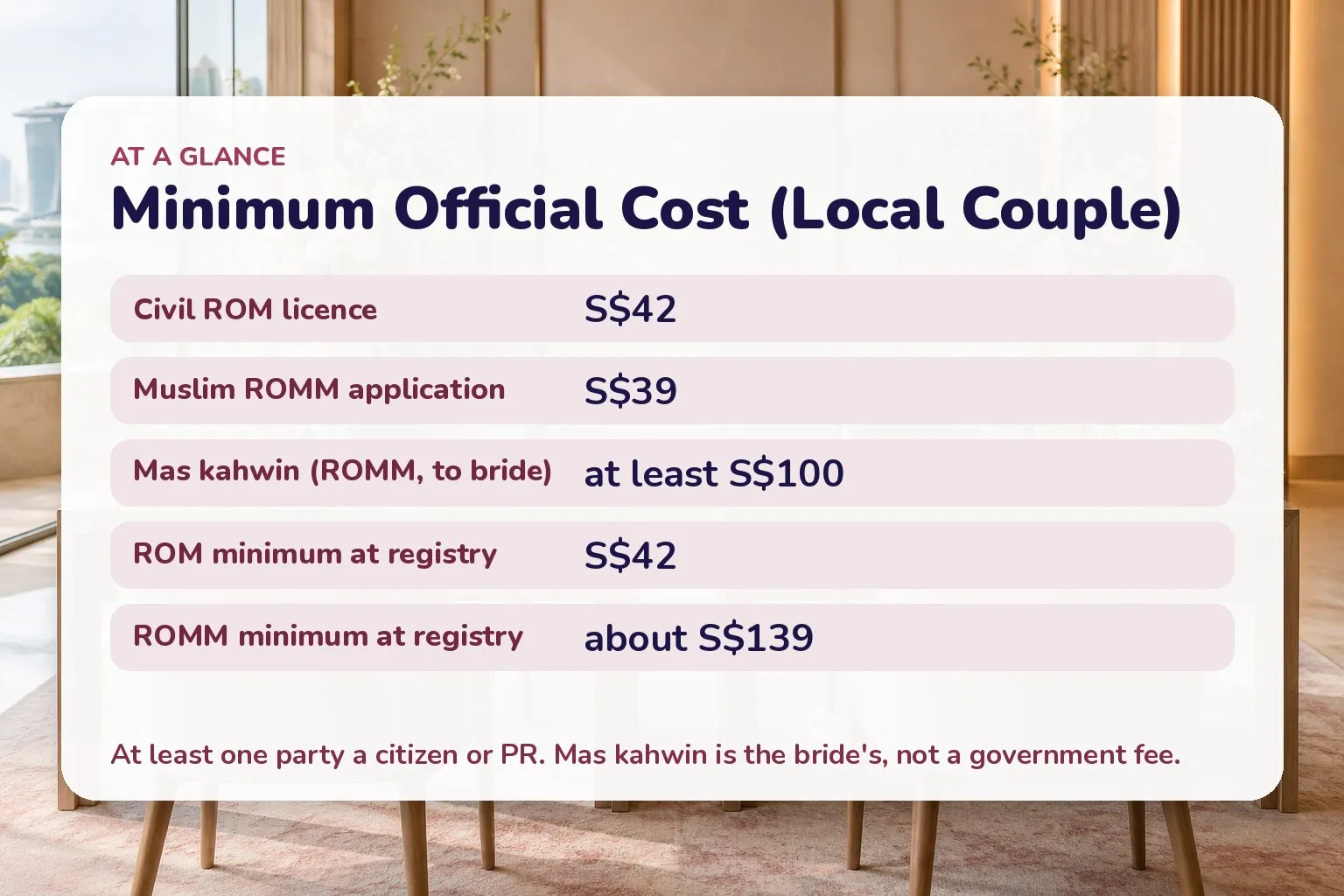
Minimum official cost at the registry for a local couple (at least one SC/PR). Source: Our Marriage Journey (ROM and ROMM), as of November 2026.
Costs only a Muslim marriage has
Two items sit on the ROMM side with no civil counterpart:
- The mas kahwin (mahar). A compulsory gift from groom to bride, given at the solemnisation; its current minimum in Singapore is S$100 cash (it can also be gold or a ring). It belongs to the bride and she keeps it. It is declared on the application and recorded by ROMM.
- A marriage preparation course with a socio-religious element. Most Malay/Muslim couples attend a two-day programme such as Cinta Abadi, which covers socio-religious content and is longer than the civil course; its fees vary by operator.
A separate, optional customary gift — the hantaran, exchanged between families — is often confused with the mas kahwin but is not a registry requirement and is not recorded by ROMM. The cultural ceremonies around a Malay-Muslim wedding are described neutrally in our Malay-Muslim traditions guide.
The civil (ROM) process, step by step
A civil marriage is handled on the Our Marriage Journey portal in three stages:
- Submit the application online with Singpass, within the filing window (below), paying the S$42 or S$380 licence fee.
- Make the declaration — eligible couples (both 21+, first marriage, applying jointly) declare online with no appointment; everyone else attends a Verification of Documents and Declaration, in person or by video link.
- Solemnise and register on the day: a licensed solemniser conducts the ceremony before two witnesses aged 21 or older, and registers the marriage. You receive a digital certificate within about a week.
Licensed civil solemnisers are volunteers, so there is no official fee for one; at an external venue a token of appreciation is customary but not required. The full detail is in our complete ROM guide.
The Muslim (ROMM) process, step by step
A Muslim marriage follows a parallel path with extra, faith-specific steps:
- Check eligibility. Both parties must be Muslim (a convert needs an MCAS conversion card, or conversion documents plus a MUIS endorsement letter for an overseas conversion), both at least 21, and neither currently married.
- Secure the wali’s consent and settle the mas kahwin. The bride’s wali (lawful guardian) must consent; the couple agree the mas kahwin (minimum S$100) and any optional hantaran, declared on the application.
- Submit the application on Our Marriage Journey and choose a Kadi or Naib Kadi.
- Attend verification with the wali and original documents.
- Solemnise the akad nikah before the wali and two male witnesses above 21, after which the marriage is registered and a digital certificate issued.
For an offsite ceremony an honorarium to the Kadi or Naib Kadi is customary; there is none when you solemnise at ROMM. The full walk-through is in our ROMM marriage guide.
Documents each path needs
Both start with identity documents — NRIC for citizens and PRs, passport for foreigners — and divorce or death papers if either of you was previously married. The differences:
- Civil (ROM): both parties’ IDs plus the two witnesses’ IDs; where either of you is a foreigner, at least one party must have been physically present in Singapore for 31 continuous days before applying.
- Muslim (ROMM): the IDs of the groom, bride and the bride’s wali; for Malaysian, Indonesian or Bruneian citizens a letter of non-impediment no more than 90 days old; a convert’s MCAS card or MUIS endorsement.
Timelines and notice compared
Both registries ask for at least 21 days’ notice before the solemnisation, but the validity windows differ. A civil (ROM) application may be filed up to six months ahead and stays valid for 6 months, lapsing automatically if you do not marry. A ROMM marriage must be solemnised within 21 to 150 calendar days of the application; miss that and you file afresh. In practice both are generous, but the ROMM window is the shorter of the two, so Muslim couples have a little less room to postpone.
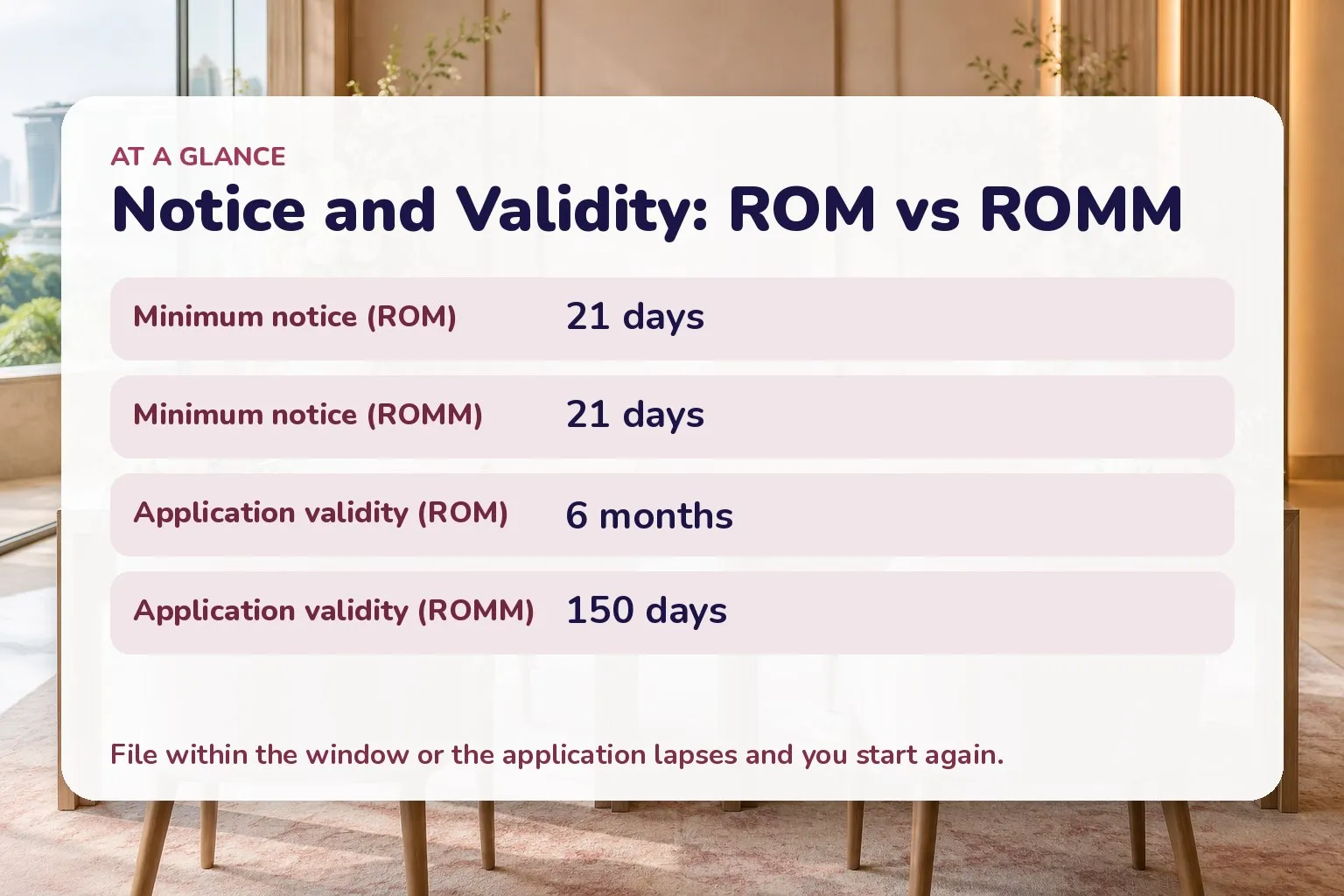
Notice and validity windows for each registry. Source: Our Marriage Journey (ROM and ROMM), as of Nov 2026.
Marriage preparation: who must, and the cost
For civil couples, a Marriage Preparation Programme is mandatory before applying only if either of you is below 21 (and a citizen or PR); for couples both 21 or older it is highly encouraged, and the mandatory version is complimentary. Muslim couples follow their own track — Cinta Abadi (CA Prep), supported by MSF, MUIS and ROMM — which is similarly compulsory for minors and recommended for first marriages; CA Prep fees vary by operator. Our Marriage Preparation Programme guide covers the civil course in detail.
Can you choose the cheaper one?
No — and this is the verdict. On paper the civil route is marginally cheaper for a local couple at the registry (S$42 versus the S$39 application plus the S$100 mas kahwin that the bride keeps), and it has the longer validity window. But the comparison is academic: the registry is fixed by whether both of you are Muslim, not by price or speed. A couple who are both Muslim cannot register civilly at ROM; a couple where either is non-Muslim cannot register at ROMM. The useful takeaway is not “which is cheaper” but “budget correctly for the path that already applies to you” — and in both cases the official cost is tiny next to the wedding itself (what a wedding costs here).
Witnesses and the wali
The witness rules are a practical difference worth planning for. A civil marriage accepts any two witnesses aged 21 or older. A Muslim marriage needs two male witnesses above 21 and, additionally, the bride’s wali to consent and either conduct or authorise the akad nikah. Line these people up early for a ROMM ceremony — the wali requirement in particular has no civil equivalent, and sorting it late is a common scramble.
Frequently asked questions
Is ROM or ROMM cheaper? At the registry, a local civil marriage is S$42; a local Muslim marriage is the S$39 application plus a mas kahwin of at least S$100 that the bride keeps. For all-foreigner couples ROMM (S$128) is cheaper than ROM (S$380). But you cannot choose on price.
Why can’t we just pick the cheaper registry? Because the law assigns it: both Muslim means ROMM, either non-Muslim means ROM. Fee and validity do not come into it.
Does the mas kahwin go to the government? No. The mas kahwin is a gift from groom to bride; it belongs to the bride and she keeps it. Only the application fee goes to the registry.
Are the witness requirements different? Yes. Civil marriages need two witnesses aged 21 or older of any gender; Muslim marriages need two male witnesses above 21, plus the bride’s wali’s consent.
Do both need a marriage preparation course? It is mandatory only when either party is under 21; otherwise it is encouraged. Civil couples use the Marriage Preparation Programme; Muslim couples use Cinta Abadi.
For any religious question about your marriage, consult MUIS or a qualified Asatizah. This guide compares the official registration cost and process only.
Where to go next
Sources
- What are the fees for the various Registry of Marriages (ROM) services? — Our Marriage Journey (Registry of Marriages) (as of November 2026)
- How much is the fee for marriage application at ROMM? — Our Marriage Journey (Registry of Muslim Marriages) (as of November 2026)
- What is a Maskahwin / Mahar? (minimum S$100) — Our Marriage Journey (Registry of Muslim Marriages) (as of November 2026)
- Who can apply for a marriage with the Registry of Muslim Marriages? — Our Marriage Journey (Registry of Muslim Marriages) (as of November 2026)
- What is the '21-day notice' and '6-month validity period'? — Our Marriage Journey (Registry of Marriages) (as of November 2026)
- How early can I book solemnisation date? (ROMM: 21 to 150 days) — Our Marriage Journey (Registry of Muslim Marriages) (as of November 2026)
- Is the Marriage Preparation Programme mandatory before a marriage application? — Ministry of Social and Family Development (as of November 2026)
- Who can be witnesses to a marriage? (above 21 years old) — Our Marriage Journey (Registry of Marriages) (as of November 2026)