Auspicious Wedding Dates 2027 in Singapore
Auspicious 2027 wedding dates come only from the Chinese almanac (Tong Shu), not any official calendar; the lists cluster them in January, May and September to December and avoid the seventh lunar month (2 to 31 August 2027). Only the S$42 ROM licence and 21-day notice are official.
On this page10 sections · tap to jump
- 01What makes a date auspicious (Tong Shu, bazi, zodiac)
- 02Auspicious wedding dates in 2027 (as listed in the almanac)
- 032027’s catch: very few auspicious Saturdays
- 04Dates and periods many families avoid in 2027
- 05Why two almanacs give different dates
- 06Booking your ROM around an auspicious date
- 07What a popular date does to venue price and availability
- 08When your auspicious date is a weekday
- 09Frequently asked questions
- 10Where to go next
If your family follows Chinese customs, picking the day often comes before picking the venue — and the day is chosen from the almanac, not the calendar on your wall. This guide lists the 2027 dates commonly cited as auspicious, flags the handful that fall on a Saturday, explains the periods many families steer clear of, and sets out the one part of the process that is official: how early you can actually book your civil ROM date. The dates themselves are tradition; treat them as a starting shortlist, not a rule.
What makes a date auspicious (Tong Shu, bazi, zodiac)
An auspicious wedding date is a day the Tong Shu (通书), the Chinese Farmer’s Almanac, deems favourable for marriage. The almanac weighs lunar cycles, the Five Elements, zodiac compatibility and Feng Shui to mark which days suit major events — and the Chinese Fortune Calendar estimates that more than 80% of Chinese families consult it, or a tung shu master, to find a wedding day. A “general” good date applies broadly, but the best day for a specific couple depends on their bazi (八字) — each partner’s birth date and time.
Two refinements matter in practice. First, each listed date carries a conflicting zodiac sign: if either partner (and in some families a parent) belongs to that sign, the custom is to pick a different day. Second, a date on the general list can still turn out wrong once a couple’s bazi is factored in. That is why most planners suggest shortlisting two or three dates and, if the family is strict, confirming with a master — a Tong Shu date consultation typically runs S$80-300 (approximate, Vows.sg / CMG Consulting). For how these dates sit inside the wider set of Chinese rites, see our Chinese wedding traditions guide.
Auspicious wedding dates in 2027 (as listed in the almanac)
2027 is the Year of the Fire Goat (丁未年), and Chinese New Year falls on 6 February 2027. The table below lists the days commonly given as auspicious for weddings in 2027, drawn from the Chinese Fortune Calendar’s Tung Shu table (cross-referenced by Vows.sg). Read it as a shortlist to check against your own zodiac and bazi — not as a fixed set.
| Month | Dates commonly listed as auspicious (2027) |
|---|---|
| January | 2 (Sat), 5, 11, 17, 27 |
| February | 5, 11, 17, 21 |
| March | 1, 4, 18 |
| April | 8, 15, 23, 24 (Sat), 27 |
| May | 7, 10, 21, 31 |
| June | 3, 9, 16 |
| July | 6, 10 (Sat), 16, 22, 28 |
| August | 1 (then Ghost Month) |
| September | 10, 11 (Sat), 20, 23 |
| October | 18, 30 (Sat) |
| November | 9, 11, 21 |
| December | 6, 7, 12, 16, 24 |
The clusters follow the tradition’s rhythm: a strong run in January, a thin March tied to the approaching tomb-sweeping season, almost nothing usable in August, and a busy September-to-December stretch. That year-end weighting lines up with the official data — SingStat records October and November as the most popular marriage months, with November the single busiest in both 2025 (2,837 marriages) and 2024 (3,144). The wedding season guide breaks that month-by-month pattern down in full.
2027’s catch: very few auspicious Saturdays
Here is the practical twist for 2027: almost none of the auspicious days are Saturdays. On the Chinese Fortune Calendar list, the good days that land on a Saturday are just 2 January, 24 April, 10 July, 11 September and 30 October — five in the whole year, and two of those sit inside less-popular months. Because most couples still want a weekend banquet so guests can attend, that scarcity funnels demand onto a tiny number of slots.
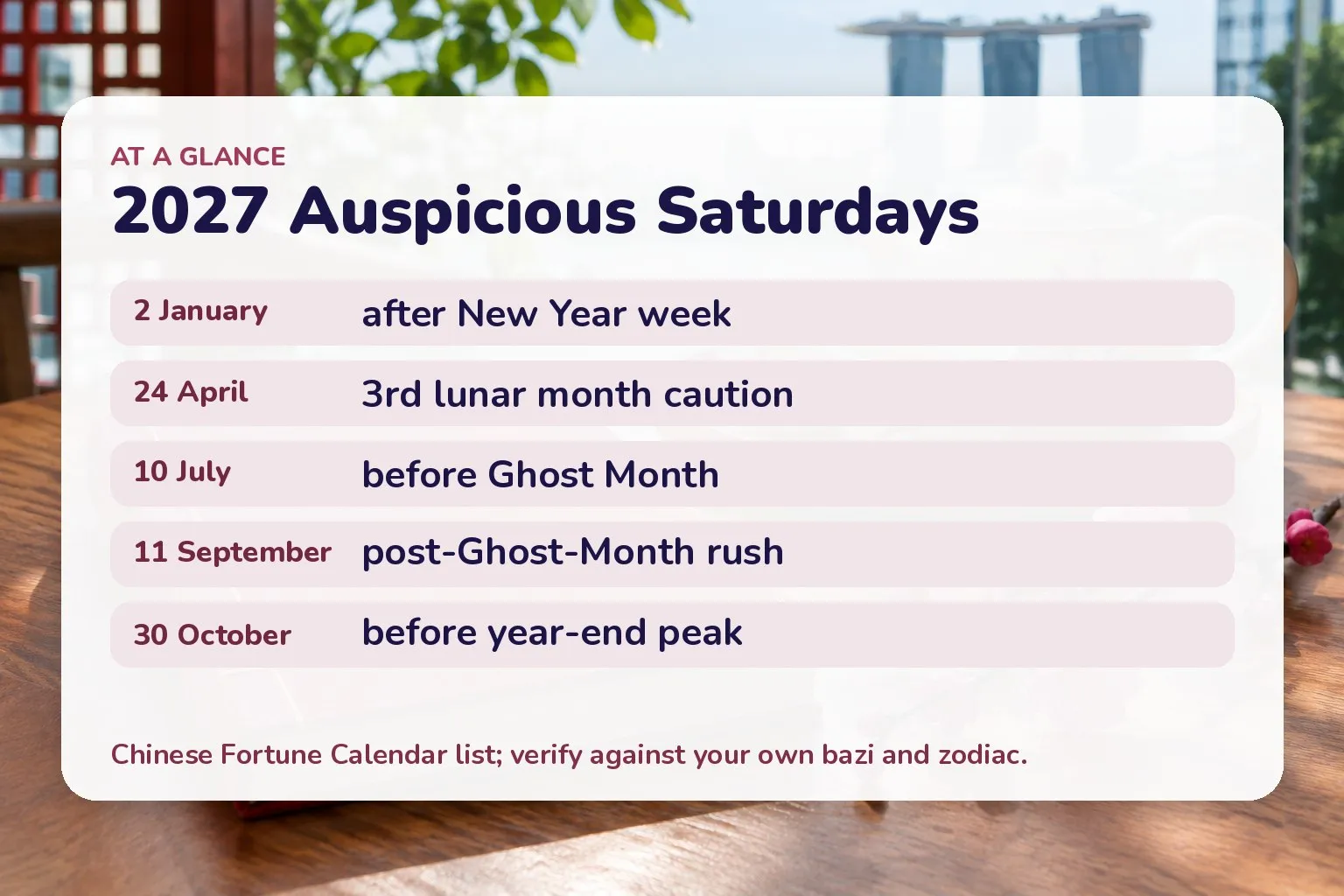
The few 2027 almanac good days that fall on a Saturday. Source: Chinese Fortune Calendar (Tung Shu), 2026.
Dates and periods many families avoid in 2027
Knowing the bad windows matters as much as the good days. Three stand out for 2027:
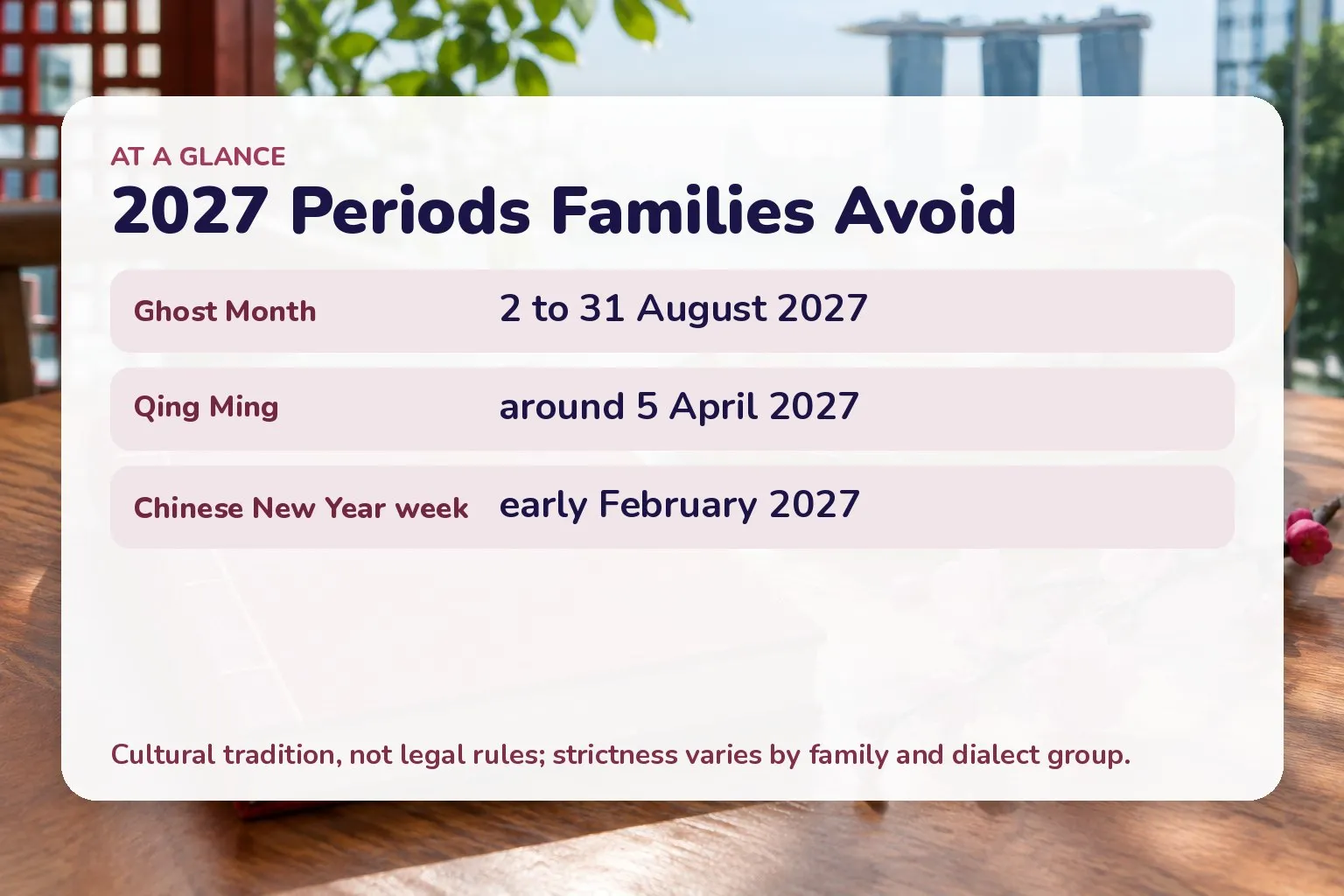
Periods many Chinese families avoid for weddings in 2027. Source: Chinese almanac traditions via Vows.sg / SingaporeBrides, 2026.
- The seventh lunar month (Hungry Ghost Month): 2-31 August 2027, with the Ghost Festival on 16 August. Most traditional families avoid weddings entirely across this month — which is why only 1 August appears as usable before it begins. Some couples do marry then, often at lower venue rates, but expect pushback from older relatives.
- Qing Ming (tomb-sweeping), around 5 April 2027. Some families avoid the ten days before Qing Ming and the whole third lunar month, which is why late March and much of April thin out on the lists.
- Chinese New Year week (early February). Not inauspicious so much as impractical — vendors are on holiday and prices spike around the festival.
Other smaller taboos some families observe include the “Year Breaker” month and Qi Xi (七夕, the “Double Seventh”), which despite its romantic name commemorates separated lovers and is skipped by some for actual weddings.
Why two almanacs give different dates
If you compare lists you will notice they do not fully agree. The Chinese Fortune Calendar’s Tung Shu table and Master David Tong’s list (CMG Consulting), published via SingaporeBrides, give overlapping but distinct 2027 dates, and each SingaporeBrides date is tagged with its conflicting zodiac sign. This is normal: the dates “may vary among different publications of the Tong Shu,” and authentic selection still weighs the couple’s bazi on top. Dialect groups add their own emphasis too — Hokkien and Teochew families tend to follow the almanac closely and avoid the seventh month strictly, while Cantonese and Hakka families are often more flexible. The takeaway is not that one list is “right,” but that you should pick the publication your family trusts and confirm the shortlist against both partners’ signs.
Booking your ROM around an auspicious date
This is the part with hard rules. For a civil marriage you may submit your application up to 6 months in advance, but not less than 21 days before your intended solemnisation date — the 21-day notice is a legal requirement, and once filed the application is valid for 6 months. So you cannot formally lodge the ROM paperwork for a date more than six months out, even if the venue is booked a year ahead. ROM offers roughly 1,200 licensed solemnisers to choose from.
Two edge cases shape the timeline. If one of you is a foreigner, either party must have stayed in Singapore for at least 31 continuous days before the application can be submitted — build that residency in. And whatever date you choose, the only fixed government cost is the S$42 marriage licence (S$380 if both of you are foreigners); the almanac does not change that. Couples syncing a flat purchase should also read how your BTO and ROM date interact.
What a popular date does to venue price and availability
Demand on auspicious weekends shows up in the price. Popular auspicious dates, especially Saturdays, can command premium pricing of roughly 30-50% more than a regular weekend (approximate, Vows.sg), and banquet venues often add a peak-period surcharge of about S$50-200 per table for Saturdays, eves of public holidays and auspicious dates. On a 20-table wedding, even the per-table surcharge alone adds S$1,000-4,000 before the premium. For the whole-budget context, see how much a wedding costs in Singapore.
When your auspicious date is a weekday
Many 2027 auspicious days fall mid-week, and that is not the problem it first seems — it is a saving. A weekday dinner or a Sunday lunch can cost roughly S$100-300 less per table than a Saturday evening (approximate, Vows.sg), so an auspicious Tuesday is both easier to book and cheaper. Couples who want the luck of the date but the convenience of a weekend often split the day: solemnise or hold the tea ceremony on the auspicious weekday, then hold the banquet on the nearest Saturday. Our weekday vs weekend wedding cost guide works through the per-table difference in detail.
Frequently asked questions
Are auspicious dates compulsory in Singapore? No. They are a Chinese cultural tradition from the Tong Shu, not a legal rule — the Registry of Marriages neither recognises nor restricts them. Couples who do not follow the custom can marry on any available day.
Why do the 2027 date lists differ between websites? Because different Tong Shu publications and masters calculate slightly different sets, and authentic selection also depends on the couple’s bazi. Pick the publication your family trusts and cross-check your zodiac signs.
Which 2027 auspicious dates are Saturdays? On the Chinese Fortune Calendar list, 2 January, 24 April, 10 July, 11 September and 30 October 2027. There are few, so they book out early.
Can I marry during Ghost Month if the venue is only free then? Technically yes — no law bars it — but the seventh lunar month, which the almanac lists as 2 to 31 August 2027, is avoided by most traditional families. Some couples proceed anyway, sometimes at lower rates; the deciding factor is whether both families are comfortable.
How far ahead can I lodge my ROM application for an auspicious date? No more than six months before, and no later than 21 days before. Reserve the venue earlier, but the ROM application itself waits for the six-month window to open.
Where to go next
- The civil ROM process and the 21-day notice
- Best dates and wedding season in Singapore, by official data
- Weekday vs weekend wedding: the real cost difference
- Chinese wedding traditions in Singapore
- How much a wedding costs in Singapore, item by item
Auspicious-date lists are cultural tradition and vary by almanac and by a couple’s bazi; this guide describes them neutrally and is not a geomancy ruling. Confirm official fees and timelines at marriage.gov.sg.
Sources
- Auspicious Wedding Dates 2027 — Chinese Farmer's Almanac (Tung Shu) — Chinese Fortune Calendar (third-party almanac; dates vary by publication) (as of 2026)
- Auspicious Wedding Dates 2026/2027 — Master David Tong (CMG Consulting) — SingaporeBrides (third-party almanac; dates vary by publication) (as of 2026)
- Auspicious Wedding Dates in Singapore (2026 & 2027 Guide) — Vows.sg (third-party; approximate ranges) (as of September 2026)
- Civil marriage process (21-day notice, 6-month validity, 31-day residency) — Registry of Marriages, Our Marriage Journey (OMJ) (as of November 2026)
- What are the fees for the various Registry of Marriages (ROM) services? — Our Marriage Journey (Registry of Marriages) (as of November 2026)
- What is the '21-day notice' and '6-month validity period'? — Our Marriage Journey (Registry of Marriages) (as of November 2026)
- Public holidays (2027 calendar) — Ministry of Manpower (MOM) (as of 2027 dates, read November 2026)
- Marriages By Month Of Marriage And Type Of Marriage, Annual — Singapore Department of Statistics (SingStat) (as of 2025 (read November 2026))