Indian Wedding Traditions in Singapore
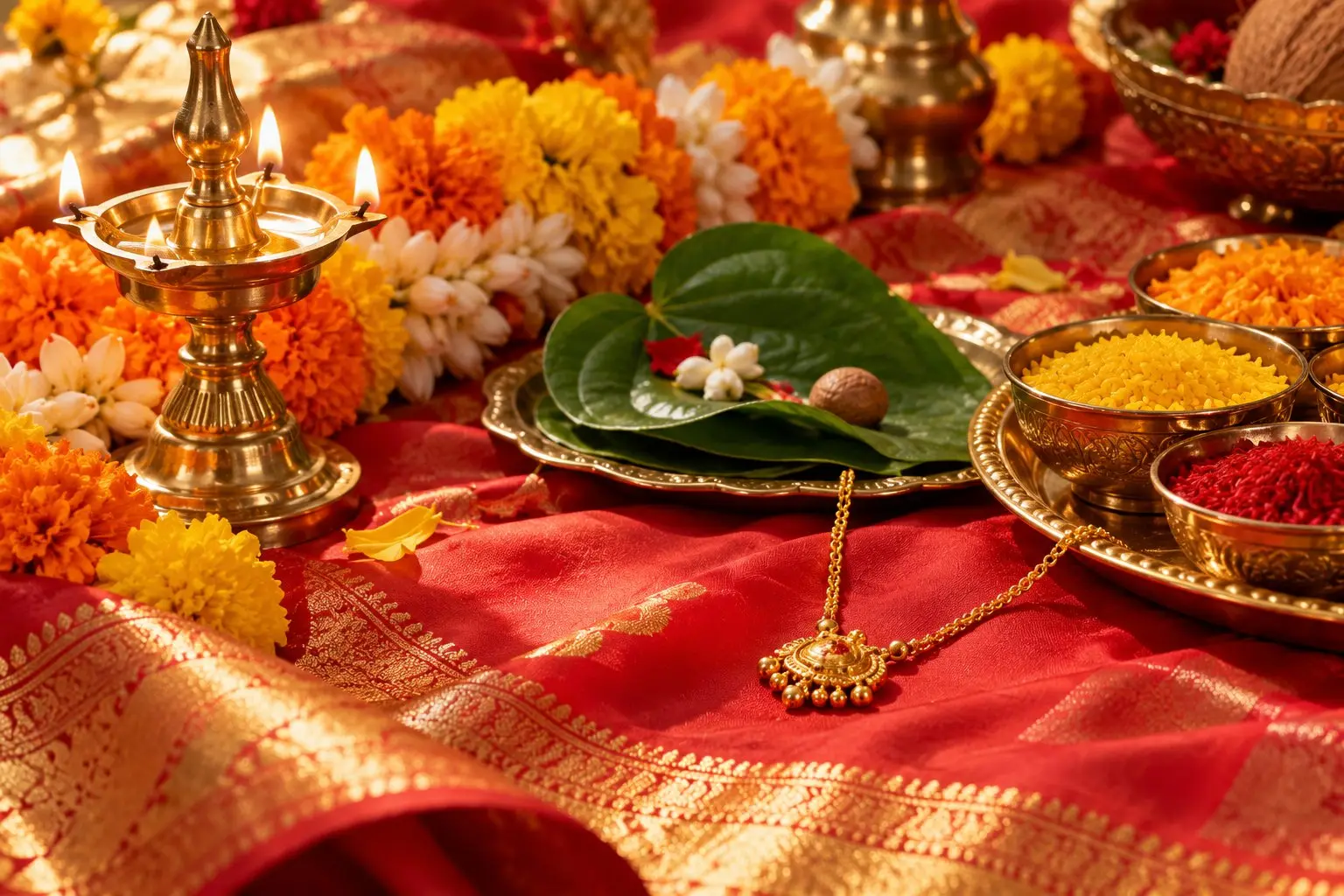
An Indian wedding in Singapore is usually a temple ceremony led by a priest, with the thali, a sacred fire and garland exchange. The rites are cultural; the marriage becomes legal only when a licensed solemniser solemnises it and ROM issues the certificate (S$42, or S$380 if both are foreigners).
On this page8 sections · tap to jump
An Indian wedding in Singapore is really two things happening alongside each other: the religious and cultural ceremony that blesses the union, and the legal registration that records the marriage in law. The ceremony is where the colour, ritual and family meaning live; the registration is a quiet administrative step through the Registry of Marriages (ROM). This is a neutral overview of the most commonly observed customs, drawn from the National Heritage Board’s heritage record, plus how the legal side fits around them. Because practices vary a great deal between communities, treat the rites below as a guide rather than a checklist.
The Tamil-Hindu ceremony, rite by rite
The Heritage Board sets out a recognisable shape for a Tamil-Hindu wedding. It usually takes place in a temple, where a priest officiates and conducts the ceremonial rites. The couple sit at the front of the hall before a ceremonial fire set up together with lamps, flowers and fruits, while the priest chants and confers blessings.
Several symbols carry the meaning. The most significant is the thali — the gold pendant known as thali in the South Indian tradition or mangalsutra in the North — which is “usually given by the groom” and can be made to order by a local goldsmith before the day. The bride also wears a red pottu on her forehead, between the eyebrows.
The ritual builds to a clear high point. Midway through, when the bride leaves to change her outfit, the couple’s flower garlands are passed around to be blessed by the guests, and saffron rice is handed out. On her return, the groom ties the thali around the bride’s neck, the couple exchange garlands as a symbol of union, and the guests throw the saffron rice over them as a blessing. As a final rite, the couple walk around the ceremonial fire three times, throwing a handful of grains into the fire at each circuit. The ceremony usually closes with a feast for the guests.
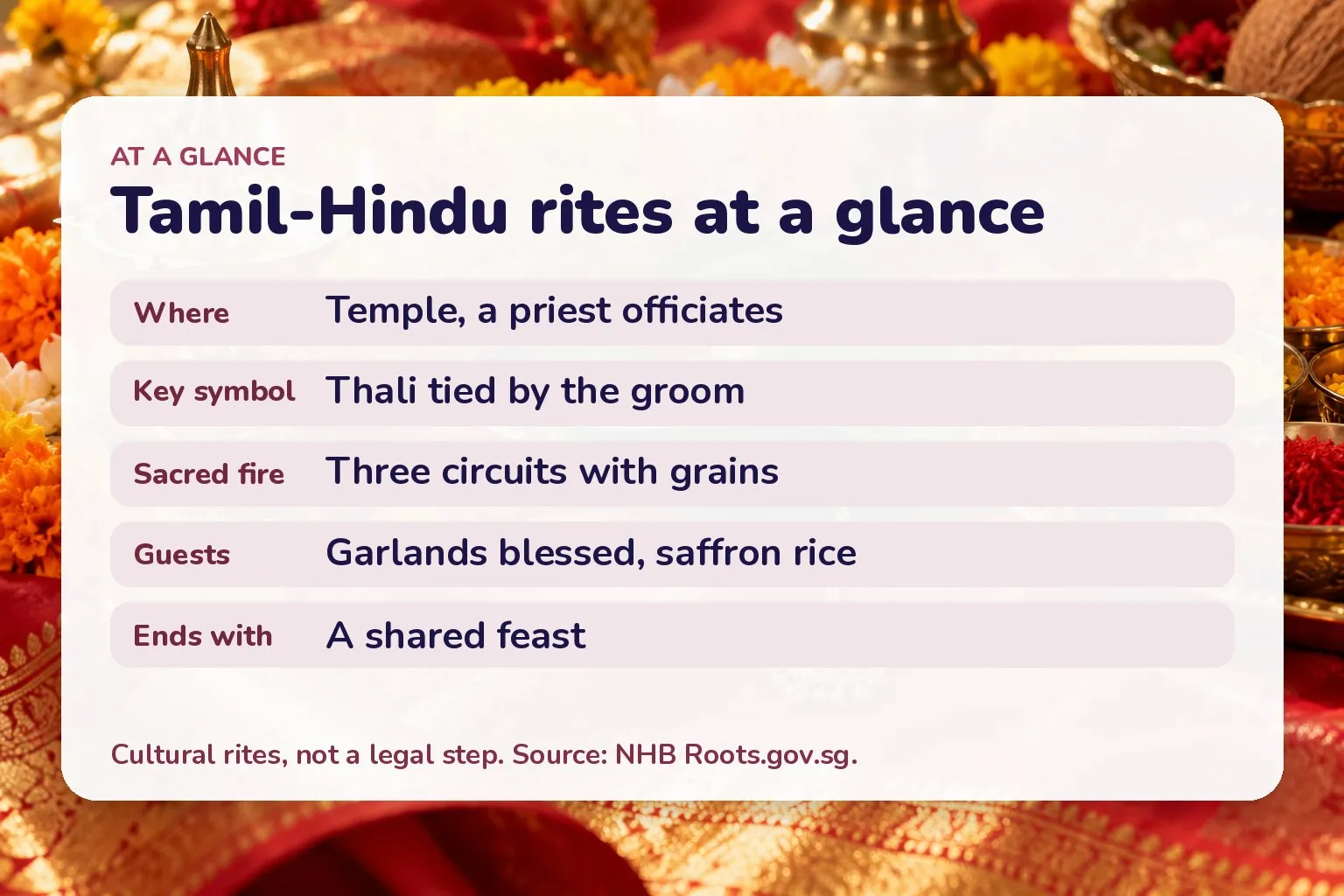
The common rites of a Tamil-Hindu wedding in Singapore. These are cultural and spiritual, not a legal step. Source: NHB Roots.gov.sg.
These customs are not relics: the Heritage Board records that wedding traditions “remain central to Singapore’s Tamil Hindu community, and many wedding couples continue to practice these rituals.”
Where Hindu weddings are held
Temples are the usual setting, and several Singapore temples have dedicated space for it. Sri Mariamman Temple on South Bridge Road — built by 1827 as “Singapore’s first” Hindu temple and a National Monument since 1973 — has been administered by the Hindu Endowments Board (HEB), a statutory body, since 1969. In 1996 a wedding hall cum auditorium with a separate entrance on Pagoda Street was added to the temple grounds.
Hall availability, capacity and hire rates are arranged with the individual temple, and those figures are not published online, so contact the temple office directly for current terms. Couples who prefer a hotel or restaurant celebration follow the same banquet economics as any Singapore wedding, set out in how much a wedding costs.
Does the ceremony register your marriage?
Here is the part couples most often get tangled. The temple ceremony is a cultural and spiritual rite — on its own it does not record your marriage in law. Under Singapore’s civil marriage framework, which applies when “at least one party is non-Muslim”, licensed solemnisers are “the only individuals authorised to conduct marriage ceremonies and register marriages in Singapore.” Your marriage is legally made when a licensed solemniser solemnises it and ROM issues the certificate.
In practice there are two routes. Some couples invite a licensed solemniser to solemnise the marriage at the temple celebration itself, so the cultural ceremony and the legal act happen together. Others hold a separate, short ROM solemnisation and keep the temple ceremony purely religious. Whether a particular temple priest is also a ROM-licensed solemniser varies, so confirm it early; ROM keeps a list of roughly 1,200 licensed solemnisers you can invite.
Registering the marriage at ROM
The civil process runs in six steps: prepare for marriage, prepare your application (date, time, venue and two witnesses), book a solemniser, submit the application with payment, make your declaration, and solemnise. The practical numbers:
- Fee: S$42 if at least one of you is a Singapore Citizen or PR, or S$380 if both are foreigners. Changing your solemnisation details later costs S$25.
- Notice: you must submit the application at least 21 days before the solemnisation, and it can be lodged up to 6 months ahead; the application expires 6 months after submission.
- Solemniser booking: you can book a solemniser 3 to 6 months before the date, and they must accept your invitation through the portal.
- If one of you is a foreigner who is a current or former work permit holder, that person needs approval from the Ministry of Manpower before an application with a Singapore Citizen or PR can be submitted.
After the solemnisation, ROM issues a digital marriage certificate by email. For a step-by-step walkthrough, see the full ROM guide.
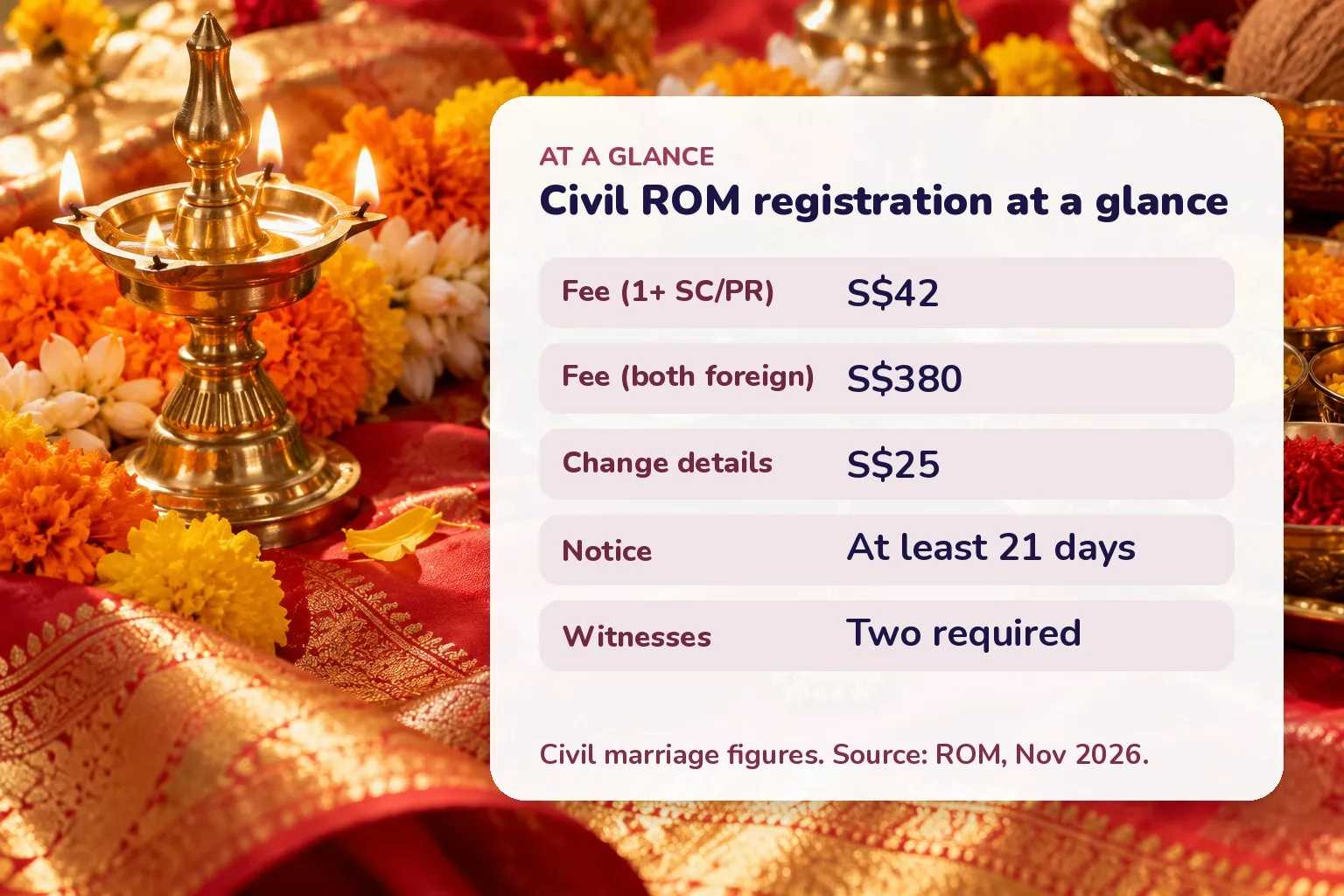
Key ROM figures for a civil marriage. Source: Our Marriage Journey (Registry of Marriages), November 2026.
A realistic order of events
Because the ceremony and the registration run on different clocks, sequence them deliberately. Settle the auspicious date and the temple or venue booking first, since good dates and halls go early. Then work backwards: book a solemniser three to six months out, submit the ROM application once the date is firm (keeping the 21-day minimum in view), and commission the thali and attire with enough lead time for custom work. The feast — caterer, decor and guest numbers — is the biggest moving cost and is best locked once the guest list is honest.
How this compares with other Singapore weddings
The split between custom and law shows up differently across communities. A Chinese wedding keeps its customary rites entirely separate from the civil ROM registration, much like a Hindu temple ceremony. A Malay-Muslim wedding is different again: there the solemnisation (akad nikah) is itself the legal act, registered through the Registry of Muslim Marriages rather than ROM. Knowing which model your wedding follows tells you whether you need a separate registration step.
Frequently asked questions
Is the temple ceremony enough to be legally married? Not by itself. The marriage is legal only when a licensed solemniser solemnises it and ROM issues the certificate. You can either have a licensed solemniser officiate at the temple celebration or hold a separate ROM solemnisation.
How much does the temple hall cost? Temple wedding-hall fees are set by each temple and arranged directly with its office; they are not published online. Ask the temple for current rates rather than relying on figures from third parties.
What is the ROM fee? S$42 if at least one of you is a Singapore Citizen or PR, or S$380 if both are foreigners, plus S$25 if you later change the solemnisation details.
Do we need witnesses? Yes — the civil marriage application requires two witnesses, whose identification is recorded with the application.
When should we book everything? Fix the date and venue first, invite a solemniser three to six months ahead, and submit the ROM application once the date is firm, keeping at least 21 days before the solemnisation.
Where to go next
- Chinese wedding traditions, for comparison
- Malay-Muslim wedding traditions
- The civil ROM registration process
- How much a wedding costs in Singapore
This guide describes customs neutrally and is not religious prescription. Communities observe different rites in different ways.
Sources
- Tamil-Hindu Weddings — National Heritage Board (Roots.gov.sg) (as of November 2026)
- Sri Mariamman Temple — Hindu Endowments Board (as of November 2026)
- Civil marriage process (requirements, solemnisers, steps) — Our Marriage Journey (Registry of Marriages) (as of November 2026)
- Submit marriage application (notice period and fees) — Our Marriage Journey (Registry of Marriages) (as of November 2026)
- What are the fees for the various Registry of Marriages (ROM) services? — Our Marriage Journey (Registry of Marriages) (as of November 2026)