BTO vs Resale Flat for Newlyweds in Singapore

For most first-timer couples who can wait, a BTO flat wins on cost: it is priced below the market and locked in at today's price. A resale flat is the better pick when you need to move in within months, or want the biggest grant stack by living near family.
On this page11 sections · tap to jump
Choosing between a new BTO flat and a resale flat is the biggest money-and-timing decision most newlyweds in Singapore make — bigger than the banquet, and far longer-lasting. The honest answer is simple: BTO is cheaper, resale is faster. This guide compares the two for a first-timer couple on the things that actually cost money or time — waiting, price, grants, income rules and the Minimum Occupation Period — and names a winner, with the rules and grant figures as of November 2026. Dollar prices are illustrative and market-driven; grant amounts, ceilings and timelines are official.
Quick verdict
For a first-timer couple who can wait several years, a BTO flat is the overall winner on cost: it is sold below the market and the price is fixed when you book, and you can still claim the Enhanced CPF Housing Grant of up to S$120,000. The runner-up is a resale flat, and it is the better choice for specific situations:
- Need to move in fast (a baby on the way, ageing parents, a rental ending): resale completes in about 8 weeks after HDB accepts the application, against 3–5 years of construction for a typical BTO.
- Want a specific town or the exact flat you viewed: resale lets you buy the unit you inspected; a BTO is balloted and may be in a newer estate.
- Lower-income couple living with or near parents: resale unlocks the full grant stack of up to S$230,000, including the resale-only Family Grant and Proximity Housing Grant.
- Household income above S$14,000: a subsidised flat is off the table, but resale has no income ceiling to buy.
Timeline: years vs months
This is the clearest split. A BTO is built to order: across 2026 HDB is launching about 19,600 flats, including more than 4,000 with shorter waiting times of under three years, but a standard project still runs roughly three to five years from application to keys. A resale flat already exists — HDB states that “a resale transaction takes about 8 weeks (from the date of HDB’s acceptance of the resale application) to complete,” on top of a 21-day option period and the time to find a flat. In practice that is a few months door to door.
If you are trying to line up your wedding date with your flat, the sequencing matters more than you would think; our guide to how your ROM date fits your BTO timeline maps the calendar stage by stage.
Price: subsidised vs market
A BTO is priced below the market with significant discounts — that is the heart of its cost advantage. A resale flat is bought on the open market at a negotiated price, which in popular towns runs well above an equivalent new flat.
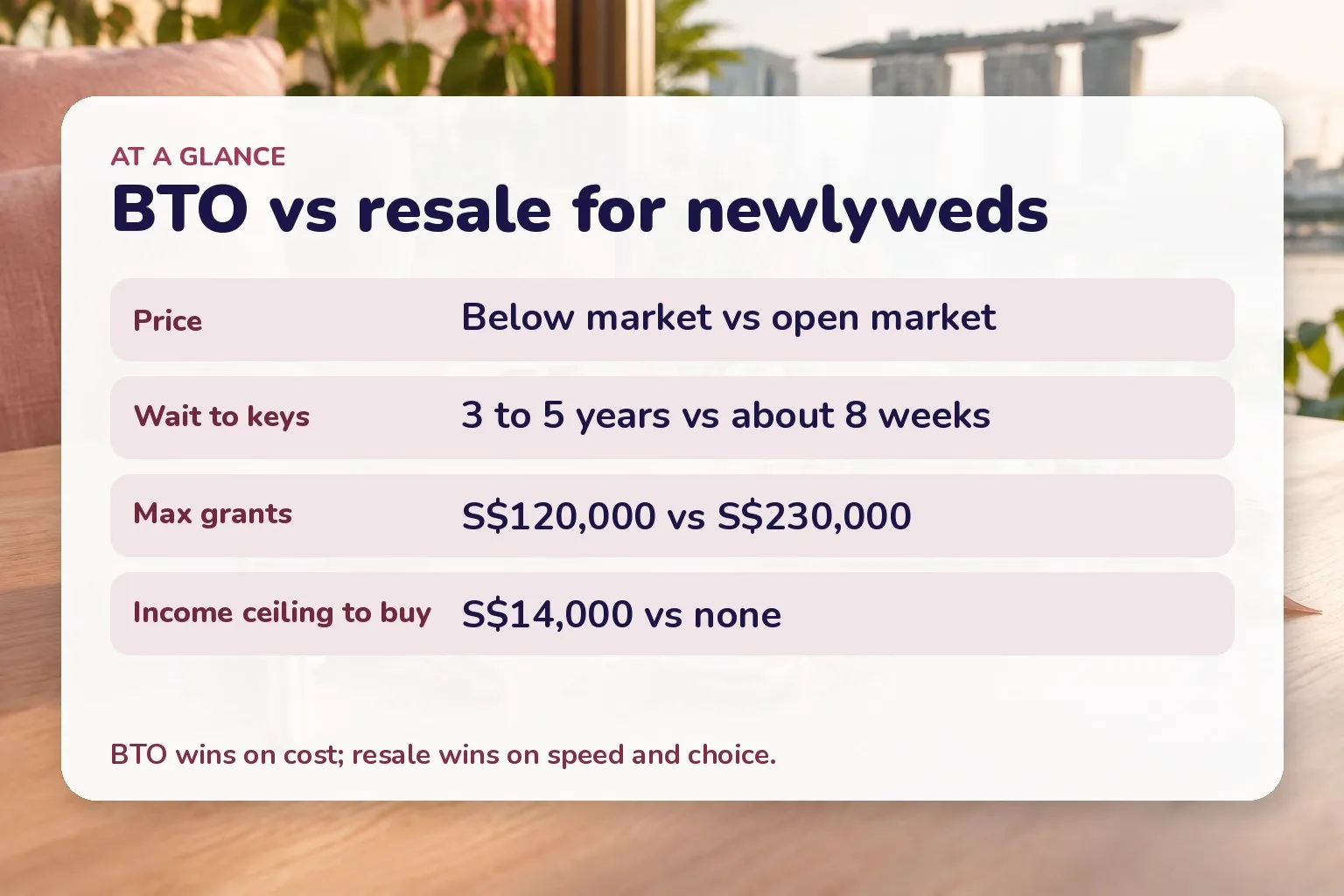
How a BTO and a resale flat compare for a first-timer couple. Source: HDB, CPF Board and Made For Families, as of November 2026.
As an illustration only, a 4-room non-mature BTO commonly falls around S$300,000 to S$400,000, while a comparable 4-room resale flat in a town like Punggol or Sengkang commonly transacts around S$630,000 to S$720,000. Those are market listings, not quotes, and they swing with town, floor and remaining lease — but the gap is the point.
Grants: where resale pulls ahead
Grants are the one area where resale clearly wins on paper. Both routes get the Enhanced CPF Housing Grant (EHG) of up to S$120,000, for a combined monthly income of S$9,000 or less, tiered so lower incomes get more. But two grants are resale-only:
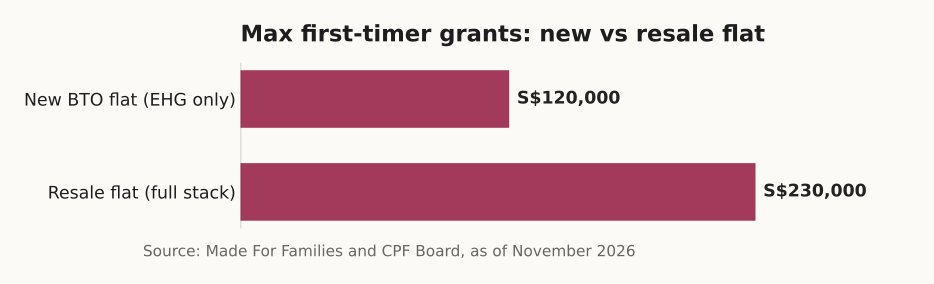
Maximum CPF housing grants for a first-timer couple, new vs resale. Source: Made For Families and CPF Board, as of November 2026.
- The Family Grant — up to S$80,000 for a 4-room or smaller resale flat, or S$50,000 for a 5-room or larger, for couples earning S$14,000 or less.
- The Proximity Housing Grant (PHG) — S$30,000 to live with your parents or child, or S$20,000 to live within 4 km, with no income ceiling.
Stack all three and a first-timer couple buying resale can receive up to S$230,000, against a BTO buyer’s S$120,000. The catch is that the bigger grant usually does not close the price gap — it narrows it. The full mechanics of each grant are in our guide to CPF housing grants for married couples, and the BTO ballot priority for living near family is covered in our guide to the Family Care Scheme (Proximity).
Eligibility and income ceilings
To buy a subsidised flat — a new BTO or a resale flat with grants — your average gross monthly household income must not exceed S$14,000. An open-market resale flat has no income ceiling to buy: HDB applies the ceiling only to decide whether you qualify for CPF housing grants (except the PHG) and an HDB loan. That makes resale the only HDB route for couples who earn above the ceiling.
Engaged couples can take either path under the Fiancé/Fiancée Scheme, without being married first — see our explainer on the HDB Fiancé/Fiancée Scheme. First-timer families also get at least two ballot chances for a BTO, and first-timer married couples aged 40 and below get an additional ballot.
Minimum Occupation Period and lease
Both a BTO and a resale flat carry a Minimum Occupation Period (MOP) before you can sell or rent out the whole flat. Since October 2024, every new flat is classified Standard, Plus or Prime, and HDB’s rule is the same whether you buy from HDB or on the resale market: Standard flats carry a 5-year MOP, while Plus and Prime flats carry 10 years, with tighter resale conditions for Plus and Prime.
A BTO also comes with a fresh 99-year lease, whereas a resale flat has a shorter remaining lease. That matters for financing: the EHG is pro-rated if the remaining lease cannot cover the youngest buyer to age 95. One point in resale’s favour on cost — the resale levy is not applicable to buyers of resale flats, so second-timers avoid it by buying resale rather than a new flat.
The cost of waiting
The price gap is not the whole story, because waiting has a price too. A couple who rent while their BTO is built can spend a five-figure sum over a few years — money that never comes back — which quietly narrows the BTO’s advantage. If your income is S$7,000 or below and you have booked an uncompleted flat, the Parenthood Provisional Housing Scheme offers interim rental from HDB while you wait, which softens that cost. Weigh the rent you would pay against the discount the BTO gives you; for some couples renting at a high rate, the wait erodes much of the saving.
A worked example
Illustrative only. Take a first-timer couple deciding between a 4-room BTO at about S$350,000 and a 4-room resale flat at about S$680,000 near one set of parents:
- BTO: priced below market, EHG only. If their income is mid-range, the EHG is modest, so the net cost stays close to S$350,000.
- Resale near parents: knock off the S$80,000 Family Grant and the S$20,000 Proximity Housing Grant, and the flat still costs well over S$200,000 more than the BTO — before counting any EHG on either side.
The resale route delivers the keys now and the exact flat they wanted; the BTO route delivers a far lower price for the patience of a multi-year wait. Which “wins” depends entirely on whether they can wait. The wedding spend that sits on top of either flat is set out in how much a wedding really costs in Singapore.
Who should not pick a BTO
A BTO is the value winner, but it is the wrong call if:
- Your timeline is fixed — a wedding, pregnancy or ageing parents mean you cannot wait three to five years.
- You earn above S$14,000 — you are over the subsidised-flat ceiling, so resale is your HDB route.
- You want to live in a mature, built-up town now — new launches often sit in newer estates.
- You are renting at a high rate — the rent over a long wait can eat much of the BTO discount.
In those cases, resale’s speed and certainty are worth the premium. For ways to trim the rest of the wedding budget while you save for the flat, see how to save on your wedding.
Frequently asked questions
Is a BTO or resale flat cheaper? A BTO is cheaper — it is sold below the market and the price is fixed at booking. Resale costs more but you move in within months.
Do resale flats get more grants? Yes. Both get the EHG up to S$120,000, but only resale buyers can add the Family Grant (up to S$80,000) and the Proximity Housing Grant (up to S$30,000), for up to S$230,000 in total.
How long does each take? A typical BTO is roughly 3–5 years from application to keys; a resale transaction takes about 8 weeks to complete once HDB accepts the application, plus the time to find a flat.
Is there an income limit for resale? There is no income ceiling to buy a resale flat on the open market. The S$14,000 ceiling only decides whether you qualify for grants (except the Proximity Housing Grant) and an HDB loan.
Does the Minimum Occupation Period differ? The MOP is 5 years for Standard flats and 10 years for Plus and Prime flats, whether bought new or resale. The difference is that a BTO’s clock starts years later, at key collection.
Where to go next
Sources
- Housing Schemes and Grants (grants, income ceiling, ballot chances, deferment) — Made For Families, Government of Singapore (as of November 2026)
- A guide to the Enhanced CPF Housing Grant and Proximity Grant — Central Provident Fund Board (CPFB) (as of November 2026)
- Eligibility for Selling a Flat — Minimum Occupation Period table — Housing & Development Board (HDB) (as of November 2026)
- Standard, Plus, and Prime Housing Framework (MOP by classification) — Housing & Development Board (HDB) (as of November 2026)
- Help — Resale Procedures (about 8 weeks to complete; 21-day option) — Housing & Development Board (HDB) (as of November 2026)